
Minority Affairs Minister Kiren Rijiju announced that the deadline for registering Waqf properties on the UMEED portal will not be extended. However, those who attempted registration but could not complete it will be exempt from penalties for the next three months.

'Only because of the absence of a dedication record in writing, how can such properties be treated as located on misappropriated government land?'

The Kerala High Court has criticized the Kerala Waqf Board's claim on land in Munambam as a 'land grabbing tactic' and upheld the government's decision to appoint an inquiry commission to investigate the ownership of the disputed area.

Tejashwi Yadav, the INDIA bloc's CM candidate, promised to scrap the Waqf (Amendment) Act if voted to power in Bihar, criticizing the current CM and the BJP.
The Supreme Court is scheduled to pronounce interim orders on key issues related to the Waqf (Amendment) Act, 2025, including the power to denotify waqf properties.
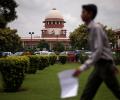
The Supreme Court is scheduled to pronounce interim orders on key issues related to the Waqf (Amendment) Act, 2025, including the power to denotify properties declared as waqf.
The Supreme Court has put on hold several key provisions of the Waqf (Amendment) Act, 2025, including the clause that only those practicing Islam for the last five years can dedicate a property as Waqf. The court also addressed the powers of collectors and non-Muslim participation in Waqf Boards.

The Supreme Court refused to stay a provision barring the declaration of tribal lands as waqf properties, upholding key provisions of the Amended Waqf Act.
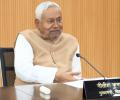
Nitish Kumar's decision to contest the Rajya Sabha elections signals the end of his long-standing tenure as Bihar's Chief Minister, paving the way for a potential BJP leader to take the helm.

The Supreme Court has rejected a petition seeking to prevent the construction of mosques named after Mughal emperor Babur.

The Supreme Court has upheld the deletion of the 'waqf by user' provision in the amended waqf law, stating it is not arbitrary and addresses potential misuse.

Authorities in Kishtwar district of Jammu and Kashmir have issued an order regulating the collection of donations during Ramzan to prevent unauthorized fundraising and ensure transparency.

Puzzled about the Waqf Bill? Syed Firdaus Ashraf explains how the amended Waqf law will plug loopholes in the existing legislation.

This was probably the largest such gathering in the country to protest the Waqf (Amendment) Act.

The Supreme Court of India has stayed several key provisions of the Waqf (Amendment) Act, 2025, citing potential violations of the Constitution. The court emphasized that laws should only be stayed in rare cases where provisions are manifestly unconstitutional or violate fundamental rights.

The Archaeological Survey of India informed the JPC that 280 protected monuments have been listed as Waqf properties.

The Supreme Court of India has reserved its interim orders on three key issues related to the Waqf (Amendment) Act, 2025, including the power to denotify waqf properties, the composition of waqf boards, and the provision regarding government land. The court heard arguments from both the petitioners, who challenged the validity of the amended law, and the Centre, which defended the Act as a secular concept. The petitioners sought interim orders to prevent the implementation of certain provisions while the court considers the legal challenges.

While it is expected that the JD-U, a major ally of the Bharatiya Janata Party, will support the Waqf Bill, two JD-U MPs, Union Minister Lalan Singh and party Working President Sanjay Jha met Union Home Minister Amit Shah in Delhi on Tuesday.

Underscoring the 'presumption of constitutionality in favour of law', the Supreme Court on Tuesday said petitioners challenging the waqf law needed a 'strong and glaring' case for interim relief.

'So, they have taken away the word Waqf from the Bill.' 'It will now be known as the UMEED Act.'
The matter would be heard by Chief Justice B R Gavai and Justice Augustine George Masih.
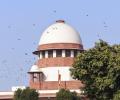
The Indian government defended the Waqf (Amendment) Act, 2025 in the Supreme Court, arguing that waqf, while an Islamic concept, is not an essential part of Islam. Solicitor General Tushar Mehta stated that waqf is essentially charity, which is recognized across religions, and cannot be considered a fundamental tenet of any faith. He also argued that the amended law addresses secular aspects of waqf and activities unrelated to Islam, and that "waqf by user" does not grant ownership of public land. Mehta highlighted the extensive consultations involved in the bill's creation, including feedback from various stakeholders. The hearing will continue on Thursday.

The Centre on Wednesday told the Supreme Court that nobody can claim right over government land and it is legally empowered to reclaim properties which are declared waqf by using the waqf by user principle.
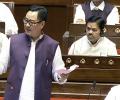
'It is not as if Hindus are not being touched at all, and only Muslims are.'
The Supreme Court of India has sought responses from the Centre and others on a petition challenging the constitutional validity of certain provisions of the Waqf Act, 1995. The petition argues that the Act gives undue favor to waqf properties and deprives non-Muslims of their property rights. The court has tagged the petition with pending petitions that raise similar issues.

Union Home Minister Amit Shah criticizes Kerala's ruling Left government over the Sabarimala gold loss case, demanding a neutral investigation and accusing the government of protecting the real culprits. He also signals the start of the BJP's campaign for the upcoming Assembly elections.

The district court in Shimla on Thursday upheld the municipal commissioner court's decision to demolish the entire structure of Sanjauli mosque, rejecting a plea by the Himachal Pradesh Waqf Board and the Sanjauli Mosque Committee.

Darakhshan Andrabi, chairperson of the Jammu and Kashmir Waqf Board, handed over a job appointment letter to Nazakat Ahmad, whose brother Syed Adil Hussain Shah was killed in the terrorist attack in Pahalgam's Baisaran area on April 22, 2025.

A bench comprising Chief Justice B R Gavai and Justice Augustine George Masih asked senior advocate Kapil Sibal, appearing for those challenging the validity of the law, and Solicitor General Tushar Mehta, representing the Centre, to file their written notes by Monday.
The Supreme Court on Monday said the pleas challenging the Waqf (Amendment) Act's constitutional validity will now be taken up by a bench headed by Chief Justice of India-designate Justice B R Gavai on May 15 as the incumbent CJI will be demitting office on May 13.

As soon as one of the pleas came up for hearing on Friday, Solicitor General Tushar Mehta, appearing for the Centre, objected and said there can't be an "endless" filing of pleas challenging the Act.

Congress MP Mohammad Jawed and AIMIM president Asaduddin Owaisi have challenged the validity of the Waqf (Amendment) Bill, 2025 in the Supreme Court, arguing that it violates constitutional provisions. The petitions claim the bill imposes arbitrary restrictions on Waqf properties and their management, undermining the religious autonomy of the Muslim community. They also allege that the bill discriminates against Muslims by imposing restrictions not present in the governance of other religious endowments. The bill was passed in the Rajya Sabha and Lok Sabha, with the petitioners arguing that it introduces limitations on the creation of Waqfs based on the duration of one's religious practice, mandates inclusion of non-Muslim members in Waqf administrative bodies, and shifts key administrative functions to government officials, thereby diluting the autonomy of Waqf management.
The Supreme Court on Friday refused to entertain a fresh plea challenging constitutional validity of the Waqf (Amendment) Act, 2025.

'We are not all Abduls, you know. Our community has any number of retired civil and defence officers, doctors, engineers, lawyers.'

The Supreme Court of India began hearing a batch of petitions challenging the constitutional validity of the Waqf (Amendment) Act, 2025. The bench, led by Chief Justice Sanjiv Khanna, asked both sides to address whether the court should entertain the petitions or relegate them to the high court. The hearing is underway with senior advocate Kapil Sibal arguing for the petitioners. The act, which was passed by Parliament following heated debates, has been challenged by various parties including AIMIM leader Asaduddin Owaisi, All India Muslim Personal Law Board (AIMPLB), and Jamiat Ulama-i-Hind.

Several petitions were filed in the apex court challenging the Act, contending that it was discriminatory towards the Muslim community and violated their fundamental rights.

'There's no transparency in work (of the Wakf Board), in property transactions (of the Waqf).'

The high court also instructed both the Mamata government and the Centre to submit detailed reports on the situation. The matter is scheduled for further hearing on April 17.
The Centre on Thursday assured the Supreme Court that it will neither denotify Waqf properties, including "Waqf by user", nor make any appointments to the central Waqf council and boards till May 5.

Prime Minister Narendra Modi criticized the Congress party following the NDA's victory in the Bihar assembly elections, accusing them of divisive politics and highlighting the rejection of casteism and communalism by the people of Bihar.
 © 2026 Rediff.com - Investor Information - Advertise with us - Disclaimer - Privacy Policy - Sitemap - Feedback - About us - Terms of use - Grievances