
The visit comes seven months after India cancelled foreign secretary-level talks.
.jpg)
Ruling out any third party intervention on the Kashmir issue, Union Minister Shashi Tharoor said had Pakistan acted in the spirit of the Simla accord the question of external mediation would not have come up.

The bus service was first started in February 1999 but suspended after the 2001 Parliament attack. It was restarted in July 2003.

"Our position has been clear and consistent on Kashmir... It is a bilateral issue between India and Pakistan," the MEA said. The US President had repeated his offer to 'help' resolve the issue on Tuesday.

'When the decision was announced, the possibilities of cross border infiltration and terrorism, we know that there would be incitement to violence. We have simply taken preventive steps'

Through the past 18-month period, peace has prevailed in the disputed border regions, which was immensely helpful in the difficult situation that the country was passing through, observes Ambassador M K Bhadrakumar.

The protest came a day after the two countries agreed to develop a corridor on their respective side of the border to link a historic Sikh shrine in Kartarpur in Pakistan.
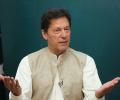
Pakistan's nuclear arsenal is 'simply a deterrent' to protect the country and there will no longer be any need for it once the Kashmir issue is resolved, Prime Minister Imran Khan has said as he asserted that if the Americans have the resolve and the will, the issue can be sorted out.
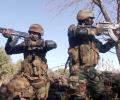
'We have to keep that in mind and have plan A B C D because the trust factor with Pakistan or China is very low.'

In his address to the UNGA, Khan spoke at length about India's decision to revoke Article 370 in Jammu and Kashmir and criticised the government's move to put in place a communication lockdown.

The Narendra Modi government has refused to move the International Court of Justice against Pakistan in the death of Army Captain Saurabh Kalia.

The US took the lead, and many other council members also joined and made it clear that the Kashmir issue was not a matter for the UN body to discuss and is a bilateral issue between India and Pakistan.

Shah said nobody can stop him from introducing a resolution on Kashmir in Parliament.

Describing Pakistan's North Western Frontier Province area as the "fountainhead" of terror activities in the region, India on Thursday said use of terrorism as state policy with deep roots in military establishment there is a major obstacle for peaceful bilateral ties.

The International Court of Justice was last a battleground for India and Pakistan nearly 18 years ago.

Poland, which currently holds the council's rotating presidency, has listed the matter for discussion at 10 am on Friday, the diplomats were quoted as saying.
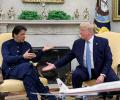
'Whether it was a habitual expression of post truth or an open offer to India and Pakistan, even Imran Khan could not have believed it,' says Ambassador T P Sreenivasan.

United States President Donald Trump remarks on Monday that Prime Minister Narendra Modi sought his mediation on the Kashmir issue will "damage" the Indo-US relations, ex-diplomats said.

It is time we pre-empt Pakistan and the separatists by fast tracking normalcy, advises Colonel Anil A Athale (retd).

India on Monday said there was 'no scope for misunderstanding or misrepresenting' its position
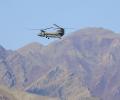
For both India and China, the most likely option -- and the most challenging -- appears to be a freezing of the status quo.

Rejecting Pakistan Prime Minister Nawaz Sharif's demand for United States intervention in resolving the Kashmir issue, External Affairs Minister Salman Khurshid on Sunday said India will not accept this as the matter is a bilateral one agreed to between the two nations.

Prime Minister Narendra Modi on Friday said his government has carried out major reforms -- including labour reforms and reforms in insurance and defence sectors -- 'in less than 100 days' and stopped reversals Indian economy had been facing.

Acting tough, India on Monday called off foreign secretary-level talks with Pakistan next week and conveyed a blunt message that it was interfering in India's internal affairs by holding talks with Kashmiri separatists which was "unacceptable".
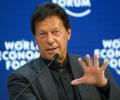
Khan also said Pakistan has decided to partner any other country only for peace and named the partnership with the US as the one.

December 3, 2021 marks 50 years since the beginning of the 1971 War which ended in a decisive military victory for India and the liberation of Bangladesh. Most analysts of the 1971 War agree that the IV Corps dash across the mighty Meghna river led by the brilliant General Sagat Singh was the turning point in the war, recalls military historian Colonel Anil A Athale (retd).
'The logical step is to challenge the very legitimacy of the Chinese claim over Tibet,' recommends Inspector General Gurdip Singh Uban (retd).
Majority of the 15 members said there should not be any statement or outcome issued after the consultations and their will prevailed, leaving China to come out and make a statement in its national capacity followed by Pakistan.

Though the Chinese find it necessary to oppose the visits of Indian leaders to Arunachal Pradesh, they want to keep the objections at a moderate level lest it cast a shadow on Narendra Modi's visit to China in May, says D S Rajan.

While Prime Minister Modi may pursue the laudable aim of building a cooperative relationship with Pakistan, he and his advisers should never think that concessions (and dialogue is a concession in itself) will change the Pakistan army's approach to India, says Vivek Katju.
"The world's eye is on Kashmir and on Pakistan...I will be the ambassador who raises Kashmir's voice at every international forum," he said.

'I don't know who is deciding Indian foreign policy today. I don't know who is deciding how India deals with Pakistan,' former Union minister Ram Jethmalani takes on the Modi government.
'New Delhi feels that given the internal dynamics in Pakistan and the overwhelming powers wielded by the army, one will have to wait for better times to see any meaningful progress in the India-Pakistan relationship,' says Ambassador G Parthasarthy.
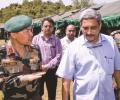
'China is likely to help Pakistan in keeping the fire burning in J&K to bleed India for its own interests.' A fascinating excerpt from Lieutenant General K Himalay Singh's Making of a General: A Himalayan Echo.
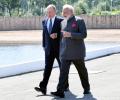
'The Vladivostok visit marks a subtle reversal of trend discernible in the revival of India-Russia relations pioneered by Modi during the past couple of years,' says Ambassador M K Bhadrakumar.

Major General Sujan Singh Uban, a legendary veteran of the Second World War, was a natural choice to raise, train and command the Special Frontier Force and mould them into a well oiled fighting machine, recalls his son Inspector General Gurdip Singh Uban (retd), who led SFF troops during the Kargil War.
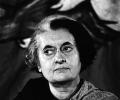
'According to me, her finest hour was in 1983-1984 when she neutralised a combined US-Pakistan-British conspiracy to Balkanise India by creating an independent Sikh State of Khalistan,' says Colonel Anil A Athale (retd). A special assessment of Indira Gandhi on her centenary.
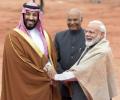
'No matter what Modi may boast about 'new India', the geopolitical reality is that India's stature diminishes when it needs a small country like Saudi Arabia under an autocratic ruler to help out with what is arguably one of the most critical templates of its diplomacy,' says Ambassador M K Bhadrakumar.

In his latest response to his Pakistani counterpart Aizaz Ahmad Chaudhry's fresh invitation of August 19 for talks, Foreign Secretary S Jaishankar once again emphasised on the need for earliest possible vacation of Islamabad's illegal occupation of PoK and conveyed that not just India but the larger region is aware that Pakistan is actually a "prime perpetrator" of terrorism.

'The China Pakistan Economic Corridor is Pakistan's number one preoccupation today -- and tensions with India and the $46 billion projects simply do not go together,' points out Ambassador M K Bhadrakumar.
 © 2026 Rediff.com - Advertise with us - Disclaimer - Privacy Policy - Sitemap - Feedback - About us - Terms of use - Grievances