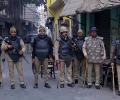
A lawyer representing the Hindu side in the ongoing dispute over the Sambhal Jama Masjid has defended the second survey of the mosque, claiming it was conducted on the orders of the advocate commissioner. He also dismissed claims that the survey was conducted in haste or without court orders.

Two members of a three-member judicial commission formed by the Uttar Pradesh government to investigate the November 24 violence in Sambhal arrived in Moradabad on Saturday and are expected to visit the violence-hit town on Sunday. The commission, headed by retired Allahabad High Court judge Devendra Kumar Arora, has been tasked with determining if the clashes were spontaneous or a planned conspiracy and assessing the police and administration's response. The commission will also analyze the events leading to the violence and recommend measures to prevent similar incidents in the future.

'It was a disaster on his part to give an oral remark which allowed ascertainment of the religious character of places of worship.' 'This disrupted the social harmony of the country.'

The Uttar Pradesh government will display posters of individuals accused of violence in Sambhal, seeking damages for public property destruction. This follows a violent clash during a mosque survey, leading to deaths and injuries.
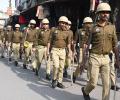
The Sambhal administration in Uttar Pradesh, India, has announced plans to put up posters of individuals involved in violence that occurred on November 24. Over 400 people have been identified and 32 arrested in connection with the violence, which stemmed from a local mosque survey. The administration is currently designing the posters and will finalize them today. Posters will be displayed after excluding those who have been arrested.

On Friday, a four-member team of the ASI surveyed the recently-discovered Shri Kartik Mahadev temple, five pilgrimage sites and 19 'koops' (wells).
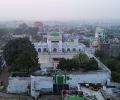
The communal violence in Sambhal that claimed four lives and left over 20 people injured has now sparked a debate over a purported rivalry between the Turk and Pathan communities, with political and administrative figures weighing in on the cause of the unrest.
The Mathura Shahi Masjid Eidgah Committee has approached the Supreme Court, requesting the court to prevent the central government from filing a response to a petition challenging the Places of Worship Act's constitutional validity. The committee accuses the BJP-led government of intentionally delaying its response. The court had previously issued a notice to the government in March 2021, but the government has yet to submit its reply despite numerous opportunities. The committee argues that the government's delay is intended to obstruct those opposing the challenge to the Places of Worship Act from filing their own responses. The petition also states that the pleas challenging the law's validity are scheduled for hearing on February 17, and closing the government's right to respond would serve justice. The Supreme Court previously issued a ruling in December 2022 that stopped courts from entertaining new lawsuits or issuing interim or final orders regarding the reclaiming of religious places, particularly mosques and dargahs. The ruling halted proceedings in 18 lawsuits filed by Hindu groups seeking surveys to confirm the original religious character of 10 mosques, including the Gyanvapi Masjid in Varanasi, the Shahi Idgah Masjid in Mathura, and the Shahi Jama Masjid in Sambhal. This decision was made in response to six petitions, including one filed by lawyer Ashwini Upadhyay, challenging various provisions of the Places of Worship Act. The 1991 law prohibits the conversion of places of worship and guarantees the preservation of their existing religious character as it stood on August 15, 1947. Notably, the dispute regarding the Ram Janmabhoomi-Babri Masjid in Ayodhya was excluded from this law. There are also several cross-petitions advocating for a strict enforcement of the 1991 law to uphold communal harmony and maintain the current status of mosques that Hindu groups seek to reclaim, claiming they were temples before being destroyed by invaders.
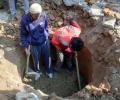
Two damaged idols were found inside the well of the Bhasma Shankar temple in Sambhal, Uttar Pradesh, India, which was reopened last week after being shut for 46 years. The temple, which houses an idol of Lord Hanuman and a Shivling, was reopened on December 13 after authorities stumbled upon the covered structure during an anti-encroachment drive. The idols, a Lakshmi idol and a Parvati idol, were found in the well, which authorities had planned to reopen. The district administration has written to the Archaeological Survey of India for carbon dating of the temple, including the well.
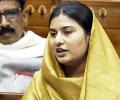
Samajwadi Party leader and Kairana MP Iqra Choudhary has moved the Supreme Court seeking effective implementation of the Places of Worship (Special Provisions) Act, 1991. This move comes amidst several petitions challenging the law's validity, including those filed by the Akhil Bhartiya Sant Samiti and lawyer Ashwini Upadhyay. The Supreme Court, in December 2022, had restrained all courts from examining fresh suits and passing interim orders in pending cases seeking to reclaim religious places. The Act aims to maintain the religious character of places of worship as they existed on August 15, 1947, but the dispute relating to Ram Janmabhoomi-Babri Masjid at Ayodhya was kept out of its purview. The court has listed Choudhary's plea with other pending pleas for February 17.

Samajwadi Party chief Akhilesh Yadav on Tuesday alleged a 'well-planned' conspiracy by the Bharatiya Janata Party for the violence in Uttar Pradesh's Sambhal, where a team of Congress MPs led by Rahul Gandhi is scheduled to visit on December 4 amid restrictions imposed by the district administration.
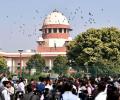
A bench comprising Chief Justice Sanjiv Khanna and Justice Sanjay Kumar also indicated that it may not take up the pending scheduled petitions, heard earlier by a three-judge bench, during the day as it was sitting in a combination of two judges.

Leader of Opposition in the Lok Sabha Rahul Gandhi along with the five other Congress MPs from Uttar Pradesh will visit violence-hit Sambhal on Wednesday, party's state unit chief Ajay Rai said.
Two days after violence broke out during a court-ordered survey of a Mughal-era mosque in Sambhal, Uttar Pradesh, life is gradually returning to normal with schools reopening and shops resuming operations. Internet services remain suspended and authorities continue to monitor the situation closely with restrictions in place on entry of outsiders and public representatives. The area around the Shahi Jama Masjid remains deserted, while the police investigate the violence and make arrests.
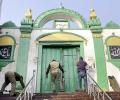
'Unless Justice Chandrachud's judgment is (over)turned, there is no end to it.'
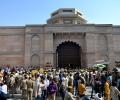
The Supreme Court of India is scheduled to hear a batch of petitions challenging the validity of certain provisions of the Places of Worship (Special Provisions) Act, 1991, which prohibits lawsuits to reclaim a place of worship or change its character from what prevailed on August 15, 1947. The pleas, including one filed by Ashwini Upadhyay, argue that these provisions violate the right to judicial remedy and create an arbitrary cut-off date. The matter will be heard in the backdrop of several ongoing cases related to places of worship, including the Gyanvapi Mosque in Varanasi and the Shahi Idgah Mosque in Mathura. The Muslim side has cited the 1991 law to argue that such suits are not maintainable. The Supreme Court had previously sought the Centre's response to Upadhyay's petition, which alleged that the law creates an "arbitrary and irrational retrospective cut-off date" for maintaining the character of places of worship.

Electricity Department has imposed a fine of Rs 1.91 crore on Lok Sabha MP from Sambhal Zia Ur Rehman and also disconnected the electricity supply to his residence for alleged power theft at his residence, an official said on Friday.
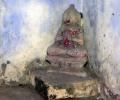
Devotees thronged the Khaggu Sarai area in Sambhal on Tuesday to offer prayers to an idol of Lord Hanuman that was discovered in the Bhasma Shankar temple, reopened last week after being shut for 46 years.
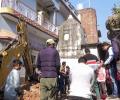
The Bhasma Shankar temple in Sambhal, Uttar Pradesh, has reopened after being locked for 45 years following communal riots. The district administration has requested the Archaeological Survey of India (ASI) to conduct carbon dating of the temple, including a well on the premises. The temple is being guarded round the clock and worshippers have started visiting. The reopening of the temple has been met with gratitude from local residents, who have expressed their desire to reconnect with their heritage.

Families of the four men killed in the Sunday violence in Sambhal are now forced to contend with the double tragedy of death and poverty, reliant as they were on the frugal income the four once brought.
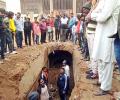
The Supreme Court of India has ordered a status quo on a private well located near the entrance of the Sambhal Jama Masjid, prohibiting any action regarding the well without its permission. The order came in response to a plea by the mosque's management committee, which challenged a lower court order that allowed a survey of the mosque, citing concerns over violence and loss of life during previous surveys. The court also instructed the authorities to file a status report within two weeks.

Holi was celebrated with pomp and splendor across India on Friday, with people soaking in the festivities by smearing 'gulaal' on each other and exchanging greetings and sweets. Homes and streets wore a colourful look as the revellers splashed colours and feasted on traditional delicacies. Public transport did not ply in the morning in most major cities while metro services started functioning from noon. As Holi coincided with the second Friday prayers during the holy Islamic month of Ramzan, security -- including increased patrolling and picketing -- was beefed up in several states. In Delhi, more than 25,000 security personnel were deployed. Police closely monitored about 300 sensitive areas with CCTV cameras and drones.

The toll in the clashes between police and protesters opposing a court-ordered survey of a Mughal-era mosque in Sambhal, Uttar Pradesh, rose to four following the death of one more injured person, officials said on Monday.
The latest issue of "Organiser", an RSS-linked magazine, has argued that the ongoing dispute over the Shri Harihar Mandir in Sambhal, Uttar Pradesh, is not about religious supremacy but about seeking "civilisational justice" by uncovering historical truth. The editorial, penned by Prafulla Ketkar, editor of "Organiser", contends that the debate should not be limited to a Hindu-Muslim perspective but should encompass a wider discussion on historical truths and social justice. The magazine further criticizes the Congress's handling of caste and religious issues, accusing it of whitewashing historical injustices and promoting a false narrative about Mughal rulers.
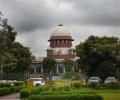
Commencing hearing on pleas challenging the constitutionality of the Places of Worship Act, 1991, the Supreme Court asked the Centre to reply to cross-pleas against or seeking implementation of statute.

Curbs under Section 163 (power to issue an order in urgent cases of nuisance or apprehended danger) of the Bharatiya Nagarik Suraksha Sanhita (BNSS), which were set to expire on Sunday, have now been extended till December 31 in Sambhal.

We no longer have the ambition to rival China save through words. We are happy to be fighting ourselves and digging up disputes from centuries ago as a substitute for real development, argues Aakar Patel.

A local court in Ajmer has issued notices to the dargah committee, the Ministry of Minority Affairs, and the Archaeological Survey of India on a plea seeking to declare the shrine of Sufi saint Khwaja Moinuddin Chishti a temple. The petition, filed in September, has sparked a heated debate, with politicians and community leaders weighing in on the potentially volatile issue. The dargah committee has declined to comment, but the Anjuman Syed Zadgan, a body representing the caretakers of the dargah, described the petition as a deliberate attempt to fracture society along communal lines. The petition comes just days after four people were killed in Sambhal, Uttar Pradesh, following a local court ordering survey of a Mughal-era shrine. The Places of Worship (Special Provisions) Act, 1991, which fixed August 15, 1947, as the cut-off date for status quo on the character of religious places, is at the centre of much of the debate. Several politicians, including Union minister Giriraj Singh and PDP chief Mehbooba Mufti, have weighed in on the issue. The Communist Party of India (Marxist) has called the civil court's decision to entertain the petition unwarranted and has asked the Supreme Court to immediately intervene.

Can ordinary citizens counter this backward march? Can peace activists ensure that the two communities retain their bonds? Do they have a choice, asks Jyoti Punwani.
 © 2026 Rediff.com - Investor Information - Advertise with us - Disclaimer - Privacy Policy - Sitemap - Feedback - About us - Terms of use - Grievances