
'Modi's idea of India is to make it less liberal, less tolerant and a less accommodative of diversity.' 'We are headed, if Modi continues, to become an ill liberal democracy.' 'Modi is not Vajpayee. Vajpayee was fundamentally decent, tolerant and fair. He played by the rules of the game. Modi is a different story.'

'This is a new phenomenon,' says Shekhar Gupta. 'Does it point to the rise of egomania, and could it also be a reason our politics is broken and Parliament non-functional? Where our biggest leaders talk not to, but at each other.'
'The issue of the larger homeland of Nagalim, the dream of the Nagas to hold sway over swathes of Manipur, Assam and Arunachal Pradesh, is just that, a dream.' 'The NSCN has been told categorically that the government is not going to concede on this issue.'
The major driver of Mod's foreign policy can be gauged from his economic priorities such as creating employment opportunities for the youth bulge. Related to this is emphasis on manufacturing, and infrastructure development, which in turn raises the issue of FDI. He has already articulated his views on all these issues, says Rup Narayan Das.
.jpg)
Throughout a quarter century of proxy war, India has shown tremendous restraint in the face of grave provocation. It is inconceivable that any other nation would have refrained from launching trans-LoC operations to eliminate terrorist training camps and interdict known routes of infiltration, says Brigadier Gurmeet Kanwal (retd).

Now that Tamil Nadu's tallest politician is no more, it remains to be seen how new political re-alignments could shape up, says N Sathiya Moorthy.

'For short-term gain, the BJP makes extraordinary promises, they take extraordinary decisions, but in the long term it is going to impact both them and the country.'
Verifiable 'distress-sharing' of available water may still be the way out of the Cauvery water row, says N Sathiya Moorthy.

'This is India, bhai. This kind of country does not exist anywhere in the world.'
Amberish Kathewad Diwanji tweaks the prime minister's Red Fort speech.

'The National Conference and the Peoples Democratic Party, as recent events suggest, are quite content as New Delhi's collaborators rather than trying to be true representatives of the Kashmiri people,' says Athar Parvaiz.

Former Delhi Chief Minister Sheila Dikshit may not be contesting the assembly polls, but she is very much in the thick of preparations for the Congress. Dikshit tells Kavita Chowdhury that she is not interested in any post in Delhi politics but does not rule out a role at the national level in the future.

Is Hyderabad the reason Telangana wants separation from Andhra Pradesh? Or has perceived backwardness of the Telangana region fuelled demand for a separate state? Mayank Mishra reports

A look at few gurus who have attracted controversy in recent times.
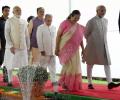
'We are a plural society that for centuries, not for 70 years, has lived in a certain ambience of acceptance.' 'It is under threat,' outgoing Vice President Hamid Ansari tells Karan Thapar.
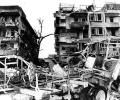
The various theories and statements about the culpability/innocence of 1993 blasts accused Yakub Memon present him with a Rashomon act, says Syed Firdaus Ashraf.

'15, 17 years back we were not even in existence in the US. Today nearly 1/3 of prescriptions written comes from India.' 'India is showing that in a very competitive environment -- like the US and Europe -- our industry is doing very well.'

'One senior Congress leader told me: "As long as Rahul is seen arriving there is no harm done, but when he opens his mouth, oh God...",' reveals T V R Shenoy.

Dr Raghuram Rajan's departure holds lessons for all, be it sections of the media, politicians or the people themselves. We need to learn how to value and retain talent. At the same time the talented must realise that talent alone does not ensure the top job, says Sanjeev Nayyar.

Swadeshi economist, columnist and chartered accountant S Gurumurthy speaks to Shobha Warrier about one year of Modi Sarkar.

'Politics is full of struggle, especially for those from my background,' says Union Minister Kumari Selja in her first interview after Sunday's attack on her. 'It has always been a struggle and will continue to be so.'
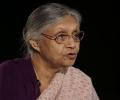
Former Delhi chief minister and Kerala governor Sheila Dikshit, speaking for the first time after her gubernatorial resignation, tells Kavita Chowdhury there is a need for Parliament to codify rules for governors if they are required to demit office with a change in the central government. Edited excerpts
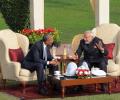
'When George Bush Senior decided in 1992 that India and the United States must start talking in this-now-changed world, who would have thought that 10, 15 years down the road, we will start looking at each other as strategic partners?'

Secretary general of CBCI Bishop Theodore Mascarenhas on what he doesn't like about the new education policy.

If the AIADMK falls short of the 117-mark required to form a government in the 234-member assembly, will it strike a post-poll deal to form Tamil Nadu's first coalition government? N Sathiyamorthy analyses.

Dabhol's assets will be demerged into the power plant and the LNG terminal.
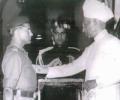
Decorated with a Vir Chakra for leading an attack that destroyed four tanks, Risaldar Ayub Khan shared a name with the Pakistani president who ordered the invasion of India in 1965. India's Ayub came from a family of soldiers and made his country proud.

'No PM has said no to anything we have proposed. I am not a politician and I cannot give speeches about things, but a lot of good things have been done in science by previous governments.' 'Under Dr Manmohan Singh, we could do a few important things. I used to meet him once in 6, 8 weeks. He often said, 'Professor Rao, you assume that you have my approval and carry on.' He was shy and decent. He is a real gentleman.' 'Science keeps me going at 80. I feel young.' Professor C N R Rao, the eminent scientist who was honoured with the Bharat Ratna, on the state of science in India.

For more than 23 years, Bhanwari Devi, who was gang-raped for speaking out against the marriage of two babies, has been fighting a lonely battle for justice. Rashme Sehgal traveled to Dausa in Rajasthan to meet the courageous woman, a winner of the Neerja Bhanot Award for bravery, a symbol of Indian women's struggle.

'Young IFS officers today would take it for granted that they represent a major country with strengths and capabilities.' 'They will be aware that India is seen as one of the 10 significant countries in the world and therefore their voice will be heard whether on climate change or regime change,' says Ambassador B S Prakash.

Rediff.com republishes an old interview of the cartoonist on politics
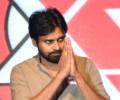
Popular Telugu film star Pavan Kalyan launched his Jana Sena party with a 'call to the nation' to 'wipe out' the Congress party on Friday.

Pranab Mukherjee's book The Dramatic Decade: The Indira Gandhi Years takes the readers through the economic and social unrest of the period leading up to the emergency, rise and fall of leaders, many splits within the Congress, while promising to offer more in the next two volumes of the trilogy, says Nivedita Mookerji.

Former editor of Femina magazine, Sathya Saran looks back at the Miss India pageant that changed the lives of two young women.

'She was the only prime minister who won a decisive military victory.' 'She won a real war; she didn't play video games on prime time TV over surgical strikes!' 'She understood power better than any other politician, saw it as her birthright and used it with inborn expertise.' 'Every politician today who tries to be a "supremo" through populism and absolute control over his or her party is referring to the Indira Gandhi playbook!'

'There is perfect coordination between them,' Vice-President Hamid Ansari said when Rediff.com asked what differences he had noted between Raul Castro and his elder brother. 'Commandante (Fidel Castro) remains the undisputed leader of the revolution.'

It is unconscionable to choose between Sardar Patel, who united India physically, and Indira Gandhi, who gave meaning, content and pride to the unity of the nation and became a martyr at the altar of national unity, says Ambassador T P Sreenivasan.

'Ne Win kept good relations with the Nehru family even though he did nothing to do business with India. When Indira Gandhi was assassinated, Ne Win took off to an undisclosed destination, leading to rumours that he had gone to India. But we had no knowledge of his visit and days later, we were told that he was so struck with grief that he went into meditation on an island.' Ambassador T P Sreenivasan delves into Rajiv Bhatia's new book on mysterious Myanmar.
 © 2026 Rediff.com - Advertise with us - Disclaimer - Privacy Policy - Sitemap - Feedback - About us - Terms of use - Grievances