
Union Minister Anurag Thakur hit out at Gandhi over his claims of being under surveillance by intelligence agencies and accused him of maligning India on foreign soil.

Consumers are paying an exorbitant 180 per cent tax on petrol, and 140 per cent on diesel in Delhi and in most other towns in India. Little wonder then that the central government expects a staggering Rs 3.46 trillion by levying excise duties on retail sale of the two fuels this year, and Rs 3.2 trillion the next. States would generally have had reason to cheer, as they command a 41 per cent share in Centre's tax revenues. But as the Centre has raised excise duties in the form of "cess," the revenue proceeds are by nature not shareable with states.
After the RBI surprised the Centre with a record Rs 99,122 crore in surplus transfer for FY21, analysts said this will help the government tide over the revenue losses from lockdowns and extend more support to the pandemic hit industries and to the poor people. In fiscal 2020, the RBI had paid only Rs 57,128 crore in dividend to the government and the finance minister had budgeted only Rs 45,000 crore from the central bank. The higher payout followed the Bimal Jalan panel report that had set a new economic framework capital buffer for the central bank along with the contingency risk buffer at 5.5 per cent.

While the Narendra Modi government has stuck to its stand that pending payment is Rs 12,343 crore, MSMEs calim outstanding amount is Rs 2-3 trillion. Moreover, MSME ministry's SAMADHAN portal has been of little help.
With West Bengal Chief Minister Mamata Banerjee seeking a uniform vaccination policy for the country, Union Health Minister Harsh Vardhan on Friday assured her that the Modi government was firm in its resolve to help the state fight the COVID-19 pandemic, but also flagged more than 40 per cent positivity rate in some districts of the state.

Any NGO critical of the government is unlikely to receive a green signal. The new amendment will leave NGOs vulnerable to harassment. It was the NGO sector that helped provide compassion and food to millions of people during the lockdown. The new Bill will render such cooperation and camaraderie impossible in future, observes Rashme Sehgal.
Kaur, the Union Minister of Food Processing Industries, is the only SAD representative in the Modi government.

Sawant swore in as Union Minister of Heavy Industries and Public Enterprises after 2019 Lok Sabha elections.
He alleged that India "lost access to 26 out of 65 Patrolling Points" which was not the case before May 2020, and questioned the Modi government's "silence" on the issue.

108 economists, social scientists said it was imperative that agencies like CSO and NSSO are not subject to political interference.
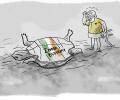
Even in this darkest hour of a crumbling economy and raging disease, there is hardly a murmur of protest against the government, observes Sumit Bhattacharya.
The posters reading "Modiji humare bachon ki vaccine videsh kyu bhej diya (PM why did you send vaccines of our children to foreign countries?)" were plastered in several parts of the city

It is "absolutely clear" that the new laws will finish government mandis (wholesale markets) and private mandis where big corporates will sell and buy will have monopoly, he claimed.
'The Union government does not have much of a governance function other than to send orders.' 'But even the sending down of orders it cannot do properly,' observes Aakar Patel.
India should take 'measured approach' with stimulus packages to deal with COVID-19 by limiting interventions to the provision of food, shelter and basic necessities of life for all; forbearance on payments of outstanding loans; and extra provision of working capital including what will be necessary to cover outstanding wages from lockdown period to enterprises.
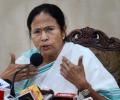
Reacting to the recent reports of WhatsApp admitting to a breach of privacy of users in India who were target of surveillance by operators using spyware Pegasus of Israeli company NSO, the West Bengal chief minister said that the central government was spying on politicians, media persons, lawyers, social activists and other important personalities.
Gandhi has been critical of the government's handling of the pandemic and has questioned the Centre's claims on battling coronavirus.
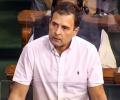
Lending his support to the ongoing farmers protests, he said in Lok Sabha that it was not an agitation of the farmers only but a movement of the country and the government will have to repeal the laws.

Out of nearly 30 public sector undertakings and assets under 'strategic sale' plan, only the ONGC-HPCL plan has been completed

'We must do all it takes to protect the rights and freedoms that our Constitution guarantees'
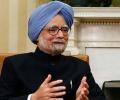
There is a need for tax reforms in the country in a bolder way, Singh said.
Rahul described the Rafale deal as a 'systematic robbery' from the Indian defence forces.

Fiscal discipline has been maintained but toxic assets worth Rs 7 crore are a massive headache

By pegging the exact area of the Babri Masjid site at 0.313 acres, and not the original 2.77 acres, the government hopes to be in line with the court ruling in the 1994 Ismail Faruqui case which mentions return of land to original claimants once the exact area needed for acquisition is determined, observes Saisuresh Sivaswamy.

The IMF lowered India's economic growth estimate for the current fiscal to 4.8 per cent and listed the country's much lower-than-expected GDP numbers as the single biggest drag on its global growth forecast for two years.
The UPA chairperson added that the Centre may "achieve its aims" through majority, but in the process, it would be disempowering each and every citizen of our country.
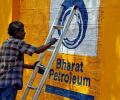
Though the NDA government had been trying to privatise 20 companies, a decision for which was taken in 2017, and included national carrier Air India, the investor community evinced little enthusiasm for any of them. Now, with an in-principle approval for privatisation of BPCL, CCI and SCI, the government has taken the plunge again.

Hinduja Group co-chairman Gopichand Hinduja said that while the $5 trillion target of 2024 is achievable, Prime Minister Narendra Modi-led government needs to shed the British style of bureaucracy to move faster. The industry veteran also said that the company has been willing to invest more than $20 billion in India, but it wants the obstacles to be removed and ease of doing business must be provided.

Laying the roadmap of the Narendra Modi government for its second term, President Ram Nath Kovind on Thursday said empowering every person is the main goal for a 'New India' by 2022 on the back of a "stronger mandate" for continuing uninterrupted the journey of development started in 2014.
The new tax regime proposed by the Modi government may not have acceptance from all corners.
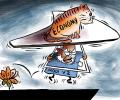
There is talk of a fresh approach to a new labour code as well as reforming land acquisition laws in such a way as to be politically.

'Their idea of unity is uniformity. They disrespect and fear diversity which means they deny our pluralism, our freedom of choice, which are integral to our fundamental rights'

In the short run, the government should loosen the purse strings but trying to invent new instruments is a bad idea, Banerjee said. Trust, he said, in the system is important at this point and keeping that in mind.

Attempts are being made to balance the need for health of the sector, consumer interest while complying with the Supreme Court order on statutory dues.
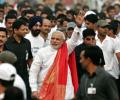
Most Indians expect their personal happiness will improve over the next five years, posing a concrete benchmark against which to measure the future success of Modi govt
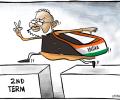
'If the current mood in North Block, headquarters of the finance ministry, is anything to go by, the government will now keep a closer watch on all kinds of schemes and projects undertaken by different central ministries. 'The next six months will determine which central schemes will have to be wound up and which ones will survive the axe,' says A K Bhattacharya.

Congress general secretary (communications) Jairam Ramesh said they will pose three questions a day to Prime Minister Narendra Modi over the issue.
'The Modi regime is not willing to use its huge political capital for taking any economic policy measure that it fears might undermine that political strength, says A K Bhattacharya.

Doubts over implementation of a Cabinet-approved strategic sale policy are puzzling.

About 78 per cent respondents said they were also satisfied with the steps taken by their own state government, according to the findings of the survey.
 © 2026 Rediff.com - Advertise with us - Disclaimer - Privacy Policy - Sitemap - Feedback - About us - Terms of use - Grievances