
If either failure of comprehension stays uncorrected, 2012 will be a singularly disastrous year, says Mihir S Sharma.
Government is tougher than the private sector -- but transformative, says UPA's highly visible ex-CEO.
The Gandhis have much to answer for. In particular, their hands-off political style, an attempt to create an above-the-fray demeanour, writes Mihir S Sharma
In all our discussions of quotas and reservations and affirmative action, we need to remember that they aren't just for the disadvantaged. They are for all of us, says Mihir S Sharma
As befits India's largest and most complex state, the UP assembly elections will be as transformative as a Lok Sabha election
Clearly, Rahul Gandhi has shown himself unable to pick the right people, and unable to pick the right issues, opines Mihir S Sharma
It's been 10 years since the Godhra carnage and Narendra Modi is still around and divisive. Why, precisely, should the world think that the man who presided over India's worst governance failure in decades is somehow a role model for efficiency, asks Mihir S Sharma.
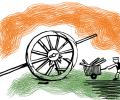
Pragmatism and flexibility is a virtue. An untethered and short-term approach to policymaking is a flaw, argues Mihir S Sharma.

If the government had paid enough to begin with, or if it had made serious advance purchase commitments that allowed the vaccine producers to mobilise necessary investment, then it is possible to imagine more free or subsidised vaccines such as are available in developed economies, asserts Mihir S Sharma.

The Indian State does not believe in the rule of law. It does not even recognise the need to follow treaties that it itself signed. And so it is refusing to shell out to Cairn; and, as a consequence, has brought on the Paris humiliation, notes Mihir S Sharma.

We are entering 2022, facing another infectious variant, with much the same baseless confidence, notes Mihir S Sharma.
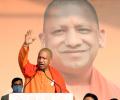
A handsome victory for the BJP in UP would act as confirmation of its recent political choices. The UP chief minister would be cemented in the popular mind as Mr Modi's chosen heir within the Hindutva fold, and presumably as his successor in New Delhi, observes Mihir S Sharma.

India will either have to create a system in which certain geographical areas will wind up being permanent political outsiders at the Union level or it will have to create a system in which certain votes are weighted more heavily than others, observes Mihir S Sharma.

'There has been far too much overconfidence about the size and composition of the Indian consumer economy,' notes Mihir S Sharma.

'The Union government has discouraged state and local governments from imposing restrictions on their own.' 'That advice should be withdrawn,' asserts Mihir S Sharma.

Unless public health is prioritised over swift re-opening, the chances are that a third wave will hit India sooner than we would like.

Weeks after the second wave peaked in many parts of the country, we are rapidly forgetting what happened to our hospitals, cautions Mihir S Sharma.

What do we know about India's devastating second wave, and can we assign responsibility for it?
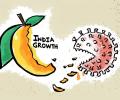
'In the real economy, the scars of the pandemic will continue to define 2021.' 'It is still hard to tell the effect on unemployment, migrant workers, poverty, and the informal sector of the lockdown and of the pandemic,' observes Mihir S Sharma.

Inflation has remained a major concern.
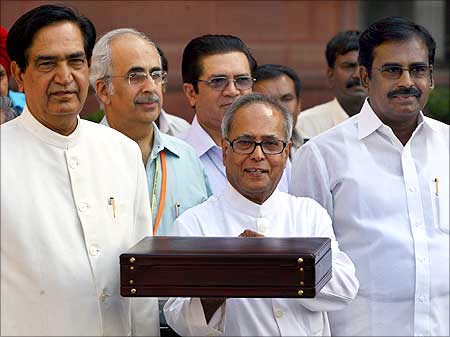
The sad truth is that the debt-to-GDP ratio will shoot up close to 90 per cent in the coming year, and the fiscal deficit glide path does not promise to reduce it substantially any time soon, predicts Mihir S Sharma.
'India resembles not just the more turbulent bits of its own past, but other 'managed' democracies, where all institutional strength and independence have been hollowed out to serve political power,' notes Mihir S Sharma.

We knew from the moment the pandemic took hold that this would be a long haul -- at least 12 to 18 months. Nothing should have changed that assessment, says Mihir S Sharma.

'As 1.3 billion people wait for our prime minister to tell us what to do and then vanish again from our television screens, it is worth noting that this is not how the rest of the world is being led,' points out Mihir S Sharma.

This is one of those crises where it does not only matter that you do something, but how you do it, suggests Mihir S Sharma.

The lockdown should have been used to drum into Indians' head the reasons for social distancing and the necessity for it, and the costs of not applying it in our daily lives and it should have been used to set up the systems that would manage large numbers of infected, observes Mihir S Sharma.
What might be useful is targeted assistance to those sectors and individuals that are disproportionately affected, suggests Mihir S Sharma.
'There appears to be no end to the errors that our leaders are willing to commit and no risk they are unwilling to run,' notes Mihir S Sharma.

'Employees may well be expected to be on call at almost all times -- much like the standard Indian approach to the workday,' points out Mihir S Sharma.

As long as even one Indian holds aloft Ambedkar's portrait and recites the Preamble, the Republic remains alive, says Mihir S Sharma.
'Every strongman leader is faced with the same opportunity: Harness the increased societal panic to amass more power,' warns Mihir S Sharma.

'That would be ridiculous and uncharacteristic of the PM.' 'It is also not how things happen in illiberal States.' 'In such places, lower-level functionaries of every rank and hue seek to ingratiate themselves with the highest authority by going pell-mell after dissenters and outsiders,' points out Mihir S Sharma.

'India is not so distant from years of high and entrenched inflationary expectations that it should start trying to play games with the economy the way the West's central bankers think they are entitled to,' argues Mihir S Sharma.

'The Post's coverage is not an authentic public discourse guided by unbiased Western intellectuals, but a slanted doomsday propaganda orchestrated by Indians and expatriate Indians,' argues Vivek Gumaste.
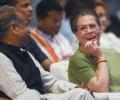
The Congress will only survive if it can transform into something more like the BJP used to be: A coalition of strong state leaders held together by shared ideology or personal loyalty, suggests Mihir S Sharma.
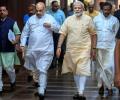
'A unified Hindu votebank -- the creation of the largest and most reliable votebank in Indian politics, ever,' says Mihir S Sharma.

For Duflo and Banerjee, an important part of their work has been ensuring that the agency of the "beneficiaries" -- usually, in developing countries like India, poorer individuals -- is put at the centre of any policy design. This is a crucial way in which experimental results are often better than large scale data-based inference, says Mihir S Sharma.

'If deterrence through India's conventional superiority is to be established now, then India will have to escalate to a point where its greater resources make the difference.' 'This is, to put it mildly, both difficult and dangerous and thus inadvisable,' points out Mihir S Sharma.
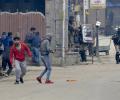
'Fighting terrorists is one thing. Fighting insurgents is worse. Fighting a population is worst of all,' says Mihir S Sharma.
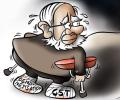
While GST and insolvency laws are among the major achievements of the Modi government, the list of failures include demonetisation, toxic banks, manufacturing hiccups and most prominently bizarre job creation figures. Mihir S Sharma takes a look at the four years of Modi government.
 © 2026 Rediff.com - Advertise with us - Disclaimer - Privacy Policy - Sitemap - Feedback - About us - Terms of use - Grievances