China has invited India to be part of its new initiative to build a Maritime Silk Road which it says is aimed at improving connectivity and trade among Asian nations through the sea on the lines of ancient Silk Route.
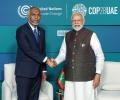
'India should respect Maldivian nationalism and their desire to be not over-dependent on India.' 'India should not behave like a big brother towards Maldives as many times, we tend to behave like that.'

The issue "will not affect" the "long-standing" economic and cultural ties between the two countries, a top Chinese official said.

Giving final touches to its most ambitious plan to build a wide network of new silk roads on land and seas to enhance global connectivity, China has invited India to join President Xi Jinping's pet project that would revive the ancient trade route and benefit the region.

Indian and Chinese militaries have agreed on the need to expand cooperation and identify new avenues of engagement, government said on Thursday.
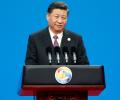
'Chinese companies have acquired stakes in 13 ports in Europe, including in Greece, Spain and, most recently, Belgium.' 'Those ports handle about 10 percent of Europe's shipping container capacity,' points out Ambassador M K Bhadrakumar.

Prime Minister Narendra Modi on Thursday arrived in Xian on a three-day visit to China during which he will hold summit talks with Chinese President Xi Jinping on a range of issues including the festering border dispute and China's plans for infrastructure projects in Pakistan-occupied Kashmir.

Observers say China's repeated invitations to India to join the BRI highlights its own anxieties over the adverse impact of New Delhi's lack of support to the multi-billion dollar investments in South Asia as it would deny access to India's market consisting over 1.2 billion people.
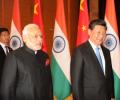
While the two sides' objectives may appear to differ, it is clear that both India and China are emphasising on the common minimum possible areas of cooperation between them, says Srikanth Kondapalli.

'There is no Buddha or Gandhi among countries, existing for the service of others; they all exist for the good of themselves.' 'For each country, its own interests should be paramount, and it is futile and churlish to expect China to be an exception to this rule,' says B S Raghavan, the distinguished civil servant and long-time China-watcher.
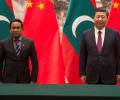
Chinese Foreign Ministry said international community should respect sovereignty and independence of the Maldives.

China will also set up 50 joint laboratories with countries participating in the Belt and Road initiative to enhance cooperation on innovation.

Hometown diplomacy mixed with a Silk Road touch is expected be part of Chinese President Xi Jinping's reciprocal gesture when Prime Minister Narendra Modi visits China before end of May.

China will increase its defence spending by "around seven per cent" this year, as it vowed to guard against "outside meddling" in its territorial disputes.

China on Thursday tried to play down the continuing border standoff at Chumar coinciding with the visit of President Xi Jinping to India, saying the incident has been "effectively controlled and managed".

'Even if such a thing happens, it will not prolong for many days like Doklam did.' 'That is because both the leaders do not want it.'

China is opposed to India's oil exploration in the South China Sea because it is a disputed area, but regards its ambitious US $46 billion (Rs 2.9 lakh crore) economic corridor through Pakistan-occupied Kashmir a "livelihood project" with issues left over from history.

'Agreements signed between the Maldives and China have seriously worried India.'
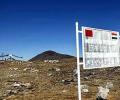
Prime minister likely to visit Beijing, Shanghai; also President Xi's home province, Shaanxi. Nayanima Basu reports

Would it serve India's interest to go to war with China over the Maldives, asks Aditi Phadnis.
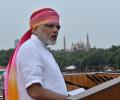
Modi talking about Balochistan, PoK and Gilgit is a tectonic shift in India's policy towards Pakistan, says Abhay Jere.

'The men in black suits and hair dye in Beijing have not only completely blown the cover story of "peaceful rise," but have managed to antagonise regional powers in the Indo-Pacific.'

With PM Modi's visit, the time has come for a relook at India-Myanmar ties, and elevate the relationship to higher levels, says Dr Rahul Mishra.
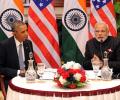
India has moved beyond the traditional trappings of non-alignment

Gwadar port India is hardly taking any note of developments in Balochistan. To counter and restrict China influence there, India needs to aggressively move forward on further consolidating its friendly relationship with Iran and Afghanistan, says Abhay Jere.

Hailing India for keeping "neutral stand" over the South China Sea issue despite pressure from the US and Japan, state-run Chinese media on Wednesday said there are some contradictions and frictions between the two nations but the overall bilateral relations have been developing smoothly.
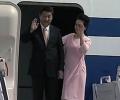
'As the first leaders of their respective countries born after Indian Independence and the Chinese Liberation, Modi and Xi would be expected to have the ability to overcome the traditional mindsets and the hierarchical nature of their official/bureaucratic establishments,' say Alka Acharya and Jabin T Jacob.

'Gwadar has the potential to facilitate PLAN's operations in the Arabian Sea and Indian Ocean.' 'Reports of China setting up electronic eavesdropping posts at Gwadar to monitor US and Indian naval activity and shipping traffic through the Straits of Hormuz and the Arabian Sea lend credence to this,' says former RA&W officer Jayadeva Ranade.

Since 55 per cent of Indian trade passes through the South China Sea, and with over $5 billion investments in the energy sector in Vietnam, it is imperative India actively pursues its national interests in the region, says Srikanth Kondapalli.

Thinking big, China is changing the world order; with mixed priorities, we can but tag along, writes T J S George.

China's South China Sea build-up and 'territorial sea' construct potentially affects 55 percent of Indian trade passing through the region. Hence, coordinating with the US and Japan could provide dividends to India in the longer run,' says Srikanth Kondapalli.

The new government needs to clearly insist on diplomatic reciprocal arrangements with China. While reciprocity is a function of power in bilateral relations, the Modi-led government's responses should be based on India'S inherent strengths, says China expert Srikanth Kondapalli.

'While visits and personal meetings are useful, changes of strategic significance have occurred recently, with Beijing trying to take the lead which Modi must take note of.'

China's intended role for AIIB is not so different from the existing Western lenders like the World Bank.

'Assuming the official defence allocations represent the true picture, the $142 billion figure still represents a phenomenal increase and surpasses that of Japan ($42 billion), India ($40 billion), South Korea ($33 billion) and several other Asian countries put together and shows that China is flexing its military muscle.'

He said he has always maintained that instead of fighting with each other, India and Pakistan should together fight against poverty.

As India rises, creating niche areas for itself in the Asian landscape, China and India are bound to step on each other's vital areas of importance, says Srikanth Kondapalli.

'India needs to adopt a more proactive policy of triggering exports to China.'

Prime Minister Narendra Modi had gone to China with a bagful of initiatives, but not all seems to have been fulfilled given China's reluctance to go the whole hog with him

'Building on the potential for closer ties is the changing narrative in each country about the other. The Chinese narrative on India has become significantly more positive over the past few years,' says Walter Andersen and Zhong Zhenming.
 © 2026 Rediff.com - Investor Information - Advertise with us - Disclaimer - Privacy Policy - Sitemap - Feedback - About us - Terms of use - Grievances