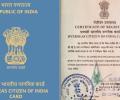
The Centre has defended in the Delhi high court its decision to cancel the overseas citizen of India (OCI) card of United States-based journalist Raphael Satter saying he maligned Indian institutions in the international arena through journalistic activities.
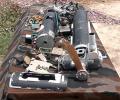
The Indian Army used Medium Machine Guns (MMGs) to target Pakistani Army forward posts along the Line of Control (LoC), inflicting heavy casualties during a ceasefire violation on the intervening night of May 7-8.

Villagers living near the International Border and Line of Control in Jammu are on high alert following the recent terror attack in Pahalgam, preparing underground bunkers and accelerating crop harvesting. The incident has heightened security concerns despite a renewed ceasefire agreement between India and Pakistan in 2021. Residents are demanding swift action against the perpetrators and their handlers.

A Pakistani intruder was also killed in the exchange of fire, they added.

The revelation may have come late in the century but the Congress disclosed on Thursday, May 29, 2025, that the Indian Army conducted six surgical strikes against Pakistan during UPA-2, the Congress-led United Progressive Alliance government's second term in power.

Following the Pahalgam terror attack, the Indian Army launched Operation Sindoor, targeting Pakistani terror infrastructure and posts in the Poonch sector of Jammu and Kashmir. Over 600 artillery shells were fired in three days, decimating 20 Pakistani posts used for infiltrating terrorists into India. The precision strikes crippled enemy logistics, material, and morale, prompting retaliatory attacks by Pakistan on civilian areas. Despite the retaliation, Indian Army officers described the operation as a success, highlighting the high morale of the troops and the effective coordination between artillery and air defense units. The article details the intensity of the artillery shelling and the impact on both sides, highlighting the strategic significance of the Poonch sector and the ongoing tension between India and Pakistan.
11, 13, 15 are not some random odd numbers but the number of days that Prime Minister Narendra Modi took to act against Pakistani terror strikes on Indian soil.

The Border Security Force (BSF) remains on high alert along the International Border (IB) and has not let its guard down, BSF Inspector General, Jammu Frontier, Shashank Anand said on Tuesday. Operation Sindoor, aimed at preventing infiltration attempts, continues as Pakistan cannot be trusted, he added. Anand highlighted the BSF's robust response after the April 22 Pahalgam terror attack, including destroying multiple terror launch pads and thwarting infiltration attempts.
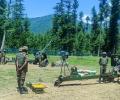
'The precision strikes were well planned and excellently executed. The world will be studying this operation.'

Police officials said the two operations were launched on August 28 based on specific inputs by Kupwara Police a day earlier.

This move is seen as part of efforts to strengthen China's ties with Pakistan and safeguard Chinese investments in Pakistan-occupied Kashmir, particularly related to the China-Pakistan Economic Corridor.

A series of blasts took place in Srinagar city as the security agencies brought down a drone that was seen hovering over Batwara area of the city, close to an army installation, officials said.
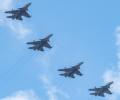
Pakistani military targets at Rafiqui, Murid, Chaklala, Rahim Yar Khan, Sukkur and Chunian were engaged using air-launched precision weapons from Indian fighter jets and the retaliation largely focused on command and control centres, radar sites and weapon storage areas, Qureshi said.

The operation at the Keran Sector in Kupwara is still underway, the Army said.

Army Chief General Upendra Dwivedi visited Kashmir to review the security situation following the Pahalgam attack earlier this week that left 26 people dead, mostly tourists. The visit comes less than 24 hours after Pakistan resorted to small arms firing along the Line of Control (LoC) in Jammu and Kashmir.

Authorities in Jammu and Kashmir on Sunday asked border villages residents, who were evacuated to safer places in view of cross border shelling by Pakistan, not to rush back to homes as they are yet to sanitise and clear these areas of any unexplored shells.

India's marquee women's ODI World Cup match against Pakistan will be held at the neutral venue of R Premadasa Stadium in Colombo on October 5, the ICC announced on Monday.

The worst-hit in the Pakistani shelling was Poonch district which accounted for all the civilian deaths, the officials said, adding 28 persons were also injured and the condition of some of them was stated to be critical.

Lt Gen (Retd) Puri and several other Kargil veterans who had played a decisive role in the 1999 war were felicitated by the Chief of Defence Staff General Anil Chauhan in Delhi recently.
Two terrorists were killed on Wednesday as an infiltration bid was foiled along the Line of Control in Jammu and Kashmir's Baramulla district, officials said. The Army said the infiltration bid was foiled in Uri Nala of the north Kashmir district. The troops on the LoC challenged and intercepted the infiltrators, resulting in a "heavy" firefight, the army said. Large quantity of weapons, ammunition and other war-like stores have been recovered from the terrorists, it said, adding, the operation is in progress.

Abdullah, who visited the shelling-affected areas of Uri, including Salamabad, Lagama, Bandi and Gingal in north Kashmir's Baramulla district, also said that he would take up the demand for building individual bunkers in these areas with the Centre.

Congress Working Committee (CWC) member Shashi Tharoor on Thursday said he has differences of opinion with some in the party leadership, but he is not going to speak about them in light of the bypoll in the Nilambur constituency.

The Border Security Force (BSF) destroyed five Pakistani posts and a terrorist launch pad across the Jammu border in an operation, an officer said. The BSF retaliated after Pakistan targeted civilian areas and Indian establishments in a systematic manner, the officer said.

The Chief of Army Staff reviewed operational preparedness and the security situation along the LoC.

The Supreme Court on Friday ordered withdrawal of the Look Out Circular (LOC) issued against Trinamool Congress MP Abhishek Banerjee and his wife Rujira in connection with the money laundering cases against them linked to an alleged coal smuggling scam in West Bengal.

The US has issued a 'Do Not Travel' advisory for Jammu and Kashmir citing potential for terrorist attacks and violent civil unrest. The advisory, issued on Wednesday, comes a day after a deadly terror attack in Pahalgam that killed 26 people, mostly tourists. The advisory also warns against traveling within 10 kilometers of the India-Pakistan border.
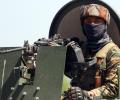
The real heroes of Operation Sindoor were not the armed forces or political leadership, but the ordinary citizens of India who refused to fall into the trap of communal provocation, asserts Colonel Anil A Athale (retd).
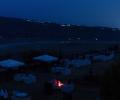
Meanwhile, a precautionary blackout has been enforfced in the multiple areas amid the esclating tensions between India and Pakistan.

The political and ideological differences between the Congress and Shashi Tharoor is no longer a matter of whispers.
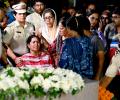
The dastardly dimensions of the attack are gradually sinking in even as the Government of India announced its immediate diplomatic and other retaliatory measures. It is generally expected to be followed up with punitive military action across the LoC, sooner than later, observes Mohammad Sayeed Malik, the distinguished commentator on Kashmir affairs.
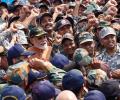
China and Pakistan are in a tight strategic alliance. India must deal with them one at a time, but be prepared in case they decide to collude, points out Shekhar Gupta.

The Indian Army effectively repulsed multiple drone attacks and other munitions launched by Pakistan's armed forces along the western border on the intervening night of May 8-9. Pakistan also violated ceasefire along the Line of Control in Jammu and Kashmir. The Indian Army said it responded with force, asserting that all nefarious designs will be countered.

'Terrorists who are active in Poonch and Rajouri are not relying on random locals for logistics, guidance etc.' 'They are being supported by a selected few who are being vetted, cleared and directed from across the LoC.'
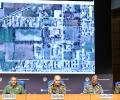
'We completely destroyed at least three posts, an ammunition depot, fuel storage facility, and gunnery, among other targets. Our retaliation was so devastating that it will take Pakistan at least 8-12 months to rebuild, possibly longer'
'Unlike the surgical strikes and the Balakot air strikes across the LoC, we have gone further inside Pakistan and raised the bar of escalation.'
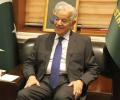
Last week, Information Minister Atta Tarar had said that 24-36 hours were important, fearing a possible strike by India. However, the time passed and there was no action by India.

The Indian Air Force conducted precision strikes on terror hideouts in Pakistan, targeting a Jaish-e-Mohammad communication network housed in a primary health centre in Tehra Kalan village. The communication setup was essential for planning and coordinating activities with infiltrated terrorists in Jammu and Kashmir. The strikes aim to dismantle the communication network and hinder the terrorists' ability to operate.
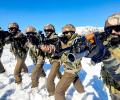
Army personnel keep vigil along the Line of Control ahead of the New Year.
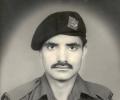
Naib Subedar Chunni Lal is the only soldier awarded the Ashok Chakra, Vir Chakra and Sena Medal.

The Pakistani flag has been removed from the historic table at Raj Bhavan in Shimla where the Simla Accord was signed, a day after Pakistan suspended the 1972 agreement. The suspension came in response to India's retaliatory actions following a terrorist attack in Jammu and Kashmir. The Simla Accord, signed by Indira Gandhi and Zulfikar Ali Bhutto, aimed to settle issues bilaterally and maintain peace at the Line of Control. However, Pakistan's frequent violations of the agreement have led to its suspension, raising concerns about the future of India-Pakistan relations.
 © 2026 Rediff.com - Advertise with us - Disclaimer - Privacy Policy - Sitemap - Feedback - About us - Terms of use - Grievances