
For the first time, there will be an Indian connection to a crewed Moon mission.
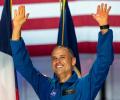
Anil Menon, the latest to join the list of American astronauts with Indian roots, will fly to the International Space Station in June 2026 as a flight engineer.

The Human-rated LVM3 vehicle, the Crew Escape System and the Crew Module and Service Module are all in final stages of testing and integration.
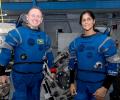
Sunita Williams and Barry Wilmore have been stranded on the International Space Station since June 2024.
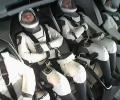
Indian-American astronaut Sunita Williams returned to Earth after completing a record-breaking 9-month mission to the International Space Station. The mission was initially planned for eight days but was extended due to issues with their Boeing spacecraft. During her mission, Williams broke the record for most time spent spacewalking by a woman, completing 62 hours and 9 minutes of extra-vehicular activity.

At 8.04 am IST on Monday, May 7, 2024, Indian-origin astronaut Sunita Williams and Barry Wilmore will fly to space as the first crewed mission of Boeing's Starliner.

After months of uncertainty, NASA astronaut Nick Hague and Roscosmos cosmonaut Aleksandr Gorbunov, travelling in the SpaceX Dragon capsule, successfully docked with the International Space Station (ISS) on Sunday to bring back Sunita Williams and Butch Wilmore, who had been stuck there since June 2024.
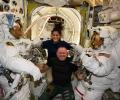
National Aeronautics and Space Administration (NASA) astronaut Nick Hague and Roscosmos cosmonaut Aleksandr Gorbunov will launch no earlier than September 24, on the agency's SpaceX Crew-9 mission to the International Space Station.

Glimpses of the Mars Dune Alpha, NASA's simulated Mars habitat, that is being used as preparation to send humans to the Red Planet.

The asteroid sample will help scientists understand the origin of organics and water that may have seeded life on Earth 4.5 billion years ago.

The United States space shuttle Endeavour took off from Houston's Ellington Airport on its voyage into retirement just after sunrise on Thursday, leaving behind heavy hearts as many consider National Aeronautics and Space Administration 's successful space shuttle programme, a part of Houston history.
The 15-minute conversation, which took place on Friday, was broadcast on National Aeronautics and Space Agency Television, following the conclusion of a station status media briefing from NASA's Johnson Space Center in Houston.
The power drop led to a temporary loss of ISS communications and the shutdown of heating units, some science equipment and one of three operating US gyroscopes used for attitude control.
An opportunity to fly on its famous 'Weightless Wonder' aircraft.

She will become the third Indian-origin woman to fly into space after Kalpana Chawla and Sunita Williams.

Lt Col Raja "Grinder" Chari, 39 is in the batch of 2017.

Crew from a United States segment of the International Space Station was recently moved after gas leak alarm went off. Though the members were evacuated post the ammonia leak scare, it turned out to be a false alarm due to some computer problem according to Nasa officials, the BBC reported.

Chari, 43, will serve as the commander while NASA's Tom Marshburn will be pilot and ESA's Matthias Maurer will serve as a mission specialist for the SpaceX Crew-3 mission to the ISS, which is expected to launched next year.

The eight active NASA astronauts and one former astronaut-turned-corporate crew member will launch on Boeing CST-100 Starliner and SpaceX Dragoncapsules to the International Space Station beginning in 2019.

Summary of sports events and persons who made news on Tuesday
Summary of sports events and persons who made news on Friday

Fifty years ago on July 20, 1969 with these words American astronauts Neil Armstrong, Michael Collins, and Edwin "Buzz" E Aldrin made history by becoming the first human beings to set foot on another world -- the moon. It was an event that was watched by millions on television and one that remains etched in all our memories. Collected here are 17 images of that historic mission, a "giant leap for mankind".

We take a look at the amazing things that Scott Kelly experienced as he hovered 400 kilometres above the earth zipping around it at 17 thousand miles per hour for nearly an year.
 © 2026 Rediff.com - Investor Information - Advertise with us - Disclaimer - Privacy Policy - Sitemap - Feedback - About us - Terms of use - Grievances