
'Attempts at long-term rapprochement have been rather feeble from both sides. The primary cause of the lack of progress is that these efforts do not appear to have the support of the Pakistan army,' says Brigadier Gurmeet Kanwal (retd).

Prime Minister Narendra Modi on Tuesday came out strongly against Pakistan for continuing its proxy war of terrorism against India, saying it has lost the strength to fight a conventional war.

India's unusual tough stand on the arrest of its diplomat Devyani Khobragade has forced the United States to initiate an "inter-agency review" to look into the lapses that happened in the high-profile case that triggered an uproar in India and strained bilateral ties.

It has it all -- an iron-clad story, strong characters, more than believable performances and music you'll want to put on loop for days.
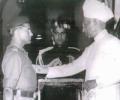
Decorated with a Vir Chakra for leading an attack that destroyed four tanks, Risaldar Ayub Khan shared a name with the Pakistani president who ordered the invasion of India in 1965. India's Ayub came from a family of soldiers and made his country proud.
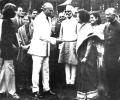
'Indira Gandhi, it appears, did not to consult her Cabinet colleagues, or diplomats, or civil servants when she decided to sign the agreement in Shimla.' 'We ruefully recall Bhutto's perfidy and the Indian prime minister's gullibility,' says Lieutenant General Ashok Joshi (retd).

The allocation in the defence budget is inadequate to meet India's long-term threats, especially from China and Pakistan, says Gurmeet Kanwal.

'Perhaps the finest example is from the current avalanche itself.' 'The Commanding Officer of 19 Madras (the affected unit) is Colonel Um Bahadur Gurung, a Gurkha who joined the Madras Regiment.' 'He inspired this recovery operation at 19,500 feet, a unique feat by itself.' 'He knew that if it was delayed the chances of finding the mortal remains in the Saltoro's ice would be impossible.' 'He did not pass orders from his base at Kumar (15,000 feet) or gave directions; he simply went there himself, inspiring the multitude that followed.' Lieutenant General Syed Ata Hasnain (retd), who has served on the Siachen Glacier, salutes the incomparable spirit of the Indian Army.
The conservative bureaucracy that influences the political masters is clearly not concerned with the vision documents prepared by defence chiefs to bring India's military into a state of preparedness, says Seema Mustafa

'Kargil was Pakistan's strategic blunder. India must remain on guard against such sinister operations being launched in future by Pakistan's vengeful and devious military leadership that continues to have a hate-India mindset and the mentality of primitive warlords,' says Brigadier Gurmeet Kanwal (retd).

A Few Good Men and the Angry Sea: 2004 Tsunami, the IAF Story, is the incredible story of survival, guts, resilience and indomitable spirit of the air warriors and their families, civilians and the government's efforts in rebuilding the strategically important military Car Nicobar air base.

How to deal with a country that has made export of terror a reason to make the world notice and fund it? Rediff.com contributor Sanjeev Nayyar offers a few suggestions
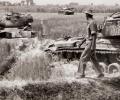
Declassified US documents of the era indicate.
The Indian Army and more recently the Indian Navy have already set up dedicated intelligence branches. It is surprising indeed that the IAF, where real time and timely intelligence is most vital for effective and safe prosecution of the air war, has still not done so itself, says Group Capt (retd) P I Muralidharan.

'With the recent challenging of the notion of the Indian Ocean Region being India's strategic backyard, China is gradually upping the ante in the maritime realm around India.'

'Pakistan's recent utterances and tendency to use pinpricks to try our patience appear reminiscent of 1965. We are a strong nation, emerging stronger,' says Lieutenant General Syed Ata Hasnain (retd).

'If one observes a common man passing a church or gurdwara or dargah, he instinctively bows his head. It is this prevalence of polytheism that has ensured that monotheists and minorities flourish in India. This may sound preposterous in wake of the recent communal clashes in Muzaffarnagar. But it must be understood that in a county of over one billion people that was at worst an aberration,' says Colonel Anil A Athale (retd).

T P Sreenivasan was India's high commissioner in Fiji in 1987, when Sitiveni Rabuka toppled the Indian-dominated government there. Ambassador Sreenivasan stayed on for two years after the coup, fighting for the rights of the people of Indian origin before he was expelled by Rabuka. 'Meeting Sitiveni Rabuka, who had overthrown a democratically elected government, discriminated against the Fiji Indians, brought untold humiliation and suffering to them, tried to disenfranchise them, ordered me out of Fiji and closed down the Indian high commission was a difficult decision to take even after 25 years,' notes Ambassador Sreenivasan who eventually caught up with Rabuka over a game of golf.

'The Panchsheel Agreement is unique in the annals of international relations as it stands out as a bizarre illustration of a prime minister trading his country's crucial national interests solely to buffer his personal international image,' feels R N Ravi.

Excerpts from Prime Minister Narendra Modi's speech at the Combined Commanders Conference on board the INS Vikramaditya at sea, off the coast of Kochi.

'There were tears in my eyes when I parted with my medals. I thought was it for this moment did I become a soldier?' In 2008, Captain H Balakrishnan (retd) of the Indian Navy returned all his medals to the President of India to protest the government's failure to implement the One Rank One Pension scheme.

'India was in no position to wage another war in 1965, having suffered a morale-shattering defeat in 1962. The three services were in the middle of a modernisation and expansion phase and therefore not fully trained or battle-ready.'
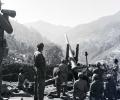
Fifty years ago, India and Pakistan fought a short but bloody war. The author finds out how Sainik Samachar, the defence ministry's journal, reported it.
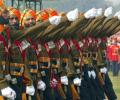
The average Indian soldier remains as hardy as before but he is certainly confused with the pace of change occurring all around him. It is here that the leaders -- the officers -- will have to adapt themselves to the new reality, says Nikhil Gokhale

'In the first meeting of this new year, we took a joint new year resolution that we will complete it this year. At the time things were not very clear, but the mood was clear that yes, we must resolve it.' 'Yes, details have to come out, but there are some sensitivities, there are some stake-holders not yet on board, especially other Naga undergrounds etc, we would like them to come on board... So at a proper time it has to be revealed to the country, and to the legislature. Perhaps, we may have to wait for some more time.' 'With better understanding of the Indian system, many of them have learnt, realised, appreciated that Naga nationalist aspirations can be accommodated in the Indian system. The Indian system is pretty comprehensive and flexible.' 'A Naga has as much stake, claim over India as any other Indian. There is no distinction. This, Nagas have realised, that yes, Naga nationalist aspirations and Indian nationalism are not mutually exclusive.' Ravindra Narayan Ravi, the Government of India's Special Interlocutor for the Naga talks, explains how the Naga Peace Accord was reached in an exclusive interview to Saisuresh Sivaswamy/Rediff.com

Full transcript of President Obama's speech at the Siri Fort Auditorium in New Delhi.
 © 2026 Rediff.com - Investor Information - Advertise with us - Disclaimer - Privacy Policy - Sitemap - Feedback - About us - Terms of use - Grievances