
An India-Japan joint statement said the two leaders expressed serious concern over the conflict and the unfolding humanitarian crisis in Ukraine.

Here are some of the glimpses of the exercise held in the North Arabian Sea.
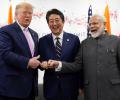
Prime Ministers Modi and Abe enjoyed a close and empathetic relationship and this certainly gave a sustained momentum to the India-Japan strategic partnership. It is necessary for India to reach out and engage with his successor as early as possible, advises former foreign secretary Shyam Saran.

US President Joe Biden on Saturday rolled out the red carpet to welcome leaders of Quad countries, Prime Ministers Narendra Modi of India, Anthony Albanese from Australia and Fumio Kishida of Japan.

'Investors looking at the next 6-12 months can be certain that the Fed will maintain its easing cycle, and we expect the overall environment to be conducive for fixed income investments for portfolio diversification.'

External Affairs Minister S Jaishankar on Friday met Akie Abe, the wife of Japan's late Prime Minister Shinzo Abe and recalled the late premier's invaluable contribution to the advancement of India-Japan relations.
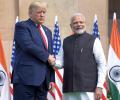
Prime Minister Narendra Modi and US President Joe Biden will have a substantive engagement on the sidelines of the Quad summit on Saturday, and the two sides will sign at least two agreements following the talks.

There is nothing to be worried about as bilateral ties are robust with solid foundations. Both are on the same page on the economic and defence/security ties bilaterally and globally and that shall continue irrespective of change in political dispensation in either country, points out Dr Rajaram Panda.
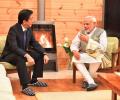
During Abe's tenure, Japan had announced support for a number of major projects. These included the bullet train project between Mumbai and Ahmedabad, besides allocations for a freight corridor between Mumbai and New Delhi.

The India-Japan joint naval exercises are a strategic signal for China, observes Dr Rajaram Panda.
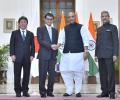
The India-Japan 2+2 dialogue added strategic heft to the special relationship in the wake of growing Chinese assertiveness on regional affairs, points out Dr Rajaram Panda.

Rejecting the criticism of the CAA, Jaishankar said, "There are people who publicly said on record that because of CAA, a million Muslims will lose their citizenship in this country."

Defence Minister Arun Jaitley leaves for Tokyo on Sunday evening for a security dialogue with Japan, a visit that acquires huge significance after North Korea's hydrogen bomb test on Sunday morning.

Pfaff said resolving the mystery shrouding Bose's life and bringing back the ashes to India would be a true tribute to the revolutionary as the country celebrates its 75th anniversary of Independence.
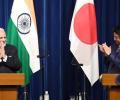
During the 13th annual summit, the two prime ministers reviewed developments in bilateral relations and explored new areas of cooperation, focusing on shared vision for peace and prosperity in the Indo-Pacific, where China is flexing its muscles.

An India-Japan civil nuclear pact would be critical in signalling that they would like to build a partnership to bring stability to the region at a time when China is going all out to reward Pakistan with civilian nuclear reactors, says Harsh V Pant.
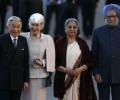
In recent years India-Japan relations have acquired rich economic content and strategic intents. Although the bilateral trade at $18 billion between the two countries is not very impressive and leaves much to be desired, the economic engagement between the two countries is both qualitatively and quantitatively noteworthy. India-Japan defence cooperation, however, has generated a lot interest among the strategic community in the context of rise of China. There has been a lot of speculation about India-Japan strategic partnership to hedge China, says Rup Narayan Das.
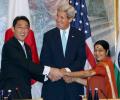
Amid China's growing assertiveness in South China Sea, India, Japan and the US at their first ever trilateral ministerial dialogue in New York.
'Relations between India and Japan are robust and devoid of either shadow of history or any irritant.' 'In fact, there is plenty of warmth and goodwill earned over history. There are no negatives but only opportunities,' notes Dr Rajaram Panda.

Had it not been for the slow but sure emergence of China as a threat to the western order, would India have been accepted as a near-equal partner by individual western nations, jointly and severally, questions N Sathiya Moorthy.
Japan is confident that a Comprehensive Economic Partnership Agreement currently being negotiated with India would help the two countries dominate Asia's economic output in the future.
"A strong Japan is in the interest of India and a strong India is in the interest of Japan," said Shinzo Abe.
The joint statement issued by Dr Singh and PM Abe in Tokyo.

Lou also spoke about China's tensions with neighbouring countries without directly mentioning the eastern Ladakh border standoff with India since May 2020 which resulted in the Galwan Valley clash in June of that year.

The trilateral AUKUS security alliance complements partnerships like Quad and there was a "very warm embrace" of the deal by India and Japan as both the countries totally understood and supported what it is seeking to achieve, Australian Prime Minister Scott Morrison said on Thursday.

Under MRA, Japan is to recognise Indian medical degrees and treat the country's doctors and other medical personnel on par with its own.

Thnew deal will likely usher in a new era of cooperation and broad-basing of economic relationship between the two Asian powers.
Indian businessmen on the forum would also include Baba Kalyani of Bharat Forge, Sunil Kant Munjal of Hero Honda, Nandan Nilekani of Infosys, Vikram Kirloskar of Toyota Kirloskar and Deepak Parekh of HDFC.
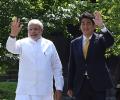
Although the India-Japan relationship has its own driving forces in terms of robust economic ties and shared values, China is the elephant in the room in the strategic parleys between the two countries, says Rup Narayan Das.
Jennifer Rawson, from the Department of Foreign Affairs and Trade, told a Senate Estimates Committee that officials from the four nations had met recently for preliminary discussions, The Age reported on Monday.
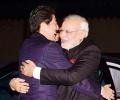
'The regional context and the personal ties between Modi and Japanese Prime Minister Shinzo Abe to a large extent contributed to this dawn of a new era in bilateral relations,' says Srikanth Kondapalli.

More and more women are making their presence felt in jobs related to sciences, technology, and engineering across organisations.

'I am privileged to have represented India for more than two decades and earning my 300th international cap is truly a special memory for me.'
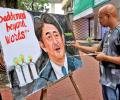
Prime Minister Narendra Modi will join several global leaders to pay tributes to Japan's slain former prime minister Shinzo Abe at his state funeral in Tokyo on Tuesday.

Putin said the 'policy' pursued by Modi is the main 'guarantor' of relations between the two countries.

The agreement provides for creation of an enabling framework for closer cooperation and interoperability, besides allowing militaries of the two countries to use each other's bases and facilities for repair and replenishment of supplies, the official said.

External Affairs Minister S Jaishankar is scheduled to meet United States Secretary of State Antony Blinken in Washington, DC on Thursday, amid the diplomatic rumpus between India and Canada stirred over the killing of a Khalistani separatist.

Several Indian traders, hawkers, as well as transport and gig workers' unions will join a global campaign by Make Amazon Pay coalition happening across close to 40 countries on Black Friday to protest alleged exploitative practices by the tech giant. Employees in the US, the UK, India, Japan, Australia, South Africa and across Europe are demanding better wages and working conditions as the cost-of-living crisis deepens, as part of the campaign. Trade unions, including Bharatiya Udyog Vyapar Mandal, Hawkers' Joint Action Committee, Gig Workers' Association, and All India People Science Network, will join the campaign.

Prime Minister Narendra Modi enjoys a close relationship with Shinzo Abe. For Abe, "a strong India is in the best interest of Japan, and a strong Japan is in the best interest of India."

PM Modi articulated five action points that would serve the common interest of promoting peace and prosperity in the Indo-Pacific region.
 © 2026 Rediff.com - Advertise with us - Disclaimer - Privacy Policy - Sitemap - Feedback - About us - Terms of use - Grievances