As Shinzo Abe begins his crucial visit to India on Friday looking to clinch a slew of deals including bullet trains and amphibious defence planes, the Chinese media on Friday said the Japanese premier is trying to rope in India as part of a strategy to contain arch rival China.

Prime Minister of Japan Shinzo Abe will pay a three-day official visit to India from January 25 during which he will attend the Republic Day Parade as Chief Guest and hold talks on key issues with his Indian counterpart Manmohan Singh for the bilateral annual summit.

China is pulling out all the stops to give a 'state visit-plus' reception to Trump on his maiden visit.

'Our equations with China require engagement and not confrontation; its interfaces with Pakistan and with some other South Asian neighbours also add to the complexities,' says Vice Admiral Premvir Das (retd).

'The Modi government would chaff at the very idea of holding talks with Pakistan, facilitated by Washington and under close US monitoring, when the 2019 poll is sailing into view.' 'But in politics and diplomacy, there may be moments when drinking from the chalice of poison is necessary,' says Ambassador M K Bhadrakumar.

'Presidents may come and go, but America will go on forever,' an American business leader tells Ambassador T P Sreenivasan in New York.
India's Current Account Deficit rose to a record 6.7 per cent in the quarter ended December of 2012-13.

By hosting the 10 ASEAN leaders on Republic Day, India amply demonstrated that ASEAN is a central pillar of its Act East policy. But is India 'central' for ASEAN, asks Dr Rahul Mishra.

About 15 lakh small and medium businesses from India are using Facebook to reach out to customers.
The US wants its trade with India to grow multi-fold, Assistant Secretary of State for South and Central Asia Nisha Desai Biswal told lawmakers.

'Today the Chinese think they can slap India, and there will be no consequences.' 'They must be made to feel the consequences through any and all means,' says Rajeev Srinivasan.

We must see New Delhi's position as a signal of competition to the Chinese grand design for the 21st century world, says Nitin Pai.

The visit of Modi to the United States represents an important opportunity to rejuvenate bilateral ties after a period of malaise and inattention.
Sharma proposes to pass on the 'handover note' to his successor, which as per the poll projections is likely to be from Bharatiya Janata Party-led National Democratic Alliance.
China tops the list with 3.5 million, followed by Brazil with 918,000.

The deal would allow Japan to export nuclear technology to India.

Lending support for India's ambitious Nalanda University project, six countries on Thursday began the process of signing inter-government agreements to pledge their commitment for this academic institution.

'Little did those in India's strategic community realise that any wise adversary in China's place and circumstances would only take the land route to disturb and trouble India.' 'It is along the land border that all of India's post-Cold War allies would be of little or no political and diplomatic, and least of all, military help,' says N Sathiya Moorthy.
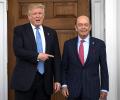
India Inc had cheered Donald Trump's decision to scrap TPP, but now there is a growing sense that it won't really lead to positive growth in trade with the US. Subhayan Chakraborty reports.

'Modi and Obama both had agendas that went beyond the nuclear deal. The threat from the chilly Himalayas had to be tackled in the warm waters of the Indian Ocean.'

US admiral's suggestion for a revival of a strategic maritime quadrilateral with Japan, Australia and India leaves China livid, says Rajeev Sharma.
.jpg)
Modi has plenty of opportunities to test out his strategy. Chinese President Xi Jinping and Australian Prime Minister Tony Abbott will visit India this month, and Modi will fly to Washington towards the end of September for a summit with US President Barack Obama.

Prime Minister Narendra Modi's visit to South Korea is considered essential in strengthening defence ties, enhancing economic cooperation and forging cultural ties between the two countries, says Dr Rahul Mishra

Setting aside the recent tumult in relations caused by the Khobragade episode, US Deputy Secretary of State Heather Higginbottom attended the first major event India's new Ambassador Dr S Jaishankar hosted in Washington. Rediff.com's Aziz Haniffa reports from the Republic Day celebration in the US capital.
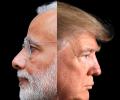
Here's why Rajeev Srinivasan believes there will be nothing particularly positive about the prime minister's US visit.

At just under 30 per cent of the global total in 2011, the United States remains, by far, the world's largest R&D performer.

'Ahmedabad-Mumbai bullet train will not begin to address any of the many problems Indian Railways faces.'

Annoyed over conflicting reports about the missing plane, China on Wednesday night asked Malaysia to verify rumours and share all information about the flight MH370 after official admission that it may have turned back and disappeared over the Straits of Malacca.
The Indian economy can grow if it is delinked from the slow growth in the West and the deceleration in China, says Ashok K Lahiri.

India's macroeconomic environment is improving, but it is still not past the point where it can ignore the developments in the global markets
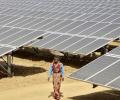
This can happen if the government reaches its goal of 100 giga watts of solar photovoltaic energy and 60 GW of wind energy

There are many reasons for Japan to turn a deaf ear to its anti-nuclear lobby and concentrate on its geo-strategic imperatives to sign the nuclear deal with India, says Debalina Ghoshal.

The Indo-Japanese nuclear deal may not come easy considering India's Civil Nuclear Liability Act provisions which had earlier put off suppliers like General Electric, says Debalina Ghoshal.

'After many rudderless years, India and Japan have prime ministers with a sense of purpose and direction,' says Brahma Chellaney.

India is no longer shying away from playing a role on the regional and international stages and is willing to don a bigger role in regional politics. It is showing traits of a responsible stakeholder in the regional security dynamics, says Dr Rahul Mishra.

The strategic pacts were inked after the summit between Prime Minister Narendra Modi and his Japanese counterpart Shinzo Abe during which they also discussed international and regional issues of mutual importance including UN security reforms.

India' can't succeed unless it is made easier for people to do business.

United States, Russia and China oppose talks to reform the powerful United Nations body
 © 2026 Rediff.com - Advertise with us - Disclaimer - Privacy Policy - Sitemap - Feedback - About us - Terms of use - Grievances