
In a first-of-its-kind initiative involving precision-flying, Indian Space Research Organisation on Thursday successfully launched the Proba-3 mission onboard a PSLV-C59 rocket, a solar experiment undertaken by the European Space Agency.

Group Captain Shukla was commissioned into the fighter stream of the Indian Air Force in June 2006.
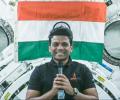
Group Captain Shubhanshu Shukla, the first Indian to visit the International Space Station, has been awarded the Ashoka Chakra, India's highest peacetime gallantry award. The award recognizes his contributions to the Axiom-4 mission and India's advancements in human space exploration.

For the first time, there will be an Indian connection to a crewed Moon mission.

Over the years, India-EU ties have grown, and covered trade, investment, climate change, science and technology, space, digital, mobility, and connectivity.
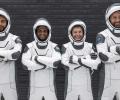
On Thursday, NASA announced that it was working with Roscosmos to understand a new pressure signature, after the recent post-repair effort in the aft-most segment of the International Space Station's Zvezda service module.

Unveiling his launch day playlist, the Indian pilot revealed that he loves to listen to Shah Rukh Khan's Swades song Yuh Hi Chala Chal.

National Aeronautics and Space Administration (NASA) has put off Sunday's launch of the Axiom-4 mission carrying Indian astronaut Shubhanshu Shukla and three others to the International Space Station and a new date will be announced in the coming days.

NASA, Axiom Space, and SpaceX are now targeting 12.01 PM (IST), Wednesday, June 25, for launch of the fourth private astronaut mission to the International Space Station, Axiom Mission 4, NASA said.

The Human-rated LVM3 vehicle, the Crew Escape System and the Crew Module and Service Module are all in final stages of testing and integration.

'The launch of Axiom 04 slated for 11th June 2025 for sending first Indian Gaganyatri to ISS is postponed.'

Meanwhile, Musk said some parts of the ISS were "simply getting too old and obviously that risk grows over time."
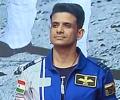
Axiom-4 mission to the International Space Station, piloted by Indian astronaut Group Captain Shubhanshu Shukla with three other crew members, has been delayed and will now be launched from the Kennedy Space Centre in Florida on June 8 at 6:41 pm IST.
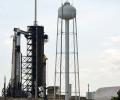
Indian astronaut Shubhanshu Shukla and three others are expected to travel to the International Space Station on June 19, after SpaceX successfully resolved the liquid oxygen leak in its Falcon-9 rocket, the Indian Space Research Organisation (ISRO) announced on Saturday.

Following the postponement of the Axiom 4 mission, Group Captain Shubhanshu Shukla's father, Shambhu Dayal Shukla, said that his family is 'mentally' prepared for the mission.
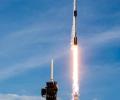
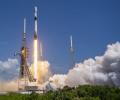
SpaceX's Falcon-9 rocket was scheduled to blast off from the Kennedy Space Centre in Florida on Tuesday evening.

The mission was originally scheduled for lift-off on May 29 but was put off multiple times when engineers detected a liquid oxygen leak in the boosters of the Falcon-9 rocket and NASA also detected leaks in the ageing Russian module of the ISS.
If Rakesh Sharma represented the dreams of a nascent India looking outward, Shubhanshu Shukla embodies a confident India reaching for the controls.

India's Group Captain Shubhanshu Shukla and three other astronauts on Thursday reached the International Space Station as the Dragon spacecraft docked with the orbital laboratory.
'The solution is to replace, clean up, retest and proceed.' 'There is nothing to worry about if corrected.'
'ISRO recommended to carry out in-situ repairs or replacement and conduct a low-temperature leak test to validate system performance and integrity, before proceeding with launch.'
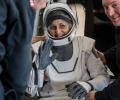
"Once the astronaut returns to Earth, they are immediately forced to readjust again, back to Earth's gravity, and can experience issues standing, stabilising their gaze, walking and turning. For their safety, returning astronauts are often placed in a chair immediately upon return to Earth," the Houston-based Baylor College of Medicine said in a note on body changes in space.
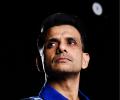
Indian astronaut Shubhanshu Shukla will be the first Indian to travel to the International Space Station (ISS), flying aboard a SpaceX Dragon spacecraft as part of a joint effort between NASA and ISRO. Shukla, a group captain in the Indian Air Force, will serve as the pilot for the Axiom Mission 4, scheduled for launch no earlier than spring 2025. The mission will also carry the first astronauts from Poland and Hungary to stay aboard the ISS.

Initially, NASA's Center for Near-Earth Object Studies estimated a roughly 3% chance of a collision on Tuesday, the highest probability ever assigned. However, additional analysis on Wednesday lowered those chances to approximately 1.5%.

In terms of success rate, the PSLV rocket has an enviable record of 57 successful missions out of 58 commercial ones.

The Indian Space Research Organisation (ISRO) has rescheduled the launch of PSLV-C59 to Thursday due to an "anomaly" detected in the PROBA-3 spacecraft. The launch was originally scheduled for Wednesday at 4.08 pm from the spaceport in Sriharikota. The anomaly was identified by scientists at the European Space Agency (ESA), who requested the rescheduling of the launch. The PROBA-3 mission, a joint project between ESA and ISRO, aims to study the Sun's corona using two spacecraft that will fly in formation. The launch will provide valuable insights for ISRO's future solar missions, including the Aditya-L1 mission which was launched in September 2023.

Group Captain Shubhanshu Shukla Shukla says Wing Commander Rakesh Sharma -- the first Indian to travel to space --has been advising him about the space flight.

Besides the scientists at the Indian Space Research Organisation, officials at the European Space Agency are also involved in tracking the lander module of the Chandrayaan-3 mission which is minutes away from making a soft landing on the surface of the moon, a senior scientist said on Wednesday.
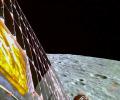
According to the Indian Situational Space Awareness Report for 2023, the nominal lift-off of the Launch Vehicle Mark-3, carrying the Chandrayaan-3 spacecraft, had to be delayed by four seconds based on the Collision on Launch Avoidance analysis.
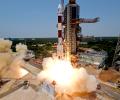
The successful launch of Aditya-L1 - the country's maiden mission to study the Sun - is expected to garner increased investor interest in the Indian space sector and trigger more funding for private players. Several private sector players, including Larsen & Toubro (L&T), MTAR Technologies, and Ananth Technologies, have played a pivotal role in the Indian Space Research Organisation's (Isro's) solar observatory mission. Aditya-L1 on Saturday set off on a 125-day journey on a PSLV-C57 rocket, in its attempt to study various elements relating to the nearest star from the halo orbit around Lagrange point 1 (L1) of the Sun-Earth system, which is about 1.5 million km from Earth.

Astronaut Samantha Cristofiretti of the European Space Agency (ESA) wished India ahead of Independence Day 2022

The space strategist said that this shows that one should not take anything for granted in space exploration.

More and more women are making their presence felt in jobs related to sciences, technology, and engineering across organisations.
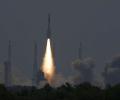
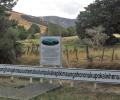
A dome-shaped mysterious object has washed up on a remote Australian beach, amid speculation that it could be from a 20-year-old Indian rocket that was used for launching a satellite.

In this process, millions and millions of tons of solar materials are thrown into the interplanetary space, he said, adding these CMEs can travel at a speed of approximately 3,000 km per second.

The successful launch of the maiden solar mission of the Indian Space Research Organisation came on the heels of the historic lunar landing mission - Chandrayaan-3.

The closest ever images of the sun reveal its surface is speckled with "campfires", miniature versions of the dramatic solar flares visible from Earth.

On Wednesday, November 10, night, a SpaceX Falcon 9 rocket blasted off from the Kennedy Space Center in Cape Canaveral, Florida.

China on Friday announced plans to boost space cooperation with Pakistan, including the development of a space centre and launching of more satellites for its all-weather ally.
 © 2026 Rediff.com - Investor Information - Advertise with us - Disclaimer - Privacy Policy - Sitemap - Feedback - About us - Terms of use - Grievances