
China has objected to Indian Minister Kiren Rijiju's remarks on the Dalai Lama's reincarnation, urging India to be cautious on Tibet-related issues to avoid impacting bilateral relations. China insists any future Dalai Lama must receive its approval.
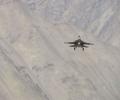
The frequency of day and night operations by frontline fighter jets is a signal that India will continue to put pressure on China until the status quo ante is restored in all the areas in eastern Ladakh including Pangong Tso, Gogra and Hot Springs, government sources said.

Lack of infrastructure development in Jammu and Kashmir for decades post Independence was one of the reasons behind the rise of terrorism in the Union territory, Defence Minister Rajnath Singh said on Friday after unveiling 75 new projects including bridges, roads and helipads in border areas.

Amid tensions over build-up by the Chinese across the Line of Actual Control (LAC) in Eastern Ladakh and reluctance to resolve remaining issues between the two countries, Indian Air Force (IAF) chief Air Chief Marshal VR Chaudhari is visiting forward areas in Ladakh to review the operational preparedness of troops deployed there.
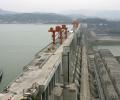
China defends its construction of a dam on the Brahmaputra river in Tibet, addressing concerns from India and Bangladesh about its potential impact on water flow and the environment.
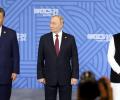
China has expressed its support for Russia's initiative to revive the Russia-India-China (RIC) troika, emphasizing its importance for regional and global security and stability.
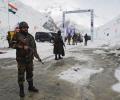
Indian and Chinese militaries on Monday moved back their frontline troops to the rear locations from the face-off site of Patrolling Point 15 in the Gogra-Hotsprings area in eastern Ladakh and dismantled temporary infrastructure there as part of a five-day disengagement process.

India is preparing to resume the Kailash Mansarovar Yatra, a pilgrimage to Mount Kailash in Tibet, after a three-year hiatus. The decision comes as part of efforts to improve relations between India and China, which have been strained since a military standoff in 2020. The two countries have also agreed in principle to resume flight services between them.
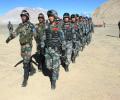
Singh said a meeting between senior Indian and Chinese military leaders has been scheduled for June 6 even as he asserted that India is not going to back off from its position. Asked about the current situation in sensitive areas in eastern Ladakh, he said Chinese have come up to what they claim is their territory while Indians believed it is theirs.

Instead, Chinese Premier and Xi's confidant Li Qiang will take part in the summit to be held on July 6-7 in which Prime Minister Narendra Modi was expected to take part.

India recently outflanked China by taking control of strategic height near Pangong lake's southern bank.

The US has issued a 'Do Not Travel' advisory for Jammu and Kashmir citing potential for terrorist attacks and violent civil unrest. The advisory, issued on Wednesday, comes a day after a deadly terror attack in Pahalgam that killed 26 people, mostly tourists. The advisory also warns against traveling within 10 kilometers of the India-Pakistan border.

The country will not allow any "unilateral action" on its border and will pay any cost to thwart such attempts, he told the Bharatiya Janata Yuva Morcha's state conference.

The Chinese see no need to fight directly. They have an able and willing proxy in Pakistan, points out Shekhar Gupta.
Foreign policy expert C Raja Mohan has said that the recent disengagement of troops with China in eastern Ladakh has given a small opening to India, but the "big issues" remain. He also stressed the importance of strengthening India's ties with the US for technological and economic growth.
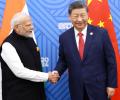
Chinese Foreign Minister Wang Yi said on Friday that India-China relations have made positive strides and achieved a series of encouraging outcomes at all levels after last year's breakthrough ending the over four-year-long military standoff in eastern Ladakh. Wang's remarks came during his annual press conference as he replied to a question on how Beijing views the course of bilateral ties after the two countries ended the prolonged stalemate in the ties.
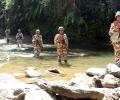
China's military has said it is willing to work with India to find a solution to the border issue, while also pushing for sound and stable defence ties. The statement comes after recent meetings between officials from both countries to normalize relations following a prolonged period of tension.

The Indian Army has commenced a verification patrolling at Depsang, the second friction point in eastern Ladakh, the government said on Saturday.

China's Defence Ministry says the militaries of China and India are making "great progress" in implementing the disengagement agreement to end over four-year-long standoff in eastern Ladakh. Spokesman Sr Col Wu Qian said Defence Minister Rajnath Singh and his Chinese counterpart Admiral Dong Jun had a positive meeting in Vientiane, Laos, last week, and the two sides are implementing the settlement reached between the two counties. The two ministers agreed to implement the important consensus reached between the top leaders and promote stable relations between the two countries, the spokesman said.

The exchange took place at five Border Personnel Meeting points along the LAC, the sources added.

On Saturday, Ministry of External Affairs spokesperson Randhir Jaiswal told the media in New Delhi that the Indian Army has commenced verification patrolling at Depsang, the second friction point in eastern Ladakh.

Sources had earlier said that the areas and patrolling status were expected to be moved back to pre-April 2020 level.

The Indian Army on Friday strongly insisted on early disengagement of troops by China from all the friction points in eastern Ladakh at the eighth round of corps commander-level talks between the two sides that primarily focused on a roadmap for restoration of peace and tranquillity in the region, according to people familiar with the developments.

The Indian Army began patrolling at Demchok on Friday, days after Indian and Chinese troops completed disengagement at the two friction points in eastern Ladakh, Army sources said.
Chinese President Xi Jinping on Wednesday pledged to strengthen the strategic relationships with neighbouring countries by 'appropriately' managing differences and enhancing supply chain ties as China's tariff war with the United States escalated.

"China is an absolutely impossible factor to ignore in what has been our confrontation with Pakistan," Tharoor said.

The two sides had started coordinated patrols in the first week of the month after completing disengagement in both Demchok and Depsang in the last week of October.
A Hyderabad-based deep-tech startup, Simpliforge Creations, has built the world's first on-site 3D-printed bunker in Leh for military use with the help of the Indian Institute of Technology Hyderabad. The project, called "Prabal," is a significant advancement in construction technology, allowing for the rapid deployment of military infrastructure in remote and challenging environments.

China on Wednesday said the Chinese and Indian militaries are implementing the resolutions concerning the disengagement in eastern Ladakh along the Line of Actual Control (LAC) in an 'orderly' manner.
The eastern Ladakh military standoff between India and China began in May 2020 and a deadly clash at the Galwan Valley in June that year resulted in a severe strain in ties between the two neighbours.

India and China have implemented a pact on patrolling in Depsang and Demchok along the Line of Actual Control (LAC) in eastern Ladakh, as per agreed modalities and timelines. The agreement was reached on October 21 and includes provisions for disengagement and patrolling in the last two friction points in the region. The pact has been effected and implemented as agreed, with both sides resuming patrolling activities and grazing, where applicable, as per longstanding practice before the friction began. The terms of the disengagement agreements reached prior to the latest pact continue to hold in relevant areas in eastern Ladakh. The agreement applies mutually to both sides and is without prejudice to India's positions on the LAC or boundary lines. India and China are each carrying out one round of patrolling in Depsang and Demchok, but they have maintained their deployment of troops along the LAC. The focus now is on de-escalation of the overall situation. The agreement was endorsed by Prime Minister Narendra Modi and Chinese President Xi Jinping in a meeting in Kazan, Russia, signaling attempts to normalize ties.

The sources have said that patrolling will begin at these points once the disengagement that began last week is completed and both sides will move their respective troops and dismantle temporary structures.
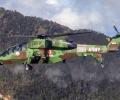
Of the 156 LCH, 90 would be for the Indian Army while 66 would be for the Indian Air Force.

Lt Gen Baggavalli Somashekar Raju will take over as the next vice chief of the Army Staff on May 1, the defence ministry said on Friday.
Asked about the reports of the troops on both sides disengaging and moving back to their previous positions, Chinese foreign ministry spokesperson Hua Chunying told a media briefing in Beijing that both sides are taking steps to ease the situation along the borders.
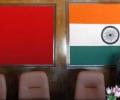
India and China have agreed to take measures to further ease the situation at the borders while continuing to implement the October agreement to resolve the standoff in eastern Ladakh comprehensively. The two sides held the 32nd meeting of the Working Mechanism for Consultation & Coordination on China-India Border Affairs (WMCC) in New Delhi, agreeing to maintain communication through diplomatic and military channels and safeguard sustainable peace and stability in the border areas. This meeting follows the October 21 agreement between the two countries to resolve the over four-year-long military standoff in eastern Ladakh.
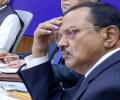
National Security Advisor Ajit Doval arrived in Beijing on Tuesday to take part in the India-China Special Representatives' talks to be held on Wednesday aimed at restoring the bilateral ties stalled for over four years' due to the military standoff in eastern Ladakh.
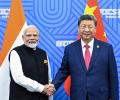
The Galwan clash occurred six months after the Doklam disengagement and two high-profile meetings. India should not be caught by surprise once again, asserts former foreign secretary Shyam Saran.

China has honored an army regiment commander who was injured in the Galwan Valley border clash with Indian soldiers in 2020 as an outstanding member of the national advisory body - Chinese People's Political Consultative Conference (CPPCC). Qi Fabao, who was made the torchbearer for the Winter Olympics in 2022, was among the 33 individuals honored with the 2024 Outstanding Performance Award for CPPCC Members. The incident, which resulted in the deaths of 20 Indian soldiers, led to a freeze in relations between the two countries for over four years. Ties were restored after a meeting between Prime Minister Narendra Modi and President Xi Jinping in October 2023.
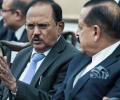
National Security Advisor Ajit Doval is likely to travel to Beijing within the next few weeks to lead the Indian delegation at a new edition of the Special Representatives dialogue on the larger boundary question that will be held after a gap of nearly five years, authoritative sources said.
 © 2026 Rediff.com - Advertise with us - Disclaimer - Privacy Policy - Sitemap - Feedback - About us - Terms of use - Grievances