
'The intrusion in Chumar, during and beyond the Chinese president's visit, is unprecedented and has qualitatively changed the tone of the India-China relationship,' says Jayadeva Ranade, a member of the National Security Advisory Board.

'Make no mistake, depriving water deliberately to a nation of 190 million people is a repugnant idea.' 'The world community won't forgive us.'

'The Communist rule in Tripura was exceptional while it lasted for a quarter century in giving good governance.' 'The chief minister himself was the paragon of virtues in his dedication in public life.' 'But all that still didn't add up when the BJP's dream merchants came up with their famous 'development agenda'.' 'One thing that emerges indisputably in the Tripura election results is that needs and aspirations more or less narrow down to one little word -- jobs,' says M K Bhadrakumar.

No country has achieved a faster, deeper modern transformation than China, says former ambassador Kishan S Rana.
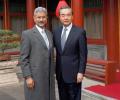
India on Wednesday hit out at China for demanding "solid evidence" for getting Jaish-e-Mohammed chief Masood Azhar banned by the United Nations

'He still has to deal with party norms and traditions and has been careful to follow the order of seniority,' points out Claude Arpi.

The readouts by the Indian and Chinese sides on the meeting on Monday between External Affairs Minister Sushma Swaraj and her Chinese counterpart Wang Yi in Moscow bring out that divergences are crowding into the centrestage of their relationship, says Ambassador M K Bhadrakumar.

Confronting a slowdown in growth, China says it will only increase its defence budget by 7.6% this year, against the anticipated rise of between 20% and 30%. 'It is difficult to explain the reduction in the Chinese defence budget,' says Claude Arpi. 'Is there a hidden budget? Possibly!'

'In India, China's capacities to conduct new types of warfare is critically underestimated,' says Claude Arpi.

China is worried about the situation post the Dalai Lama and that his reincarnation could surface in Arunchal Pradesh, a region it claims as its own, but which is part of the Indian Republic, says former RA&W Additional Secretary Jayadeva Ranade.

Democracy is a necessary but not a sufficient condition for rooting out corruption

The decision to not attend the forum attended by 28 heads of state and 130 national delegations is a clear break from its usual policy of going along with the crowd.

China's major economic problem has been that its heartland is an agricultural region with about one-third of the arable land per person as the rest of the world.

We can learn much from China with regards to making civil service recruitment more efficient, says former diplomat Kishan S Rana.

'Islamic State has declared that the liberation of Islamic Xinjiang from China is an objective. Beijing may well find that Pakistan is unable to assist in any meaningful way,' says China expert Jayadeva Ranade.

Though growth in China is unlikely to slow down soon, India should prepare to take advantage of a shifting of gears there.

'Extending the range of the DF-21D could challenge Indian aircraft carriers if the missiles are launched from southwest China. Also, if Pakistan acquires these systems, these missiles could directly challenge India's aircraft carriers.'

'Why assail the Tibetan leader at a time when many in China realise that the Buddhist monk is the best bet if Beijing is seriously trying to find a solution to the Tibetan issue?' asks Claude Arpi.

'India is a huge market for Chinese goods. I don't think a war stands to logic when you have economic compulsions, but then Chinese are known to do illogical things.'

'If we play our cards right, we may even benefit from the competition between the US and China as seen from increased investment from each of these countries into India.' 'The size of our market gives us an important lever of power which we shall have to play adroitly and intelligently,' points out Ambassador Gautam Bambawale -- who served as India's envoy to China -- in the Professor V M Dandekar Memorial Lecture 2019, delivered on March 8, 2019 in Pune.

Communist China has recently developed a great expertise in 'soul reincarnation', feels Claude Arpi

Amid souring ties, the president visited Beijing for three days. On his return to India, a hope of better ties has arisen, says senior correspondent R Rajagopalan, who travelled with Pranab Mukherjee to the Asian superpower.

While trying to persuade North Korea to give up its provocative actions, engaging China is the first hurdle that world leaders will have to deal with, says Rajaram Panda.

From planning Prime Minister Narendra Modi's foreign trips to playing a key role in the Jammu and Kashmir elections, former RSS spokesperson Ram Madhav is become increasingly important in the BJP

The chaos on its stock markets, a fierce battle between the old and new guard in the Communist Party and the restive border provinces of Tibet and Xinjiang forebode tough times ahead for China, says Claude Arpi.

The Dalai Lama is a huge charmer, knowing how to say things that will please an audience in his gentle avuncular manner.

'Tibet remains a prickly issue between the giant Asian nations. China still claims more than 80,000 sq kilometres of Indian territory in the Northeast. Why? Just because Beijing refuses to acknowledge the McMahon line which separates India and Tibet, and this, simply because the 1914 Agreement delineating the border was signed by the then government of independent Tibet with India's then foreign secretary (Sir Henry McMahon),' says Claude Arpi.
'We should not flatter ourselves that China is fixated on encircling India. She has greater goals, becoming the pre-eminent power in the world, and India as a major power is dealt with as part of that strategy.'

Can you find a world leader who has met generations of Indian politicians, most US Presidents, European head of States, several Popes, celebrated cricketers, Hollywood and Bollywood stars, some of the greatest scientists and many ordinary people, including what he calls, 'Chinese brothers and sisters?'

Outlining seven principles of engagement for closer cooperation between India and China, Prime Minister Manmohan Singh on Thursday said the two countries should show sensitivity to each other's interests and sovereignty and move quickly to resolve the boundary issue.

We're behaving like frogs in warm water. We swim around untroubled, cooled by our faith in Indian liberal democracy. We are blind to the bubbles popping around us, the bubbles warning of fundamental changes, says Mihir S Sharma.
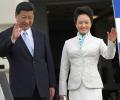
'India and China have to make concrete progress with regard to the border issue, addressing the trade deficit, and facilitating people-to-people interactions. This has to happen in the next two, three years.' China expert Tansen Sen tells Sheela Bhatt/Rediff.com how India and China can take their relations to the next level.
 © 2026 Rediff.com - Investor Information - Advertise with us - Disclaimer - Privacy Policy - Sitemap - Feedback - About us - Terms of use - Grievances