
'The default by the State or its agents in terms of deprivation, exclusion and discrimination (including failure to provide security) is to be corrected by the State; this needs to be done at the earliest and appropriate instruments developed for it.'

This was a very strong position and was criticised by many, both from the developed and developing world.

The Diaspora is no longer a mere remittance economy. It today claims dual loyalty and demands a say in Indian politics, says sociologist Shiv Visvanathan

A goal each half gave India a 2-0 victory over Nepal, and made Sunil Chhetri the country's all-time leading goal-scorer, in Tuesday's friendly at the Kanchenjunga stadium in Siliguri.
The days of political elite have ended with the advent of new politics and new media. Today every citizen is a politician, social worker and an intellectual, says Ram Madhav, BJP national general secretary.
Why does Modi want to speak to the students while his audience should be teachers and parents, not necessarily in that order. And September 5 is not Children's Day but Teachers' Day, says Mahesh Vijapurkar.

Parag Saigaonkar, author of The Perfect Storm in an interview lists out ten things India's Gen Y should know.

Educationist Dr Shashi K Pande on how he sees India, and how he would like to see it change.
'Non Resident Indians know that India's problems are the combination of many factors over the centuries, including foreign rule, lack of resources and the ever-growing population, among other things. Yet, India has achieved many things and even looks at Mars as a neighbour.'

Haresh Pandya recounts one of the biggest upsets in One-day cricket.

Excerpts from Prime Minister Narendra Modi's speech at the Combined Commanders Conference on board the INS Vikramaditya at sea, off the coast of Kochi.

'He depended too much on assurances given by sadhus and sants. He may not be culpable, but he was wholly responsible for December 6, 1992.' 'While Manmohan Singh came to reforms out of conviction, Rao came to reforms out of compulsion. If the compulsion had not been there, I don't know how he would have responded.'

Being a pragmatist Modi is not likely to give preference to China over Japan. Both security and economic aspects are likely to shape Modi's decision in terms of engaging the two biggest economies of Asia, says Sana Hashmi.

What is Change really like in Bihar? Once seen as India's basket-case, what is its turnaround story like?

'India today has to fight many a battle, all of which cry out for innovation. This is where the experience of the Diaspora could be the most productive well-spring.'
Congress leader Jairam Ramesh interacts with readers on Rediff Chat as he discusses the period that changed India's history, forever.

The euphoria of Ab Ki Baar Modi Sarkar will fade quickly if the Modi government does not raise its game, and focus significant monetary resources and managerial skills on making India's infrastructure truly world-class, says Ram Kelkar.

Over the years, pravasis have become a constituency, to be tapped, cultivated, and honoured, or at the very minimum to be listened to, says Ambassador B S Prakash.

Thanks to rupee depreciation, India has a chance to fundamentally rework its stifled manufacturing sector.

'When it comes to India-Pakistan relations, seminal moments of progress invariably bring out saboteurs of peace -- whether we're talking about fresh provocations along the LoC, or even a terror attack in India.'
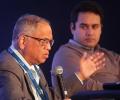
Founders should have faith in themselves, their vision and their team, feels Infosys founder Narayana Murthy.
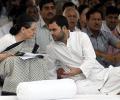
Could this reluctance be tied to the family's projection of themselves as the last bastion of the aam-aadmi's interests? Do they fear that a full disclosure of their not-inconsiderable assets would go against their carefully-cultivated pro-poor image, wonders Saisuresh Sivaswamy.

This could be a major drag, not just on the empowerment of women but on the India growth story as well.
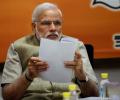
In the final part of his interview with Sheela Bhatt/Rediff.com, journalist Rajdeep Sardesai says the Congress lost the election in 2011, the year of Anna Hazare.

The second part of journalist Rajdeep Sardesai's interview to Sheela Bhatt/Rediff.com.

The year 2014 has been an eventful one for India. The country got a new government and a new state, broke new frontiers in various fields and of course its share of controversies.
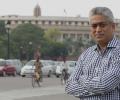
On the eve of the release of his book, 2014: The election That Changed India, Rajdeep speaks candidly in an interview with Sheela Bhatt/Rediff.com.

'I am almost tempted to say there is some kind of a vested interest operating to play down the achievements of Modi.' 'I think the focus should be on what has been achieved in 70 days and not on how this government functions.' Commerce Minister Nirmala Sitharaman's exclusive interview with Sheela Bhatt/Rediff.com on how the Modi sarkar is changing India.

'We saw how vigorous democracy was when it dislodged authoritarianism under Indira Gandhi. We saw its vigour again when it voted Mr Modi out of humble origins as prime minister. It was Nehru who laid that foundation for India and what is worrying today is Modi's rather imperial style of functioning,' says writer Nayantara Sahgal.

Narendra Modi has a once in a lifetime chance to change and take the RSS-BJP-VHP to a new level. Varanasi is the right place to turn the page on saffron history. By surrendering to the spirit of mystical Varanasi, Modi and his party can change the trajectory of their political journey.
.jpg)
The disparity between the outlook of the rich and poor was greater in India than in any other emerging economy. Indians might want to be worried about this because this suggests that the rich are really out of touch with the poor, Bruce Stoke, Director of Pew Research Center, tells Faisal Kidwai in an interview.

'Modi as the PM of the country has to take everybody on board and deliver on good governance. That is his responsibility. In that talking alone won't help, he's working.' Commerce Minister Dr Nirmala Sitharaman tells Sheela Bhatt/Rediff.com how the Modi government plans to change India.

What is Change really like in Bihar? Once seen as India's basket-case, what is its turnaround story like? Archana Masih reports from India's other most talked about state.
 © 2026 Rediff.com - Investor Information - Advertise with us - Disclaimer - Privacy Policy - Sitemap - Feedback - About us - Terms of use - Grievances