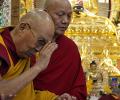
The Dalai Lama addressed rumors about his successor, stating he intends to live for another 30-40 years to serve people. He spoke at a long life prayer ceremony ahead of his 90th birthday.
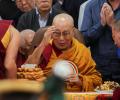
A heavy rain Sunday morning did little to dispirit the thousands who gathered in the main courtyard of Tsuglagkhang, the Dalai Lama temple, to observe the 90th birth anniversary of the 14th Dalai Lama.
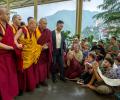
'We are now in a situation where our country is not yet free.' 'China is still very strong and militarily powerful.' 'In such a situation, we need the Dalai Lama to bring about a resolution to the cause of Tibet.' 'That's one of the main reasons that at age 90, he has accepted that there should be a 15th Dalai Lama after him.'
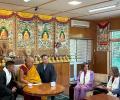
Former US House Speaker Nancy Peolsi, who is part of a US bipartisan delegation which met with the Dalai Lama on Wednesday, launched a broadside against Chinese President Xi Jinping, stating that while the legacy of the Tibetan spiritual leader will live forever, Xi will be gone in a few years.

Dr Lobsang Sangay entered the United States White House on Friday -- a historic feat. This is the first time in the last six decades the head of the Central Tibetan Administration (CTA) has been invited into the White House, the CTA said in a statement.

Tsering described the gesture as an "innocent grandfatherly affectionate demeanour" that was followed by his "jovial prank" with a tongue.

The Chinese reaction came after Zeya met with the Dalai Lama during her India visit, according to Central Tibetan administration, a non-profit political organisation, which works for the Tibetan government in exile.

While addressing a gathering, he also gave a short teaching from the Jataka Tales.

US special coordinator for Tibetan issues Uzra Zeya met the Dalai Lama in Dharamshala on Thursday and discussed the rich traditions of freedom and democracy in the United States and India.

Penpa Tsering was on Thursday sworn-in as president of the Central Tibetan Administration, the Dharamshala-based Tibetan government-in-exile, and said he will reach out to the Chinese government to find a "mutually beneficial" and non-violent solution to the Sino-Tibet conflict.

China on Thursday sharply criticised US special coordinator for Tibetan issues Uzra Zeya's meeting with the Dalai Lama and her visit to Dharamshala, saying it violated Washington's commitment that Tibet is part of China and it does not support Tibetan separatists.

Many people believe that India's first prime minister Jawaharlal Nehru made a blunder when he recognised China's sovereignty over Tibet but he did what he thought was best for his country, said the president of the Tibetan government in exile.
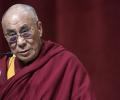
US Special Coordinator for Tibetan issues Uzra Zeya will travel to India and Nepal this week to deepen cooperation on human rights and democratic governance goals with the two nations, the state department has announced.

In the meeting, Ngodup Dongchung, an official in the Tibetan government-in-exile and representative of the Dalai Lama, thanked Blinken for the continued support by the US to the Tibetan movement.

China firmly opposes all forms of contacts between foreign officials and the Dalai Lama, he said.

Self-immolation by six Tibetans, including three teenage monks, protesting Chinese rule in Tibet continued to haunt China as Communist Party leaders on Thursday began a key meeting where Panchen Lama, projected by Beijing as the rival to the Dalai Lama, was given prominence.
13-day event inaugurated by His Holiness, the Dalai Lama.

In his message to the Buddhist community from his home in McLeodganj, the Tibetan spiritual leader asked people to recite the 'om mani padme hum' mantra. With this practice, you will create some roots of virtue that you can dedicate to me -- Avalakiteshvara's messenger -- to live for 110 or 108 years or so, the Dalai Lama said.
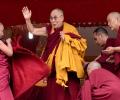
'The Bharat Ratna should have been given a long time ago. Not just to irk the Chinese, but to recognise His Holiness for what he is and how we have benefited immensely from his presence in India.' 'I don't think there's been a better ambassador for India's philosophical and cultural past than the Dalai Lama.'
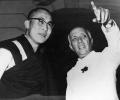
One priority for Delhi (for the new foreign secretary in particular) is to have an in-depth discussion with Dharamsala as soon as possible, suggests Claude Arpi.
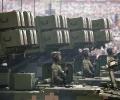
The first priority for the new Tibetan administration in Dharamsala should be to look at Tibetan recruitment in the PLA, suggests Claude Arpi.

Samdong Rimpoche's visit to China materialised against the backdrop of strained India-China relations consequent to the face-off between Indian and Chinese troops at Doklam, says former RAW officer Jayadeva Ranade.

'When you look at the border -- from Ladakh to Arunachal -- which is called the Sino-Indian border, but in effect it is actually the Indo-Tibet border.' 'Since the borders are still not secure, it has resulted in transgressions in Galwan, Dokalam etc.'

Statements emanating from the recent Chinese Communist party congress suggest potentially increasing pressure on India with regard to the Dalai Lama and the Central Tibetan Administration in Dharamsala, notes former RAW officer Jayadeva Ranade.
'The Dalai Lama is in a tearing hurry.' 'The 'reincarnation' card remains unplayed, and time is running out.' 'Is something big being planned for the event of Tibetan Buddhist leaders in Leh in November?' asks Ambassador M K Bhadrakumar.

'China is concerned about its impact within Tibet.'

The Chinese Communist party has not closed its door of contacts and negotiation with the Dalai Lama, a senior Communist leader wrote recently. Former RA&W officer and China expert Jayadeva Ranade explains what the thinking on Tibet is likely in Beijing.

'If, as appears to be the case, India is on way to 'mending fences' with China, and China is equally desirous to 'reset' the relationship, this could be a self-reflexive moment in India's positioning vis-a-vis not just the Dalai Lama, but also the Tibetan issue and China as a whole,' points out China expert Alka Acharya.

Cancelling Uighur leader Dolkun Isa's visa could have been a mutual face-saving exercise for New Delhi and Beijing.
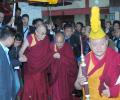
Beijing is clearly rattled by the Dalai Lama's visit. Unlike the 2009 visit, which was a four-day religious tour, the current visit is a high-decibel, 10-day affair, without the fig leaf of a "religious event", reports Ajai Shukla.
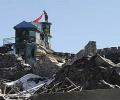
Public interest centres on whether the two leaders might make headway in resolving the Sino-Indian boundary dispute.

The people who know Tibet will continue to fight the good fight. Long, hard, less than hopeful, but always peaceful.
 © 2026 Rediff.com - Investor Information - Advertise with us - Disclaimer - Privacy Policy - Sitemap - Feedback - About us - Terms of use - Grievances