
The PM chaired the AEC meeting on Saturday.
Dhirendra Singh on Tuesday assumed charge as the new divestment secretary, following Monday's high level bureaucratic reshuffle.
The total nuclear power generated in the country would now increase to 3310 MW.
Pakistan Friday said it plans to generate 8,800 MW of nuclear power by 2030 and maintained that its nuclear programme was for peaceful purposes.
PM Manmohan Singh on Wednesday revealed in the Lok Sabha that the inking of the joint statement between him and US President George Bush was delayed by 12 to 15 hours as he refused to sign it without the approval of the AEC chairman.
India's Tryst with the Atom: Unfolding the Nuclear Story by O P Sabherwal reveals details hitherto unknown about India's nuclear programme.

Pakistan Prime Minister Nawaz Sharif on Thursday inaugurated construction work on a China-backed USD 10 billion (approximately Rs 654 crore) nuclear power plant in Karachi.
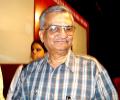
Dr Kakodkar's strategic stubbornness ultimately got India what it wanted though the negotiations with the US went to the wire, notes Shivanand Kanavi.

Dr Bhabha and Dr Sarabhai didn't feel guilty for their ambitions; it was for those 'mad scientists' that India is a powerhouse -- both at the atomic level and in the vastness of space, observes Kumar Abishek.

The study titled 'Indian Unsafeguarded Nuclear Program' published by the Institute of Strategic Studies Islamabad is co-authored by four nuclear scholars, including Adeela Azam, Ahmed Khan, Mohammad Ali and Sameer Khan.

To curb rising food prices, the Union government is contemplating using large-scale nuclear irradiation technologyfor increasing the shelf life of fruit and vegetables, particularly that of onions and potatoes.

Nehru's faith in science and technology, his genuine respect for Bhabha, and their burning ambition worked synergistically to place India on the nuclear map of the world. Atomic energy developed and prospered because of Nehru's vision fulfilled by Bhabha's mission, recalls K S Parthasarathy, former secretary of the Atomic Energy Regulatory Board, on the occasion of India's first prime minister's 119th birthday today.
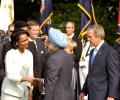
The night before Dr Singh was to meet President Bush, he said he could not sign the agreement.

Vajpayee had always felt that India must act with conviction and panache. He decided that, irrespective of the attendant risks, he would undertake what many felt was a precarious course. A fascinating excerpt from N K Singh's Portraits Of Power: Half A Century Of Being At Ringside on Atalji's 96th birthday, December 25.
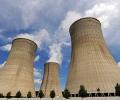
In a major relief to component suppliers in the nuclear energy sector, the government on Tuesday said they will not have any "obligation" if there is any liability. However, the major suppliers, for instance companies building the reactors, will not be absolved if there is such an eventuality.

Membership of Nuclear Suppliers Group ensures continued availability of fuel sufficient to operate India's nuclear plants.
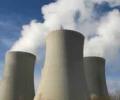
With the Trinamul government and NGOs stalling the Haripur nuclear plant, will the DAE allot the Russians another site elsewhere in India?

'When economic policies were attacked by people on his own side, he went ahead despite all the criticisms in the coalition, within the party and the Sangh Parivar.'
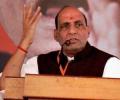
The Bharatiya Janata Party on Thursday demanded a statement from the prime minister on media reports about the government's 'decision' to allow an American company to install a nuclear reactor diluting the provisions of Nuclear Liability Bill.

'As a nation we came up short, but that did not deter Kalam. He made it his life mission to exhort the young to greatness.'

Manmohan Singh had told his team to "call off" the Indo-US civil nuclear deal a night before its scheduled announcement by President George Bush after Americans came with a killer proposal to let India have just two of its nuclear reactors out of the international safeguards, a top aide of the former Prime Minister has said.

T N Seshan believed that toughness at every level is needed to keep the flock under him strictly duty bound, recalls Dr K S Parthasarathy, former secretary, Atomic Energy Regulatory Board.
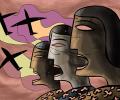
It is important to approach the belief of people in ancient India's achievements with a sense of proportion, balance and empathy, argues B S Raghavan, the distinguished civil servant.
The Kudankulam Nuclear Power Plant will attain criticality by mid-night on Saturday, Atomic Energy Commission Chairman S K Sinha announced in Tirunelveli.
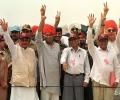
'1998-1999 was the only year in the last quarter century that India had net-negative foreign investment.' 'Foreign money ran away from India that year because capital is a coward and does not like uncertainty of the sort produced by such casual treatment of a destructive technology,' says Aakar Patel.
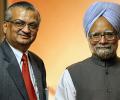
'Dr Singh, visibly relieved, said, 'Yesterday night I couldn't sleep. I stayed awake, praying throughout. You have saved the country'.' A fascinating excerpt from former atomic energy chief Dr Anil Kakodkar's memoir Fire And Fury: Transforming India's Strategic Identity.

20 years ago this day, May 11, 1998, India conducted its second nuclear test at Pokharan in Rajasthan. In a fascinating interview on Rediff.com, K Subrahmanyam revealed how Indian PMs reacted to nuclear ambitions.

'She preserved national unity against great odds.'

'There has definitely been a breakthrough in the nuclear logjam. It is good to see nuclear energy back on the rails,' says Dr Anil Kakodkar, former chairman, Atomic Energy Commission.
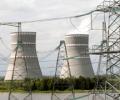
Under a 2010 nuclear liability law, nuclear equipment suppliers are liable for damages from an accident, which companies say is a sharp deviation from international norms

"I am an academic and I have always made it clear that my ultimate home is in the realm of ideas," Rajan said in a letter to staff.
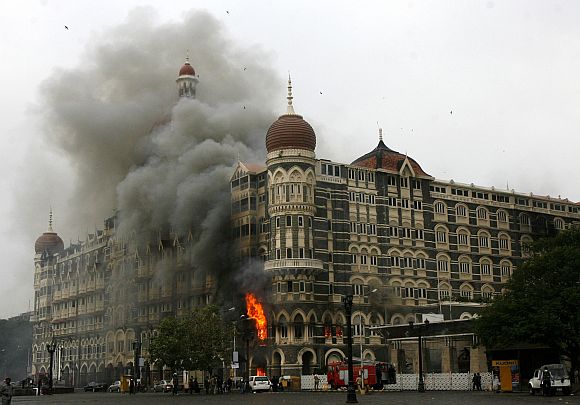
'Headley's testimony indicates to what extent the Pakistan government and its proxies can go to destroy not only Indian scientific talent but also international expertise.'

Immediate NSG membership will not help India realise its nuclear ambitions any faster. It could have easily left the process take its own course, instead of running a high-stakes campaign to get in, says B S Raghavan.

In the absence of a conducive environment, India should not show any "hurry" to hold talks with Pakistan when Prime Minister Manmohan Singh visits New York later this month, BJP president Rajnath Singh said.

While nuclear engineers cheer KNPP's first full operation, on nine other sites which house atomic reactors, scientists spend sleepless nights.

Ramji Raghavan is using this principle to help village children from government schools enjoy science and maths. Indulekha Aravind reports

Professor Chintamani Nagesa Ramachandra Rao is the third scientist to be awarded the highest civilian award -- Bharat Ratna, a crowning glory of his inexorable list of outstanding achievements.

India has built two top-secret facilities in Karnataka to enrich uranium in pursuit of its hydrogen bomb dream.

The government must justify why we need to buy foreign reactors when we have developed up to 700 MWe unit-size pressurised heavy water reactors, a design which can be easily extended to 900 to 1000 MWe unit size. Why can't the 'Make in India' philosophy apply to indigenous nuclear reactors, more than 18 of which have been designed, built, and being operated by Indian engineers, asks Dr A Gopalakrishnan.
 © 2026 Rediff.com - Investor Information - Advertise with us - Disclaimer - Privacy Policy - Sitemap - Feedback - About us - Terms of use - Grievances