
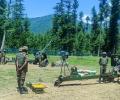
Following the Pahalgam terror attack, the Indian Army launched Operation Sindoor, targeting Pakistani terror infrastructure and posts in the Poonch sector of Jammu and Kashmir. Over 600 artillery shells were fired in three days, decimating 20 Pakistani posts used for infiltrating terrorists into India. The precision strikes crippled enemy logistics, material, and morale, prompting retaliatory attacks by Pakistan on civilian areas. Despite the retaliation, Indian Army officers described the operation as a success, highlighting the high morale of the troops and the effective coordination between artillery and air defense units. The article details the intensity of the artillery shelling and the impact on both sides, highlighting the strategic significance of the Poonch sector and the ongoing tension between India and Pakistan.
The Army further made it clear that the continuation of a break in hostilities, as decided in the DGMOs interaction of May 12, has no expiry date to it.

China supplied more than $20 billion worth of arms to Pakistan. These include 20 J-10CE and JF-17 Block III fighter aircraft, Wing Loong drones, frigates, submarines, Hongqi HQ-9P surface-to-air missiles, 240 PL-15E air-to-air missiles, LY-80 air defence systems, ZDK early warning aircraft and other weapons.
The exercise is taking place at a time when tensions between India and Pakistan have gone up after the Pahalgam attack.
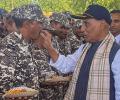
He also reviewed the joint actions undertaken in coordination with the Indian Air Force and the Border Security Force, they said.

Interacting with the Indian diaspora in Kuala Lumpur, Banerjee said, "We have been in talks with them (Pakistan) for decades, despite changes in various paradigms and governments. But one thing remains constant, the conflict with Pakistan."
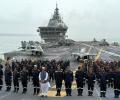
In an interaction with naval warriors on board aircraft carrier INS Vikrant off Goa, Singh sent a stern warning to Islamabad saying India will not hesitate to use the methods to deal with terrorism that Pakistan cannot even think of.
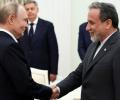
Will Russia's entry deter Trump on his warpath?, asks Ambassador M K Bhadrakumar.
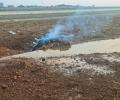
Dar's statement, echoed by another federal minister, came as the Indian and Pakistani militaries targeted each other's installations using missiles in the last more than 12 hours, further escalating the already tense conflict situation.

Indian Navy's carrier battle group, submarines and aviation assets were immediately deployed at sea with full combat readiness in the aftermath of the Pahalgam terror attack, a top Navy official said on Sunday.

Pakistan military spokesperson Lieutenant General Ahmad Sharif Chaudhry told a hurriedly called press conference in Islamabad at around 4 am that th Pakistan air force's Nur Khan (Chaklala, Rawalpindi), Murid (Chakwal) and Rafiqui (Shorkot in Jhang district) airbases were targeted.
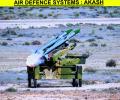
'The Pakistanis called the US state department and said we agree with India on peace.' 'It was then that US President Donald Trump jumped in and took credit for the ceasefire.'
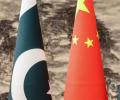
The Chinese military on Monday denied reports that its largest military cargo plane has carried arms supplies to Pakistan and warned legal action against those spreading such rumours.

Even Prime Minister Narendra Modi told US Vice President JD Vance on May 9 that Indian response will be "more forceful, stronger, devastating" in response to Pakistani actions, the sources said.
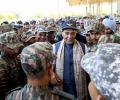
'Pakistan is no longer a front-burner issue for America.'
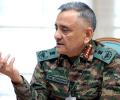
Chief of Defence Staff General Anil Chauhan on Saturday said India's Operation Sindoor has drawn a 'new red line' of intolerance against terror, and expressed hope that the military action has brought 'some lessons for our adversary also'.

The Director General of Air Operations said "whatever methods and whatever means we have chosen, it had the desired effects on the enemy targets",
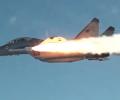
The Directors General of Military Operations of India and Pakistan firmed up the arrangement on stopping military actions on May 10 after four days of fierce offensives between the two sides that triggered fears of a wider conflict.
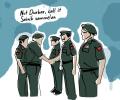
>The Indian Army still uses old British-era names and recruits soldiers based on caste or region, which hurts national unity, argues Colonel K Thammayya Udupa (retd).

Suspected drones were observed along the International Border in Samba district of Jammu region on Monday, while armed forces downed a 'surveillance drone' in Punjab's Jalandhar district.

'Make-in-India played a key role in India's effective action against terrorism during Operation Sindoor.'
'I am worried that Pakistan will still feel compelled to take substantive military action beyond this apparent drone activity.' 'If so, the crisis could persist for a while more and dangerous days are still ahead.'
'The precision strikes were well planned and excellently executed. The world will be studying this operation.'

The ministry of external affairs also seemed to reject Trump's forceful comments that Washington brokered the understanding between India and Pakistan on ending their four-day military conflict.

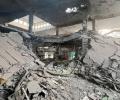
The assault occurred as residents were attending Sunday church services.
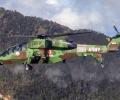
Of the 156 LCH, 90 would be for the Indian Army while 66 would be for the Indian Air Force.

'It is important India to stay focussed on its primary national objectives: Combating terrorism; not losing sight of other security and strategic concerns (on the Sino-Indian front for instance); ensuring a strong economy and registering growth which includes improving the lot of common people; and finally making certain that the social fabric remains intact and harmony among people is not jeopardised, at least any further,' asserts Nilanjan Mukhopadhyay.
India on Friday called on the International Monetary Fund (IMF) to reconsider its $1 billion assistance to Pakistan, suggesting that Islamabad could use it for terror funding.
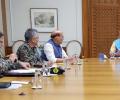
India has called Pakistan's nuclear bluff with Operation Sindoor and sent a psychological message to state-sponsored terrorists: nobody is untouchable and no place in Pakistan is safe for you, government sources said on Sunday.

The casualties were reported hours before India and Pakistan agreed to end hostilities, which soared after the Indian Armed Forces hit terror launchpads in Pakistan and Pakistan-occupied Kashmir earlier this week in response to the Pahalgam attack.

The move came against the backdrop of Turkiye backing Pakistan and its condemnation of India's strikes on terror camps in the neighbouring country and Pakistan-occupied Kashmir under Operation Sindoor.

Asserting that India will not tolerate any 'nuclear blackmail', Prime Minister Narendra Modi on Monday said operations against Pakistan have only been kept in abeyance and the future will depend on their behaviour.
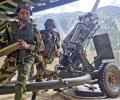
'Will this near-war, India's strongest military response so far, buy India another seven years of deterrence?' asks Shekhar Gupta.

'They thought nobody would hit Bahawalpur and Muridke because they have nuclear weapons.' 'They used to think India cannot touch our military targets because we are a nuclear weapons country.' 'After Operation Sindoor we have called their bluff.'
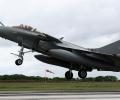
The western media is going all out to prove that India suffered a major setback in Operation Sindoor and how China helped shoot down Indian fighter jets. One of the articles published in British newspaper Telegraph stated Operation Sindoor shattered the myth of India's air dominance over Pakistan. "The Pakistani Air Force, aided by Chinese targeting satellites and AWACS executed a sensor-fusion kill. The Rafales never got a lock, never even saw their adversary. When the missiles hit, it was already over," wrote the British Newspaper, The Telegraph.

Hours after, however, firing from the Pakistani side was reported in Akhnoor sector in Jammu and Kashmir. Drones were also seen in the Pir Panjal area.
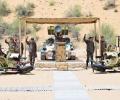
'War is not an answer. War is not a solution.' 'Deterrence is a solution. We should have the stick with us with which we can beat Pakistan.'
'For weeks, months and years, it would continue to be debated if India should have pushed the early advantage and decapacitated Pakistan militarily.' 'India refused to bite the provocatively proverbial bullet and escalate it into a full-fledged war,' notes N Sathiya Moorthy.

'The lesson Beijing would have learned is that there is, cost-benefit wise, no better option than to keep the Pakistan military supplied with its most advanced armaments, certain that in hostilities with India these would be used for maximum effect.'
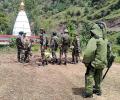
'Unfortunately, India and Pakistan could learn a 'lesson' from this conflict that will make them more likely to use these weapons against each other in the future.' 'Rounds of missile and drone attacks could be more routine features of their hostility, just like artillery fire has become a familiar fact of life along the Line of Control.'
 © 2026 Rediff.com - Advertise with us - Disclaimer - Privacy Policy - Sitemap - Feedback - About us - Terms of use - Grievances