
India is strengthening the naval component of its nuclear triad with Navy Chief Admiral Dinesh K Tripathi on Tuesday saying that the third indigenous nuclear-powered submarine 'Aridaman' will be commissioned soon and that his force is focusing on boosting its overall combat prowess.

In 2025, India launched Operation Sindoor, a multi-domain combat mission against Pakistan in response to cross-border terrorism. The operation involved precision strikes, military retaliation, and diplomatic measures, marking a significant shift in India's security policy.

Top Indian military commanders highlight the success of Exercise Trishul in enhancing jointness and interoperability among the Army, Navy, and Air Force. The exercise, culminating in Amphex 2025, involved 30,000 troops, multiple aircraft, and naval vessels, including INS Vikrant.

China has commissioned its third aircraft carrier, the Fujian, featuring advanced electromagnetic catapults, amidst rising tensions and military modernization efforts.

Indian Navy's carrier battle group, submarines and aviation assets were immediately deployed at sea with full combat readiness in the aftermath of the Pahalgam terror attack, a top Navy official said on Sunday.
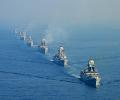
A parliamentary panel on external affairs has expressed concern over China's growing presence and influence in the Indian Ocean Region, citing risks to India's national security and strategic interests. The panel also highlighted the strengthening China-Pakistan naval nexus as a cause for concern.
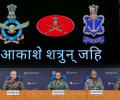
The Indian Air Force on Monday said all its military bases and systems continue to remain fully operational, and ready to undertake any further missions if the need arises.

During Operation Sindoor, Indian naval ships, submarines and aircraft were operationally ready and deployed, projecting strength and preparedness to deter any "potential actions from our western adversary" in the maritime domain, Navy chief Admiral Dinesh K Tripathi said on Friday.

India needs to be technologically and militarily prepared to defend itself from both Pakistan and China, alerts Ramesh Menon.
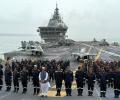
In an interaction with naval warriors on board aircraft carrier INS Vikrant off Goa, Singh sent a stern warning to Islamabad saying India will not hesitate to use the methods to deal with terrorism that Pakistan cannot even think of.

China and Pakistan are in a tight strategic alliance. India must deal with them one at a time, but be prepared in case they decide to collude, points out Shekhar Gupta.

The Indian military also acknowledged suffering some losses but declined to provide the details as the operations are going on.
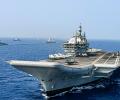
'It brings precarious peace because the red lines have shifted. 'The next Pahalgam attack would mean a full scale war.'

'You can be sure that the Pakistanis knew when the Indian Air Force aircraft took off, which type these were, and what their likely targets were.' 'The question was: How would they determine that the IAF wanted to fire, and when to bounce them?', notes Shekhar Gupta.

'The lesson Beijing would have learned is that there is, cost-benefit wise, no better option than to keep the Pakistan military supplied with its most advanced armaments, certain that in hostilities with India these would be used for maximum effect.'
'Had Haji Pir and/or Skardu been taken, the message would have gone out not just to General Asim Munir and his cohort in the Pakistan army but to the Pakistani people that every terrorist incident in India would lead to substantial loss of territory in PoK.'

The resumption of two-carrier operations signals India's return to the elite clutch of navies that have the ship platforms and experience for operations that simultaneously involve more than one aircraft carrier.

It is the first mega exercise involving the two aircraft carriers after induction of the indigenously-built INS Vikrant in September.

The deployment of the UK's "most advanced naval capabilities" has been flagged by the UK ministry of defence as a "decisive step" in bolstering UK-India security ties.

In his remarks, Admiral Singh complimented his force for continuously maintaining 'peak combat-readiness' and 'high tempo' of operations over the past few months, they said.

The missile was fired by frontline corvette INS Prabal as part of a mega naval drill involving aircraft carrier INS Vikramaditya and a number of warships, attack helicopters, aircraft and other assets of the navy.

India's historical focus on its continental borders has overshadowed its maritime ambitions, but that is changing quickly, notes Ajai Shukla.
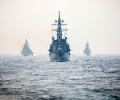
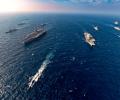
Aircraft carriers of India, the United States, Japan and Australia are set to take part in the second phase of Exercise Malabar that is scheduled to take place from November 17 to 20 in the Indian Ocean region, the Navy said on Monday.
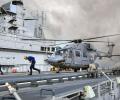
The navy is pushing hard for IAC-2 to be a 65,000-tonne, flat deck carrier that is designed and built in India, with technical and tactical consultation from the US navy -- the global masters in aircraft carrier operations.

While the first phase of the 24th edition of the Malabar exercise was conducted in Bay of Bengal from November 3-6, the second phase was conducted in the Arabian Sea from November 17-20, said a statement by the Indian Navy.
"Relevant countries should abandon the obsolete Cold War mentality and narrow-minded geopolitical rivalry concept and view correctly and respect people's aspiration in the region and do more things conducive to regional solidarity and cooperation," Chinese foreign ministry spokesman Zhao Lijian said.

London hopes to convince New Delhi's naval planners to power India's second indigenous aircraft carrier with the Queen Elizabeth's integrated all-electric propulsion system.

The US has deployed its naval carrier strike group, led by the nuclear-powered aircraft carrier USS Ronald Reagan, as well as a fleet of F-18 fighter jets and E-2C Hawkeye all-weather aircraft for the exercise, officials said. The Indian assets at the exercise included Jaguar and Sukhoi-30MKI fighter jets, IL-78 air-to-air refuelling tanker aircraft, Airborne Warning and Control System aircraft and warships Kochi and Teg. The Indian Navy has also deployed a fleet of P8I maritime surveillance aircraft and MiG 29K jets, apart from other platforms.

China will use airpower to support Pakistan from the start of a war. China will use the opportunity to at least take Ladakh. Its growing navy will prevent India from blockading or attacking the Makran Coast. And thanks to Chinese weapons, Pakistan keeps expanding its forces, observes Ravi Rikhye.
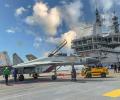
New Delhi's regional partners in restraining a belligerent China -- primarily the US, Japan, Australia and Singapore -- would like the Indian Navy to lock down the Indian Ocean Region, while the other partners can focus on deterring the PLA (navy) in the South China Sea, explains Ajai Shukla.

It looks as if India's plan to have three carrier battle groups, centred around INS Viraat, INS Vikramaditya and an indigenously built aircraft carrier in Cochin shipyard, has suffered a huge setback, reports RS Chauhan

The Indian Navy has a big role to play in support of our strategic objectives in the Indian Ocean. The increasing Chinese presence in the Indian Ocean is a matter of concern and need to be factored. Hence, the requirement of an Aircraft Carrier is a foregone conclusion, asserts Commodore Venugopal Menon (retd).

The Indian Navy said it was in a high state of readiness to "deter, prevent and defeat" any "misadventure" by Pakistan in the maritime domain.
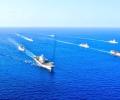
French naval commander expresses concern over China expanding its maritime influence in the region.
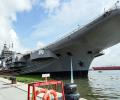
In New Delhi's corridors of power, debate continues on whether the navy even needs a third aircraft carrier.

The Indian Navy has just one aircraft carrier. The INS Vikramaditya carries just 26 unreliable MiG-29 fighters and 10 helicopters -- an insufficient capability to battle a serious foe.

The deployment seems to be more than what is needed.
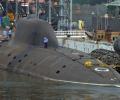
The INS Chakra III will be ideal for 'sea denial' missions, in which the submarine denies the enemy the use of the sea.

The navy finds itself fighting for relevance, with navy planners lamenting that its share of the budget has dropped dramatically.
 © 2026 Rediff.com - Advertise with us - Disclaimer - Privacy Policy - Sitemap - Feedback - About us - Terms of use - Grievances