
The Kerala High Court has criticized the Kerala Waqf Board's claim on land in Munambam as a 'land grabbing tactic' and upheld the government's decision to appoint an inquiry commission to investigate the ownership of the disputed area.
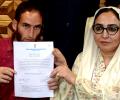
Darakhshan Andrabi, chairperson of the Jammu and Kashmir Waqf Board, handed over a job appointment letter to Nazakat Ahmad, whose brother Syed Adil Hussain Shah was killed in the terrorist attack in Pahalgam's Baisaran area on April 22, 2025.

The Supreme Court has rejected a petition seeking to prevent the construction of mosques named after Mughal emperor Babur.
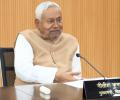
Nitish Kumar's decision to contest the Rajya Sabha elections signals the end of his long-standing tenure as Bihar's Chief Minister, paving the way for a potential BJP leader to take the helm.

Authorities in Kishtwar district of Jammu and Kashmir have issued an order regulating the collection of donations during Ramzan to prevent unauthorized fundraising and ensure transparency.

The district court in Shimla on Thursday upheld the municipal commissioner court's decision to demolish the entire structure of Sanjauli mosque, rejecting a plea by the Himachal Pradesh Waqf Board and the Sanjauli Mosque Committee.

The new TTD chief said all those who work at Tirumala should be Hindus.

BJP president JP Nadda said on Sunday that the party does not seek to control the Waqf Board but wants to ensure that those managing it operate within the bounds of law and adhere to established rules. He said the properties and funds of the Waqf Board should be dedicated to promoting education, providing healthcare and employment opportunities for the Muslim community. Nadda also highlighted the BJP's growth and achievements, emphasizing its commitment to national unity and cultural heritage.

The Maharashtra State Waqf Board has denied issuing notices to farmers in Latur over land ownership. The notices were issued by the Waqf Tribunal following a claim filed by an individual. The Waqf Board says it has not made any claim on land in any village in Latur district.

Udai Pratap College in Varanasi is entangled in a land dispute with the Uttar Pradesh Sunni Central Waqf Board, which claims a mosque on the campus and surrounding land as Waqf property. The college administration rejects the claim. The dispute dates back to 2018 when a notice was sent to the college alleging the mosque and land were donated by the Nawab of Tonk to the Waqf Board. The college claims the mosque was built illegally and the land belongs to a trust. The Waqf Board attempted construction in 2022 but was stopped by police after the college complained. The college also alleges the mosque is stealing electricity. The mosque administration asserts ownership based on the Nawab's donation and claims a mutual agreement for electricity supply. The college, founded in 1909, has a long history of promoting education in the region.

The development comes a day after a government resolution (GR) was issued, in which the state administration ordered disbursal of Rs 10 crore funds for strengthening the state Waqf Board.
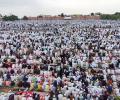
'We are not all Abduls, you know. Our community has any number of retired civil and defence officers, doctors, engineers, lawyers.'
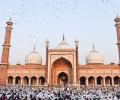
'Only because of the absence of a dedication record in writing, how can such properties be treated as located on misappropriated government land?'

A massive controversy is raging in Jammu and Kashmir after a plaque with the Ashoka emblem was vandalised in the Hazratbal shrine as parties on Saturday accused Waqf Board chief Darakshan Andrabi of hurting religious sentiments by using the national emblem in the mosque and demanded registration of a criminal case and her immediate removal.
Police have detained over 50 people for questioning after a plaque with the Ashoka emblem was vandalized at the Hazratbal shrine in Srinagar. The incident has sparked controversy, with political parties and religious figures expressing outrage.

The inauguration plaque placed inside the shrine has the national emblem etched in the stone, drawing sharp criticism from various quarters.
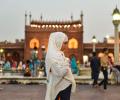
Prominent Muslim organisation Jamiat Ulema-e-Hind on Tuesday backed the Andhra Pradesh waqf board's stance describing the Ahmaddiya community as non-Muslims, claiming that this is the "unanimous position" of all Muslims.

The Supreme Court has upheld the deletion of the 'waqf by user' provision in the amended waqf law, stating it is not arbitrary and addresses potential misuse.

The Supreme Court has put on hold several key provisions of the Waqf (Amendment) Act, 2025, including the clause that only those practicing Islam for the last five years can dedicate a property as Waqf. The court also addressed the powers of collectors and non-Muslim participation in Waqf Boards.
The Supreme Court is scheduled to pronounce interim orders on key issues related to the Waqf (Amendment) Act, 2025, including the power to denotify waqf properties.
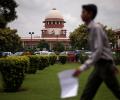
The Supreme Court is scheduled to pronounce interim orders on key issues related to the Waqf (Amendment) Act, 2025, including the power to denotify properties declared as waqf.

Puzzled about the Waqf Bill? Syed Firdaus Ashraf explains how the amended Waqf law will plug loopholes in the existing legislation.

A section of residents of Sanjauli and Hindu outfits had launched an agitation to press for the demolition of the mosque, claiming that it was unauthorised but no action was taken by the Corporation during the past 15 years.
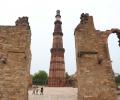
The Archaeological Survey of India informed the JPC that 280 protected monuments have been listed as Waqf properties.
Five individuals have been arrested in Ahmedabad, India, for allegedly impersonating trustees and collecting rent for 17 years from properties belonging to two Waqf Board-registered trusts. The accused, who are not actual trustees, constructed around 100 houses and shops on the trust land and collected rent from them, misusing the properties for personal benefits. An FIR has been registered against them for cheating and forging documents.
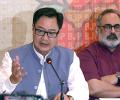
The Web portal of the Organiser, the RSS mouthpiece, published an article (withdrawn later) that the Christian community holds many acres of land, far more than Waqf property.'

The Supreme Court expressed its disapproval of an analogy used by the Centre in support of the inclusion of non-Muslims in Waqf boards, stating that such logic would disqualify a bench of Hindu judges from hearing matters related to Waqf. The CJI questioned the Centre's stance on the provisions of the Waqf (Amendment) Act, 2025, which allows non-Muslim members in the Central Waqf Council and state waqf boards. The Solicitor General defended the provisions, emphasizing that the non-Muslim inclusion is limited and does not impact the Muslim composition of these bodies. However, the CJI asserted that judges shed their religious affiliations while serving on the bench and maintained their secularity in their judicial capacity.
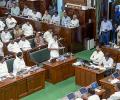
The Tamil Nadu Assembly passed a resolution on Thursday condemning the Centre's proposed Waqf Amendment Bill 2024, calling for its recall. Chief Minister M K Stalin argued that the amendment interferes with religious affairs and would negatively impact the Muslim minority. The resolution was unanimously passed by the Assembly, with support from all parties, including the opposition AIADMK and PMK. The BJP, however, walked out in protest, accusing the ruling DMK of engaging in divisive politics. The bill aims to streamline the Waqf Board's work and ensure efficient management of Waqf properties but has been criticized for potentially encroaching on religious freedom and autonomy. The Tamil Nadu government claims that the amendment would lead to government control over the Waqf Board and its properties, impacting its autonomy and potentially allowing for government acquisition of Muslim-owned lands.

Underscoring the 'presumption of constitutionality in favour of law', the Supreme Court on Tuesday said petitioners challenging the waqf law needed a 'strong and glaring' case for interim relief.
Under attack, Sibal claimed he did not represent the Sunni Waqf Board in the Ayodhya case in the SC.

The Centre on Wednesday told the Supreme Court that nobody can claim right over government land and it is legally empowered to reclaim properties which are declared waqf by using the waqf by user principle.
'There's no transparency in work (of the Wakf Board), in property transactions (of the Waqf).'
'Muslims need to work according to strategy and not fall into the trap of Opposition parties.'

They stated that when a soldier fights for the nation, he does so not as a Hindu, Muslim, or any other religion, but as a patriot.

The joint committee of Parliament examining the Waqf (Amendment) Bill submitted its report to Lok Sabha Speaker Om Birla on Thursday. The panel adopted the report by a majority vote, with changes suggested by members of the ruling BJP. Opposition members, who submitted dissent notes, called the exercise an attempt to destroy Waqf boards and termed the bill an attack on the constitutional rights of the Muslim community.

The Indian government has claimed a significant increase in waqf land following the 2013 amendment to the Waqf Act, asserting that the addition of 20 lakh acres raises concerns about potential "misuse" of the provisions. In an affidavit to the Supreme Court, the Centre highlighted a 116% rise in auqaf area after the amendment and urged the dismissal of petitions challenging the Act's validity.

The Places of Worship (Special Provisions) Act, 1991 provides for maintaining the 'religious character' of holy structures as it existed on August 15, 1947.
Would have constructed Ram temple on 5 acre land if given to us: UP Shia Central Waqf Board

'So, they have taken away the word Waqf from the Bill.' 'It will now be known as the UMEED Act.'

Hours after the Waqf (Amendment) Bill was passed in Parliament, 50 individuals embroiled in land disputes in Kerala's Munambam joined the BJP, hoping for a resolution to their claims. The residents, who have been protesting for 174 days, allege that the Waqf Board is claiming ownership of their properties. BJP leader Rajeev Chandrasekhar assured them of the party's support and a meeting with Prime Minister Narendra Modi to express gratitude. The BJP capitalized on the Catholic Church's support for the legislation, accusing the Congress and the Left of appeasement politics. The opposition, however, questioned the impact of the bill on the Munambam issue.
 © 2026 Rediff.com - Investor Information - Advertise with us - Disclaimer - Privacy Policy - Sitemap - Feedback - About us - Terms of use - Grievances