Silver and gold prices snapped a two-day rebound and declined sharply up to 10 per cent in the futures trade on Thursday amid weak trends in the international markets and a strong US dollar.

Russia's First Deputy Prime Minister Denis Manturov met with Indian leaders to discuss strengthening bilateral ties in key sectors amidst the escalating conflict in West Asia.

World leaders often have simple tastes when it comes to food.

The RusBeam 2800 is now India's largest electron-beam wire deposition 3D printer operating under vacuum. The machine was custom-built for India and is operated with software developed by Rosatom.

"Presented a copy of the Gita in Russian to President Putin. The teachings of the Gita give inspiration to millions across the world," PM Modi said in a post on X.

President Vladimir Putin attended an early Wednesday Russian Orthodox Christmas service and hailed his troops' 'holy mission' to defend Russia, pairing the ceremony with a holiday address on unity, charity and support for the armed forces.

A Russian intelligence agency has claimed that the UK and France are covertly planning to transfer nuclear weapons to Ukraine, alleging a violation of international law.

President Vladimir Putin announced that Russia has successfully tested the Poseidon, a nuclear-powered submersible drone with unlimited range, along with updates on the Sarmat missile and Burevestnik cruise missile.

Russia has shared intelligence with Iran that could help Tehran target American warships, aircraft and other military assets in the region, according to United States intelligence assessments cited by media reports, marking the first indication of Moscow's possible involvement in the ongoing conflict. Officials familiar with US intelligence findings said a significant portion of the shared information reportedly includes imagery from Russia's network of surveillance satellites.
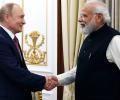
Russian President Vladimir Putin will visit India in December for an annual summit with Indian Prime Minister Narendra Modi, the Kremlin said.
Sharif waited for over 40 minutes, visibly impatient, before joining the meeting and staying for just 10 minutes.

India and Russia are expected to sign a bilateral mobility agreement during President Vladimir Putin's visit to New Delhi, establishing a framework for legal migration, worker protection, and expansion of skilled Indian manpower in Russia.
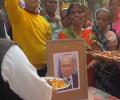
A group in Varanasi organized an 'India-Russia Friendship March' to welcome Russian President Vladimir Putin ahead of his visit to India for the annual summit with Prime Minister Narendra Modi. The march highlighted the strong ties between the two nations and expressed hope for strengthened cooperation and global peace.
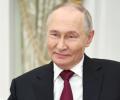
Putin argued that European countries are putting forward demands related to the conflict that Russia cannot accept. He further accused Europe of obstructing initiatives by the United States and President Donald Trump to pursue a negotiated settlement.

United States President Donald John Trump and Ukrainian President Volodymyr Zelenskyy met for lunch at Trump's Mar-a-Lago club in Palm Beach, Florida, on Sunday. This was their first one-on-one meeting after their disastrous encounter at the White House in March.
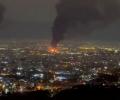
To be sure, Trump is furious, as the trajectory of the war is in a state of Zugzwang, as chess players call it. Trump and Netanyahu stare at two choices -- retreat in humiliation and concede Tehran's demands -- recognition of its rights, reparations, and binding security guarantees -- or perish in a quagmire, points out Ambassador M K Bhadrakumar.

India and Russia are expected to unveil a major nuclear energy partnership during Vladimir Putin's visit, potentially involving Russian small modular reactors and expanded cooperation as India pushes toward its 100-GW nuclear goal by 2047.

Russian President Vladimir Putin, who is known for his penchant for adventurous stunts, dived to the bottom of the Baltic Sea aboard a submersible to explore the wreck of a ship that sank in 1869, for his latest adventurous stunt.

The Congress on Friday said that the leaders of the opposition, Mallikarjun Kharge and Rahul Gandhi, were not invited to the banquet, and took a swipe at Tharoor for accepting the invite.
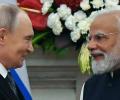
United States representative Sydney Kamlager-Dove while talking about the famous car selfie of Prime Minister Narendra Modi with Russian President Vladimir Putin said that it spoke a thousand words.

China has reacted positively to Russian President Vladimir Putin's visit to India, emphasizing the importance of trilateral ties between China, Russia, and India for regional and global peace and stability.
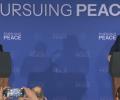
During a bilateral lunch with the Ukrainian President in the White House, Trump reiterated his confidence in facilitating an end to the ongoing war.

United States President Donald Trump has said Prime Minister Narendra Modi 'knew he was not happy' with India's purchases of Russian oil and that Washington, DC can raise tariffs on New Delhi 'very quickly'.

India and Russia have agreed to encourage joint manufacturing of military hardware and spare parts in India, aiming to improve maintenance of Russian-origin defence equipment and boost overall bilateral defence cooperation.

Check out these images from the Shanghai Cooperation Organisation summit in Tianjin, China, on Monday morning featuring Prime Minister Narendra Modi, Chinese President Xi Jinping and Russian President Vladimir Putin, taking bon homie to a new level.

In the context of India's energy ties with Russia, Putin said certain "actors" dislike New Delhi's growing role in international markets in view of its close relations with Moscow and these elements are aiming to constrain India's influence for political reasons by imposing "artificial obstacles".
India and Russia are poised to sign multiple agreements to bolster cooperation in various sectors, including trade and healthcare, during Russian President Vladimir Putin's visit to New Delhi. Discussions will also address the Ukraine conflict and efforts to increase Indian exports to Russia.
Russian President Vladimir Putin will make a two-day visit to India from December 4 to hold annual summit talks with Prime Minister Narendra Modi that is expected to produce a plethora of significant outcomes, including in the defence sphere, to further solidify the bilateral strategic ties.

The US-Israeli military campaign, dubbed "Operation Epic Fury" by Washington, has entered its third day, with US President Donald Trump stating that operations would continue "until all of our objectives are achieved."

Lavrov's comments came two days after Russia accused the US of attempting to prevent India and other countries from buying Russian oil, saying Washington was using a wide range of 'coercive' measures, including tariffs, sanctions and direct prohibitions.
India has refuted claims made by NATO Secretary-General Mark Rutte that Prime Minister Narendra Modi contacted Russian President Vladimir Putin to discuss Russia's strategy on Ukraine in light of US tariffs on India.

Putin's surprise appearance on a music channel to hand out awards came as a shock even to the journalists his minders handpicked to follow him around not to mention the audience of baseball cap-wearing adolescents
Russian President Vladimir Putin, in his address to the Federal Assembly (Russia's bicameral parliament) on Sunday, stated that Moscow had developed a small-sized nuclear power unit that could be used in a cruise missile to extend its range practically indefinitely.

This comes despite Russia on Monday stating that Lavrov and Rubio held a "constructive" conversation as part of preparations for the meeting between their two presidents in Budapest, Hungary, Russian media has reported.
Prime Minister Narendra Modi strongly supported efforts to end the war in Ukraine and conveyed to Russian President Vladimir Putin that India will stand shoulder-to-shoulder in all peace efforts to find an amicable solution to the conflict.
Russian President Vladimir Putin on Thursday described the latest United States sanctions as an 'unfriendly move' that would not help relations between Moscow and Washington, DC.

Deputy Chairman of Russia's National Security Council Dmitry Medvedev claims military victory in Ukraine is visible and emphasizes the need to plan for the aftermath. He also comments on Donald Trump's desire to be seen as a peacemaker.

Trump stated that Russia will face "severe economic consequences" if Putin doesn't show interest in de-escalating the Ukraine conflict.

Days after Russia alleged that Ukraine targeted President Vladimir Putin's official residence in a drone attack, Russian authorities on Thursday said they had shared what they described as evidence related to the incident with the United States, Anadolu Agency reported.
The Russian president is no stranger to bizarre photocalls as he is previously been photographed going horse-riding with his shirt off, sedating Siberian tigers and polar bears, and guiding cranes to new migration routes in a microlight.
