
Sri Lanka President Mahinda Rajapaksa has debunked international criticism over the treatment of the island nation's Tamil minority population.
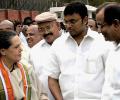
In the 2009 election, P Chindambaram the Sivaganga seat by a narrow margin. Then the Congress was in alliance with the ruling DMK. This time his son Karti is battling the seat with the alliance. India abstention at the UNHRC on an anti-Lanka resolution will further fuel Tamil anger against the Congress party. This leaves the finance minster sulking and his son facing an uphill political debut, says N Sathiya Moorthy.

Janjua will replace incumbent foreign secretary Aizaz Ahmad Chaudhry, who will be taking charge as Pakistan's new ambassador to the US, Foreign Office said on Monday night.

If Sri Lanka continues to follow the path of evasion and tries to impose a dictated solution on the Tamils, India has to act tough, says B Raman

The UNHRC agreed to defer the report on Sri Lanka's alleged human rights violations.
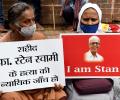
The Bombay high court, while hearing posthumously the appeals filed by late Jesuit priest Stan Swamy in the Elgar Parishad-Maoist links case, on Monday said he was a wonderful person and the court had 'great respect' for his work.
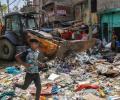
The Modi leadership could lose Election 2024 if a communal flare-up becomes cause for all-round catastrophe, warns N Sathiya Moorthy.
Extrajudicial executions, often disguised as encounters with armed criminals, have become the norm and are widely reported in Indian media. Torture and arbitrary detentions continue, not just in insurgency-affected areas, but also in most police stations in the country. Yet, India continues to provide effective immunity from prosecution to its security forces and other public officials, HRW laments.
She said the Citizenship Amendment Act (CAA) adopted last year by India's Parliament was of 'great concern'.

Elated after India's abstention at the UN Human Rights Council vote on Sri Lanka, President Mahinda Rajapaksa on Friday ordered the release of all Indian fishermen in Sri Lankan custody for poaching.

It is the first time that India has voted on a resolution at the UN that is being perceived as pro-Israel.
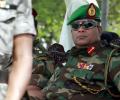
Silva's name was mentioned in the resolution passed by the UN Human Rights Council (UNHRC) in 2013, alleging rights abuses by the Sri Lankan Army.

'For the Tamil Nadu protestors to openly ask popular film actor Vijay Sethupathi not to don Murali in 800 is a travesty in every sense. It may have given them a cause to tell the world, and the governments in New Delhi, Colombo and Chennai, that the Sri Lankan ethnic issue was still alive in the state -- more so, during the current run-up to two major events in the first half of 2021,' says N Sathiya Moorthy.

Xi Jinping is winning the war without firing a shot in Sri Lanka, observes Colonel R Hariharan (retd).

A double-quick analysis of the Lankan election results would show that the relatively narrow victory margin of challenger Maithripala Sirisena was made up by the three minority communities of Tamils, Muslims and Christians, says N Sathiya Moorthy.

UN intervention has been sought to address the grievances of the people of Gilgit-Baltistan in Pakistan-occupied Kashmir.

Interestingly, in his entire remarks, Modi never once mentioned regional security, Ambassador M K Bhadrakumar points out.
'None of these three countries -- Turkey, Iran or Malaysia -- ever made a hostile move against India to support the Pakistan-based terrorist elements,' notes Ambassador M K Bhadrakumar.

Though dubbed as the 'war hero', the role of Rajapaksa in ending the conflict with the LTTE with the death of its supremo Velupillai Prabhakaran in 2009 is quite divisive as he stands accused of violating human rights, a charge he vehemently denies.

'The sooner Pakistan and India face these geopolitical realities, the better it will be for their own security and prosperity,' observes Ambassador M K Bhadrakumar.

Abstaining from voting on a UNHRC resolution on Sri Lanka was dictated as much by necessity and self-preservation as by a desire to place bilateralism at the front and centre of New Delhi's ties with Colombo, says Ramesh Ramachandran.

A country required two-thirds majority of 124 to win a seat in the elections.
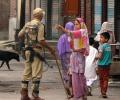
Pakistan has criticised India over alleged human rights violation in Kashmir and threatened to expose the country in the world over the "abysmal rights situation" in other parts if it continued to talk about Balochistan.

AG Mukul Rohatgi led the Indian delegation at the UN Human Rights Council.
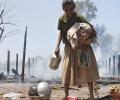
Hindu American Foundation: 'As an organisation that works on issues affecting Hindu minorities... in the civil war although all groups were affected, Hindu temples and Hindu institutions were disproportionately affected, and Hindus continue to be affected.' Sri Lanka's Ambassador to the United States Prasad Kariyawasam: 'Assume that Sri Lanka is referred to the ICC through the UN Security Council -- which will never happen because Sri Lanka has enough clout to block it. But assume it is. Still, the ICC cannot handle it because retrospectively they don't have jurisdiction.'
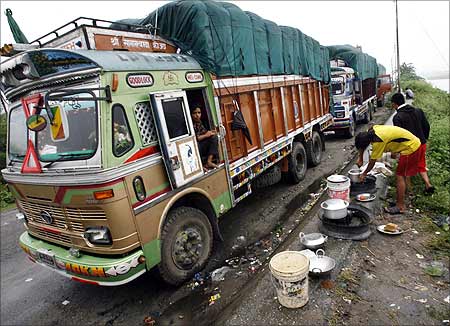
Nepal's Cabinet on Monday passed a special resolution asking India to open the border entry points to ease supplies of essential goods like medicines, gas and petroleum to the landlocked country, reeling under acute shortage due to blockade of key trade points.
In a goodwill gesture, Pakistan freed 59 Indian fishermen of the eve of Prime Minister Nawaz Sharif's visit to India to attend the swearing-in ceremony of Prime Minister-designate Narendra Modi.

In his latest response to his Pakistani counterpart Aizaz Ahmad Chaudhry's fresh invitation of August 19 for talks, Foreign Secretary S Jaishankar once again emphasised on the need for earliest possible vacation of Islamabad's illegal occupation of PoK and conveyed that not just India but the larger region is aware that Pakistan is actually a "prime perpetrator" of terrorism.
This is for the first time the UNHRC has issued a report on the alleged human rights violations in Kashmir and PoK.
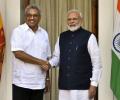
New Delhi is approaching Gota with an open mind, observes N Sathiya Moorthy.

Even as the polity find ways and means to address the genuine concerns and fears of the society, the Sri Lankan State apparatus would have to unravel these mystery-questions with convincing answers, and a road-map to the future, says N Sathiya Moorthy.

In a significant victory, India has been re-elected to the UN's main human rights body for the period of 2015-17, receiving the highest number of votes in the Asia-Pacific group.
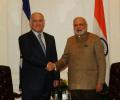
Modi's visit is aimed at commemorating 25 years of establishment of diplomatic ties between the two countries.

The answer seems to be 'yes' since party veterans themselves are questioning the move in the backdrop of the April 24 Lok Sabha polls, even as their hopes of a possible tie-up with Dravida Munnetra Kazhagam seem to have dashed with its chief M Karunanidhi virtually shutting the door despite extending an olive branch.

In the circumstances, an independent probe alone would establish the truth, starting from Koodangulam. It is more so in the case of Marina violence, which may even at this late hour hold a candle to the events and developments in Thoothukudi, says N Sathiya Moorthy.

In a significant development, India for the first time on Thursday abstained from voting on the United States-sponsored resolution against Sri Lanka on alleged human rights violation which was passed by 23 votes in favour as against 12 in opposition and 12 abstentions in the United Nation's Human Rights Council in Geneva.

Unlike in the presidential polls, victory might not have been complete, at least as yet, for Mahinda Rajapaksa's electoral rivals. While his one-time aide and confidant, Maithripala Sirisena, became president without any issues after defeating him, incumbent Prime Minister Ranil Wickremesinghe, who again may not command an absolute majority in the 225-member parliament, would have to count on his 'national government' concept to carry the day and the nation with him, this time round, says N Sathiya Moorthy.
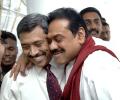
Gotabaya Rajapaksa
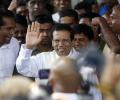
'Our policy is pro-Sri Lanka.' 'Burma is not the only girl on the beach in South Asia.''

One shocking finding of the investigation was the extent to which sexual violence was committed against detainees, often extremely brutally, by the Sri Lankan security forces, with men as likely to be victims as women.
