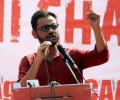
Former JNU student Umar Khalid on Wednesday withdrew his bail plea from the Supreme Court in a case lodged under anti-terror law UAPA over his alleged involvement in the conspiracy behind the northeast Delhi riots of February 2020.

Khalid was booked under the Unlawful Activities (Prevention) Act (UAPA) and provisions of the Indian Penal Code for allegedly being a mastermind of the February 2020 riots, which had left 53 people dead and more than 700 injured.
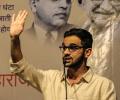
He was arrested by the special cell of the Delhi police after 11 hours of interrogation. He will be produced before a Delhi court on Monday, they said.

Khalid was booked under the UAPA and provisions of the Indian Penal Code for allegedly being a mastermind of the February 2020 riots, which had left 53 people dead and over 700 injured.
The court framed charges against Aam Aadmi Party leader Tahir Hussain and 10 others in the case.

The counsel pointed to two contradictions in Delhi Police's claims. Firstly, he showed the court a 21-minute video clip of Khalid's speech in Maharashtra, which the prosecution had allegedly labelled inflammatory.
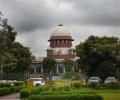
The Supreme Court of India has ruled that an 'act of terror' under the Unlawful Activities (Prevention) Act (UAPA) includes planning, coordination, and mobilization, not just the final execution of the act. The court emphasized that the intent and effect of the act are crucial, not solely the instrumentality used.
Khalid's petition challenging the October 18 last year order of the Delhi High Court, which had rejected his bail plea in the matter, came up for hearing before a bench of Justices A S Bopanna and Prashant Kumar Mishra.
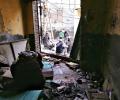
The Supreme Court has directed lawyers for the accused in the February 2020 Delhi riots to restrict their oral arguments to 15 minutes, emphasizing the need for a time schedule. The court also addressed bail pleas from activists like Sharjeel Imam and Umar Khalid, while the Delhi Police maintained the riots were a pre-planned attack.
While ordering Khalid's release on bail for a week on Monday to attend the marriage related functions of his sister, the court imposed several conditions.

Police in Mumbai have registered a case against students of the Tata Institute of Social Sciences for allegedly holding an unapproved event to mark the death anniversary of former DU professor G N Saibaba and raising slogans in support of Sharjeel Imam and Umar Khalid.
The Delhi high court on Tuesday refused to grant bail to former Jawaharlal Nehru University student Umar Khalid in a Unlawful Activities (Prevention) Act (UAPA) case related to alleged conspiracy behind the riots here in February 2020.
The judge dismissed the plea observing that it is devoid of merits and filed in a mechanical manner and without application of mind by the high echelons of the Delhi Police and prison authority.
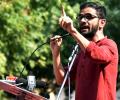
Advocacy against the law like the Citizenship Amendment Act (CAA) is not a crime, former JNU student leader Umar Khalid told a Delhi court on Monday, asserting that the police pressured the witnesses to give statements in the riots conspiracy case.
During the hearing, Umar Khalid's lawyer told the court that his client was willing to surrender at a time and location, but the Delhi Police objected to the place.
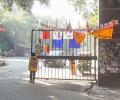
Jawaharlal Nehru University (JNU) has sought a first information report (FIR) after students allegedly raised 'provocative' slogans against Prime Minister Narendra Modi and Union home minister Amit Shah inside the university campus during an event on Monday night, varsity officials said.
The court's directions came on an application filed by the accused seeking adequate security in prison so that he was not harmed by anyone in judicial custody.
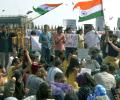
The Colaba Police have registered an offence against more than 350 persons for the 34-hour-long protest at the Gateway of India.
Khalid's RT-PCR test report came on Saturday as positive, the official said, adding he has been isolated within the jail premises.
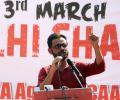
The Delhi police prosecutor on Friday compared the alleged planning of the February 2020 riots with that of the 9/11 terror attacks in the US while opposing former Jawaharlal Nehru University student Umar Khalid's bail plea.
In the FIR, the police has claimed that the communal violence was a "premeditated conspiracy" which was allegedly hatched by Khalid and two others.
'Umar is being targeted because he is emerging as educated, knowledgeable leader of the Muslim community and, unlike popular perceptions that many harbour about Muslims, took to peaceful means to protest against the NRC and CAA.' 'They (the State) are scared of educated Muslim leadership.'
The Wire news portal, in the third part of its revelations from the international collaborative journalistic investigation called the Pegasus Project, reported that those marked as potential targets for surveillance include Ambedkarite activist Ashok Bharti; academic and chronicler of life in Naxal-dominated regions Bela Bhatia; railway union leader Shiv Gopal Mishra and Delhi-based labour rights activist Anjani Kumar.

JNU student Umar Khalid and other students, against whom a lookout notice had been issued by the Delhi Police, moved the Delhi HC seeking ample security before they surrender.
A Delhi court on Thursday denied bail to former JNU student Umar Khalid in a case of larger conspiracy in connection with Delhi riots during February 2020.
The high court's observation came while hearing the bail plea of Khalid who has challenged a trial court's March 24 order dismissing his bail application in the case.

'This process is the punishment.' 'Once the trial starts, they know this fairy tale case will fall on its face. So they don't want to begin the trial.'
'It is very easy to invoke Bhagat Singh but difficult to emulate him... There was a gentleman who was eventually hanged .... He stayed there..., he did not run away. You are saying you weren't even there'
Umar Khalid was forced to discontinue the hunger strike owing to acutely failing health. He had severe cramps in the evening because of low sodium-potassium level in his blood following which he was taken to AIIMS post midnight for saline drips.
Delhi Police strongly opposes bail pleas of activists Umar Khalid, Sharjeel Imam, and others in the February 2020 riots case, claiming it was a pre-planned attack on the nation's sovereignty and an attempt to divide society on communal lines.

The anti-Citizenship (Amendment) Act protest was secular but the charge sheet in the Delhi riots conspiracy case was communal and the police fabricated a story to suit its narrative, former Jawaharlal Nehru University student leader Umar Khalid told a court in New Delhi on Tuesday calling it a 'naked form of false implication.'

The JNU student leader said, "There is an atmosphere of fear in the country and anybody who speaks against the government is threatened."
A bench of Justices Siddharth Mridul and Rajnish Bhatnagar was hearing Khalid's plea challenging a trial court's order which had on March 24 dismissed his bail application in the case.

"The very fact that Pandit Jawaharlal Nehru believed that democracy has made revolution superfluous after independence and how it meant the complete opposite of a bloodless change," it said.
The police can now name them in their supplementary charge sheet, an official said. In a late evening statement, the government said that this is a purely procedural matter, adding that the elected government has no role to play in this.

Activist Sharjeel Imam has moved the Supreme Court challenging a Delhi High Court order denying him bail in a case linked to the 2020 Delhi riots. The High Court had denied bail to several individuals, emphasizing that conspiratorial violence under the guise of protests cannot be allowed.
In the FIR, police has claimed that the communal violence was a "premeditated conspiracy" which was allegedly hatched by Khalid and two others.
Additional Sessions Judge Reetesh Singh allowed Khalid to travel to the city from May 20 to 23 to attend panel discussion organised by Bastar Solidarity Network (Kolkata Chapter).

In May, 40 Rohingyas were blindfolded and flown to the Andaman and Nicobar islands and then thrown into the sea and made to swim to an island in Myanmar. And after the Pahalgam attack, at least 300 Muslims were 'pushed back' to Bangladesh from Assam.
Syed Qasim Rasool Ilyas, father of Umar Khalid, a PhD scholar at Jawaharlal Nehru University, has claimed that he received a "death threat call from underworld don Ravi Pujari".
