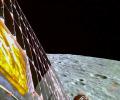
Chandrayaan-1, India's first mission to the Moon, was launched on October 22, 2008 from Sriharikota spaceport in Andhra Pradesh.

The space strategist said that this shows that one should not take anything for granted in space exploration.

Luna-25 took off from the Vostochny launch facility in Russia's Far East, Russia-based TASS news agency reported.
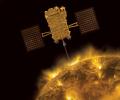
Data collected around L1 would provide insights into the origin, acceleration, and anisotropy of solar wind and space weather phenomena, it said.

'Today onwards, the onboard thrusters will be fired and Chandryaan-3 will be taken away from Earth for an eventful landing on Moon's surface on August 23'

Indian Space Research Organisation (ISRO) will conduct three more test vehicle missions under the ambitious Gaganyaan programme after the maiden TV-D1 test flight, which is scheduled on October 21, the space agency's chairman S Somanath has said.

Aditya L1, the first space based Indian mission to study the Sun underwent the second earth-bound manoeuvre successfully, during the early hours on Tuesday, Indian Space Research Organisation (ISRO) said.

Indian Space Research Organisation has successfully realigned the orbit of its Mars Orbiter Mission 'Mangalyaan' so it is not affected by long-duration eclipse, ISRO Chairman A S Kiran Kumar said.

India created history on Wednesday when the lander module of Chandrayaan-3 touched down on the lunar south pole, propelling the country to an exclusive club of four and making it the first country to land on the uncharted surface.
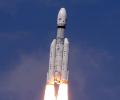
'ISRO takes a very cautious approach.' 'After reaching the moon, the orbit has to be brought down from a single elliptical orbit to a circular orbit while simultaneously ensuring the stability of Chandrayaan 3 and the health parameters of the lander and rover.'

Aditya -- the name in Sanskrit refers to the Sun -- is a coronagraphy spacecraft manufactured at the U R Rao Satellite Centre in Bengaluru to study the solar atmosphere.

'We started AgniKul to show that space transportation should be as simple as road transportation.'

India has planned an unmanned scientific mission to moon called Chandayan-I.

The successful launch of the maiden solar mission of the Indian Space Research Organisation came on the heels of the historic lunar landing mission - Chandrayaan-3.
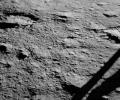
The lessons learned from the failure of Chandrayaan-2 contributed to the success of India's third lunar mission, former space scientist with the Indian Space Research Organisation (ISRO) Nambi Narayanan said, after the successful touchdown of the 'Vikram' lander on the lunar South Pole.
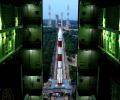
Aditya-L1 is a fully indigenous effort with the participation of national institutions., an ISRO official said.

Weighing 320 tonne at lift-off, the vehicle used larger strap-on motors to achieve higher payload capability.
ISRO's maiden solar mission, Aditya L1, has captured its first high energy X-ray glimpse of solar flares. During its first observation period from approximately October 29, the High Energy L1 Orbiting X-ray Spectrometer (HEL1OS) on board Aditya-L1 spacecraft has recorded the impulsive phase of solar flares, the space agency said in a statement on Tuesday.

From The New York Times to BBC and The Guardian to The Washington Post, the historic event in India's space programme on Wednesday made headlines across the globe.

The spacecraft will now prepare for separation of the lander module -- comprising the lander and rover -- from the propulsion module.

The Lagrange point 1 (L1) of the Sun-Earth system is about 1.5 million km from the Earth. It is about one per cent of the total distance between the Earth and the Sun.

ISRO chairman S Somanath said the success gave the space agency "greater confidence," as the GSLV will be next deployed in the NISAR mission, a collaborative effort with the US' NASA.

India will become the fourth country to master the technology of soft-landing on the lunar surface after the US, China and the erstwhile Soviet Union.

Thotakura was selected as one of the six crew members for the NS-25 mission, making him the first Indian space tourist and the second Indian to venture into space after the Indian Army's Wing Commander Rakesh Sharma in 1984.
As scientists at the Indian Space Research Organisation (ISRO) gear up for the much-awaited soft landing of the Chandrayaan-3 spacecraft on the Moon's surface, the space agency may postpone the touchdown to August 27 in the event that health parameters of the lander module are found to be "abnormal", a senior official has said.

Announcing that the health of Chandrayaan-3's Lander Module is normal, ISRO on Friday said that the module has successfully undergone a deboosting (slowing down) operation, taking it closer to the Moon.

The Orion capsule returns to earth after a 26 day mission orbiting the Moon and back.

Luna-25 may land on the lunar surface earlier than Chandrayaan-3.

Astronauts aboard the space station have found themselves facing a foe far tinier than any rogue asteroid: A joint study by IIT-Madras and NASA's Jet Propulsion Laboratory -- under Principal Investigator Kasthuri Venkateswaran -- has revealed that strains of the bacterial species Enterobacter bugandensis, a multi-drug resistant superbug, have been hitting the gym in the microgravity crucible. Though the situation at the ISS is slightly unsettling, holding funeral dirges would be an overkill, says Kumar Abishek.

Here is the timeline of the moon mission as undertaken by the Indian Space Research Organisation.

The entire process being autonomous when the lander has to fire its engines at the right times and altitudes, use the right amount of fuel, and scan of the lunar surface for any obstacles or hills or craters before finally touching down.

The images show VELC (Visible Emission Line Coronagraph) and SUIT (Solar Ultraviolet Imager) instruments as seen by the camera on-board Aditya-L1 on September 4, 2023.
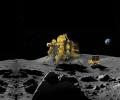
This eagerly anticipated event will be broadcast live on August 23, starting from 17:27 Hrs IST on multiple platforms, including the ISRO Website, its YouTube channel, ISRO's Facebook page, and DD National TV channel.

The Indian Space Research Organisation (ISRO) on Thursday announced that its lunar mission Chandrayaan-3 will be launched on July 14 from the space port at Sriharikota in Andhra Pradesh.
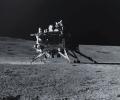
The cryogenic upper stage of the LVM3 M4 launch vehicle, which successfully injected the Chandrayaan-3 spacecraft into the intended orbit on July 14 this year, made an uncontrolled re-entry into the Earth's atmosphere, the ISRO said.

The asteroid sample will help scientists understand the origin of organics and water that may have seeded life on Earth 4.5 billion years ago.

Shifting the focus to its next space odyssey after successfully placing a lander on the moon's uncharted South Pole region, the Indian Space Research Organisation (ISRO) chief S Somanath on Saturday said that the country's maiden solar mission Aditya-L1 is ready and will be launched in the first week of September.
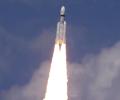
For the Gaganyaan programme, LVM3 rocket is re-configured to meet the human rating requirements and has been christened as 'Human Rated LVM3', ISRO said and it would be capable of launching the Orbital Module to an Low Earth Orbit of 400kms.
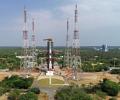
The Aditya-L1 mission carries seven scientific payloads to carry out the study.

The entire mission operations of Chandrayaan-3, right from the launch till landing, "happened flawlessly" as per the timeline, the team that led India's third mission to the Moon said on Wednesday.
