'It is something that he always wanted to do and he has achieved phenomenal success in doing it.'
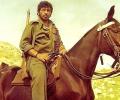
'The second Sunday after Sholay's release, Amjad and Shehla had taken Shadaab to Juhu beach. They were strolling leisurely when, to Shehla's shock, he suddenly picked up their son, grabbed her hand and pulled her along, urging her to run. They raced towards their car and had just managed to get in and lock the doors when all hell broke loose. Hundreds started banging on the car, shouting, 'Gabbar Singh bahar niklo!''

Sukanya Verma quizzes you to find out just how much you know about the movies.

Shatranj Ke Khilari was Satyajit Ray's first Hindi film. The Master set the Premchand story against the backdrop of the First War of Independence in 1857. Bijoya Ray, his wife, reveals fascinating glimpses behind the making of the epic in this exclusive excerpt from her memoir.
'When you are a pioneer and someone who's put on a pedestal, but then the pedestal gets dusty, people don't look at the statue anymore.' 'They would say, 'Yes, yes, of course I know Bimal Roy. He made Do Bigha Zamin.'.'
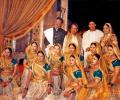
During the lunch or tea breaks, Maharajji, Manikda, Amjad Khan and I often sat together as Maharajji sang old compositions or recited some bols. Amjad Khan had a great music sense and sang very well.

Why history doesn't always make for box-office success.
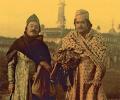
From Pakeezah to Ladies vs Ricky Bahl, from Shatranj ki Khilari to Umrao Jaan, the great city of Lucknow has made its way to the wornderful world of Hindi films.
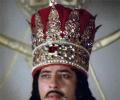
Shatranj Ke Khilari was Satyajit Ray's first Hindi film. The Master set the Premchand story against the backdrop of the First War of Independence in 1857. Bijoya Ray, his wife, reveals fascinating glimpses behind the making of the epic in this exclusive excerpt from her memoir.

'Jaffrey played all his roles with a characteristic elan and amiability: He looked like a clever, all-knowing, winking Super Mario, gloriously grey around the edges. Irresistible, really.'

Shatranj Ke Khilari remains an accessible, yet deep period film.

Bollywood mourns Saeed Jaffrey.

Shatranj Ke Khilari was Satyajit Ray's first Hindi film. The Master set the Premchand story against the backdrop of the First War of Independence in 1857. Bijoya Ray, his wife, reveals fascinating glimpses behind the making of the epic in this exclusive excerpt from her memoir.

Saeed Jaffrey lives on through his versatile body of work.

At best, a serviceable buffoon with a flair for repartee, Kapil Sharma is awfully limited in his humour and screen presence to perk up this half-decent premise, feels Sukanya Verma.

Had he not taken his final curtain call on April 23, 1992, Satyajit Ray would still, undoubtedly, have been making movies.

If you haven't watched The Rising yet, you've been lucky.

'Once Attenborough had locked the shot, Jaffrey turned to Amitabh and told him in a very controlled but stern voice that he should never talk to an actor in between takes.'

'Suddenly, a deafening silence surrounds us. Broken occasionally by the sighs of those who admired this consummate actor, this splendid human being, and trying to grapple with the impermanence of mortal life.' Rinki Roy Bhattacharya, legendary filmmaker Bimal Roy's eldest daughter, celebrates Farouque Shaikh's life.

Saluting Tom Alter, who passed into the ages on September 29.

'Sent off to interview him in the late 1970s I met him in a cafe in New Delhi's Regal Building called The Parlour. With impromptu send-ups of Laurence Olivier, Sybil Thorndike and the rich, gravelly tones of a well-known All India Radio Hindi newsreader called Devki Nandan Pandey, he soon had the whole restaurant listening in.'

A look at Shyam Benegal's period classic, Junoon.

'That night -- when Gandhi won Best Picture at the 1983 Oscars -- belonged to India and it meant a lot to a young student like me, who was trying to establish his Indian identity among the Americans around him.' Aseem Chhabra/Rediff.com, who worked as an extra on Richard Attenborough's acclaimed biopic, salutes the late legend.

'He represented the warmth, gentleness and goodness that existed in Hindi cinema before Bollywood became a loud commodity.' Aseem Chhabra on the legendary actor he admired for over 40 years.