
'The Indian private space sector is no longer a high-risk bet; it is a highly bankable, globally competitive asset class capable of easing the global small satellite launch bottleneck.'

The Department of Space has directed that requests for voluntary retirement or resignation from Group 'A' Scientific and Technical personnel associated with the prestigious Gaganyaan human spaceflight programme and other important missions should not be accepted as a matter of routine.

'With Vikram-1, we take our biggest step yet towards a reliable, high-cadence launch programme built in India, for India and the world.'

The appointment comes as Agnikul prepares for Mission 02, a flight that will attempt, for the first time on Indian soil, the recovery of an orbital-class rocket booster and the extension of a rocket's upper stage into an on-orbit platform.

India's move to privatise PSLV rocket production through IN-SPACe has triggered debate over national security, ageing technology and the agency's role.

Security has been beefed up at the Satish Dhawan Space Centre at Sriharikota in Andhra Pradesh in the wake of credible intelligence that the high-profile place is under the radar of Pakistan-based terror groups.

A high-level committee investigating the failures of ISRO's PSLV rockets, which have impacted strategic satellite missions, has yet to release its report and recommendations, raising concerns about the future of the ageing launch vehicle.

Astronaut Shubhanshu Shukla discusses the Gaganyaan mission and its potential to inspire other nations in space exploration, drawing on his experiences as an IAF test pilot and his time on the International Space Station.

Based on the broadcast visuals, a rocket expert said the failure appeared similar to the anomaly seen during the PSLV-C61 mission.
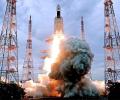
ISRO is developing a third launch pad at Shriharikota to accommodate heavier satellites and next-generation launch vehicles. The new facility will support both crewed and uncrewed missions.
A Spanish startup, Orbital Paradigm, claims its payload, KID, survived the failed PSLV-C62 mission and transmitted data, despite ISRO's silence on the matter. The mission, carrying 16 satellites, failed due to issues in the rocket's third stage.

While India's interplanetary ambitions remain significant, the current pace of financial and technical progress raises questions about whether the 2027-2028 timelines can be met.

The move follows a quiet visit by National Security Advisor Ajit Kumar Doval to the Vikram Sarabhai Space Centre in Thiruvananthapuram.

ISRO stated that the disengagement of at least one contact -- in both the main and redundant paths -- of a connector led to the failure of NVS-02.

From a surge in startups to crewed mission preparations, 2025 marks a transformative year as India eyes $44 billion space economy by 2033.

India is set to take its first steps towards its own human space flight when the uncrewed Gaganyaan mission soars to the skies later this year. Private players in the space sector are also gearing up for launching satellites on home-built rockets.
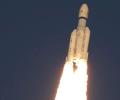
Indian Space Research Organisation scientists have carried out a new experiment on the indigenously developed C25 cryogenic stage of the LVM3-M5 rocket which successfully placed the Communication Satellite CMS-03 into the intended orbit on Sunday, said its Chairman V Narayanan.

ISRO is set to launch its communication satellite CMS-03 from Sriharikota. The satellite, weighing 4,410 kg, will be the heaviest launched from Indian soil into a Geosynchronous Transfer Orbit (GTO).
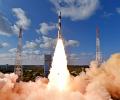
Andhra Pradesh will establish two expansive integrated space cities in Lepakshi and Tirupati, spanning around 33,000 acres.
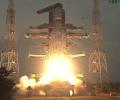
The heaviest communication satellite to be launched from the Indian soil onboard a new generation, homegrown 'Bahubali' rocket was successfully placed into the intended orbit on Sunday, the Indian Space Research Organisation said.
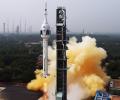
ISRO Chairman V Narayanan announces ambitious space program goals, including landing Indians on the Moon by 2040 and launching the 'Gaganyaan' mission in 2027. The agency is also working on a national space station and uncrewed missions.
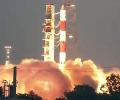
'There's too much coincidence in back-to-back failures of missions critical to national security.'
'You can observe a lot of things from space.' 'Another thing is communication, in real time, especially in war-like situations.' 'During Operation Sindoor, we could play our part well.'

The NASA-ISRO NISAR mission has entered its 90-day commissioning phase, involving rigorous checks and calibrations to prepare the satellite for Earth observation. Scientists highlight the collaborative benefits and technological advancements of the mission.

India and the US on Wednesday marked their maiden space collaboration with the successful flight of a GSLV rocket that placed an earth observation satellite, jointly developed by the two space agencies, in a precise orbit.
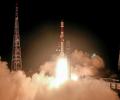
The two Space Docking Experiment (SpaDeX) satellites that the Indian Space Research Organisation is hoping to unite are at a distance of 1.5 km and will be brought much closer on January 11, the space agency said on Friday.
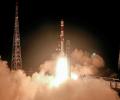
The Indian government has approved the construction of a third launch pad at Sriharikota, capable of sending heavier spacecraft into orbit. This new facility will support India's ambitious space program, including the Gaganyaan human spaceflight mission and a lunar landing. The launch pad will be built at the Satish Dhawan Space Centre and is expected to be operational within four years.

Here is the timeline of the moon mission as undertaken by the Indian Space Research Organisation.

The Indian Space Research Organisation (ISRO) on Sunday said the two satellites launched to perform space docking experiments were brought within three metres and then moved safely back in a trial attempt.
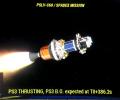
Dubbed as a prelude to ISRO setting up its own Space Station by 2035, the PSLV-C60 mission would also make India join an elite club in achieving this feat which is expected to take place in the coming days.

Indian Space Research Organisation's 101st mission from Sriharikota, an earth observation satellite onboard the agency's trusted Polar Satellite Launch Vehicle (PSLV) rocket, could not be accomplished on Sunday following a pressure issue in the third stage of the launch vehicle, the space agency said.
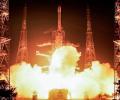
ISRO's vendor policy and quality control processes are under scanner.
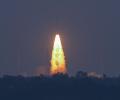
A PSLV rocket carrying Earth observation satellite EOS-09 failed to launch from the Sriharikota spaceport early on Sunday.
Chandrayaan-4 will involve at least two separate launches of the heavylift LVM-3 rocket that will carry five different components of the mission which will be assembled in orbit.
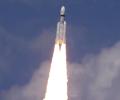
Currently, some of the rocket hardware for the human space programme has reached the Satish Dhawan Space Centre in Sriharikota and the integration of the crew module was going on at the Vikram Sarabhai Space Centre, Trivandrum, ISRO chairman S Somanath said.

Twice every 12 days, the NISAR satellite will scan nearly all of earth's land and ice surfaces to measure changes in the planet's ecosystems, growth and retreat of its land and sea ice, and deformation of its crust.
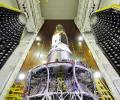
India will launch the PSLV-C56 carrying DS-SAR satellites from Singapore, along with six co-passenger satellites, from ISRO's Sriharikota spaceport on Sunday, July 30, 2023.

The next firing is planned for Tuesday between 2 pm and 3 pm. it said.
'The satellite's condition is healthy.'

In terms of success rate, the PSLV rocket has an enviable record of 57 successful missions out of 58 commercial ones.
