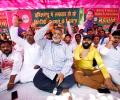
Unless controlled and contained, given the untested belief that the north Indian labour support and follow the Hindutva kind of political ideology, there is a potential in terms of ideological clashes with their Dravidian brethren in the local neighbourhoods, and it all escalating into violence, especially during election time, predicts N Sathiya Moorthy.


'Some said this wild goose chase was a deliberate ploy of Chidambaram, a reluctant home minister, who believed that keeping all the agencies and forces spinning around all the while, would ensure him a safe career in an otherwise dicey charge, no matter how much enduring damage it did to the institutions.' R N Ravi, retired special director, Intelligence Bureau, assesses how India can meet the challenges of terrorism in 2013.

Although the latest aggression by China has caught the attention of the nation, the countrymen have been kept in the dark about their ongoing numerous such transgressions, says R N Ravi

The equation between the army and its countrymen in a democratic country should be one of mutual pride and implicit trust. Protracted deployment of the army on the home-turf tends to skew the equation. The people tend to perceive it as the occupation-army, says R N Ravi.

The BJP continuing to look at the Dravidian polity through the religious prism has not worked in Tamil Nadu whereas it has yielded political and electoral results across much of the rest of the country, observes N Sathiya Moorthy.

According to state government sources, not only did the governor insert some corrections, but he also initialled the final draft after those corrections had been made, reveals N Sathiya Moorthy.
"You have radical elements in the neighbourhood. Again, you have some people in the northeast who are disgruntled against the state and the system. There is a convergence between the two," Additional Director of Intelligence Bureau R N Ravi told media persons after the conclusion of the northeast DGPs conference in Shillong.
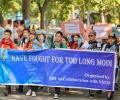
The talks were convened in Delhi in a bid to iron out differences, particularly on the NSCN-IM's demands for a separate flag and Constitution for the Nagas, which have already been rejected by the Centre.
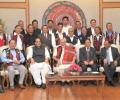
'NSCN-IM leader Muivah warns that the NSCN-IM has come very close to an honourable solution to the peace process with the Government of India, but if it does not materialise, then the Nagas will go away so far that it would be difficult to bring them back to the negotiating table easily,' note Sandeep Pandey and Meera Sanghamitra.
The central government has already rejected the NSCN-IM's demand for unification of Naga inhabited areas -- located in Manipur, Arunachal Pradesh and Assam.

In a letter to Prime Minister Narendra Modi written on February 25, but kept secret so far, Thuingaleng Muivah, the general secretary of the group and chief Naga negotiator in the talks with the government, also spoke about the framework agreement (FA) signed in 2015 and its proposal that the state should be allowed to have a Constitution and national flag.
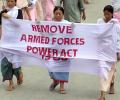
The decision has been taken due to a significant improvement of security situation in the state, a home ministry official said.
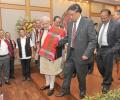
The talks were convened in Delhi in a bid to hammer out differences, particularly on the NSCN-IM's demand for a separate flag and Constitution for the Nagas, officials said.
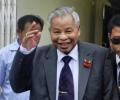
The 87-year-old chairman of Nationalist Socialist Council of Nagaland- Isak-Muivah was undergoing treatment for almost a year at a private hospital in South Delhi where he breathed his last on Tuesday afternoon, Nagaland government spokesperson Kuolie Mere said.
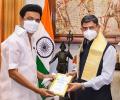
The DMK feels its genuine gestures have had no bearing on the governor's politico-administrative conduct, which is 'more political and politicised than administrative and Constitutional', observes N Sathiya Moorthy.
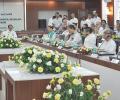
Union Home Minister Rajnath Singh on Saturday said that the Centre would soon take pragmatic steps to effectively manage the country's borders with Myanmar and Bangladesh to check the movement of militants and arms.
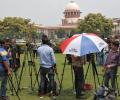
The counsel appearing for Assam told the bench that they would place certain 'confidential documents' in the matter before the court for its perusal.

India and China on Tuesday agreed to "jointly deal with security threats" and take measures to strengthen cooperation in combating terrorism during their first dialogue on counter-terrorism and security in Beijing, amid Indo-Pak tensions following the Uri terror attack.

The decision has been taken at a meeting of the Union Cabinet chaired by Prime Minister Narendra Modi.
'The issue of the larger homeland of Nagalim, the dream of the Nagas to hold sway over swathes of Manipur, Assam and Arunachal Pradesh, is just that, a dream.' 'The NSCN has been told categorically that the government is not going to concede on this issue.'
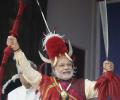
'If the NSCN-IM is cold shoulderd, the chances are that it will slip back into insurgency,' caution Sandeep Pandey, Meera Sanghamitra and Babloo Loitongbam.

Prime Minister Modi felt there were too many silos with no arrangement to take a comprehensive view on national security. The PM has entrusted NSA Ajit Doval to evolve a comprehensive roadmap and get it implemented, reveals Nitin Gokhale, Editor-in-Chief, Strategic News International.
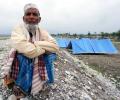
The recent bouts of violence by suspected Bodo militias that killed over 30 hapless 'Muslims, mostly children and women, and rendered several thousands homeless in lower Assam recently, once again offers a shocking glimpse of the horrendous game of violent communalism being played by the Congress government of Assam in furtherance of its cynical power politics for the last several years.' 'The result is, the state is a simmering communal cauldron that sporadically erupts at the slightest real or imagined provocation,' says R N Ravi.
The BDCA is yet another dose of insidious placebos administered on the people of India by their own government that has been in perpetual denial over the steady incremental loss of strategic Indian territory, says R N Ravi

'The government is in no hurry to talk to the separatists and would like to approach the Kashmiri people directly through various other organisations.' 'Officials in charge of J&K affairs at the Centre are clear that there would be no let up in the operations against terrorists,' reveals BharatShakti.in founder Nitin A Gokhale.

Ajit Doval is now India's all-powerful security boss. This concentration of power disrupts our layered security system. Will it not weaken whatever remains of the power and authority of the home, defence and finance ministers? asks Shekhar Gupta.

Union Home Minister Rajnath Singh has painted a grim security situation in the country's border with Myanmar and Bhutan where there were reports of insurgents, weapons and drugs crossing over and said that his ministry was taking measures to effectively manage the international borders.
It is a dark legacy bequeathed by Nehru to India. In its DNA lies the subconscious fount of India's schizophrenic geopolitics that forsook in one sweep all its historically-entrenched strategic interests in Tibet in favour of China, says R N Ravi, on the 60th anniversary of the Panchsheel Agreement.

'The Panchsheel Agreement is unique in the annals of international relations as it stands out as a bizarre illustration of a prime minister trading his country's crucial national interests solely to buffer his personal international image,' feels R N Ravi.
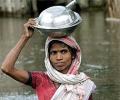
The local labour force is streaming out of the region, creating a vacuum that makes it easier for the Bangladeshis to fill in, says R N Ravi

Much of the negative perceptions of the north-east diaspora owe their origin and existence to the perverse policies of the central government toward the region and its people. This realisation must be the beginning of an earnest endeavour to address the issue, says R N Ravi.
'According to top government sources, the territorial boundaries of the existing North-Eastern states will not be disturbed although cultural integration of Nagas living in states other than Nagaland will be facilitated through special measures,' reveals Nitin A Gokhale.
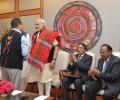
With an aim of ending insurgency in Nagaland, the government on Monday signed an accord with key outfit Nationalist Socialist Council of Nagaland- Isaac-Muivah which Prime Minister Narendra Modi described as a "historic" step to usher in peace in the state.

People on the Ladakh sector of the border with China are compelled to ponder over a heart ripping prospect of a future in China -- a country they viscerally hate for steadily usurping their land. Their swelling disillusionment and popular frustration with India is fraught with grave geo-strategic and national security implications for the country. New Delhi's morbid indifference is indeed frightening, says R N Ravi.

'In the first meeting of this new year, we took a joint new year resolution that we will complete it this year. At the time things were not very clear, but the mood was clear that yes, we must resolve it.' 'Yes, details have to come out, but there are some sensitivities, there are some stake-holders not yet on board, especially other Naga undergrounds etc, we would like them to come on board... So at a proper time it has to be revealed to the country, and to the legislature. Perhaps, we may have to wait for some more time.' 'With better understanding of the Indian system, many of them have learnt, realised, appreciated that Naga nationalist aspirations can be accommodated in the Indian system. The Indian system is pretty comprehensive and flexible.' 'A Naga has as much stake, claim over India as any other Indian. There is no distinction. This, Nagas have realised, that yes, Naga nationalist aspirations and Indian nationalism are not mutually exclusive.' Ravindra Narayan Ravi, the Government of India's Special Interlocutor for the Naga talks, explains how the Naga Peace Accord was reached in an exclusive interview to Saisuresh Sivaswamy/Rediff.com
 © 2026 Rediff.com - Investor Information - Advertise with us - Disclaimer - Privacy Policy - Sitemap - Feedback - About us - Terms of use - Grievances