
The primary goal of HysIS, whose mission life is five years, is to study the earth's surface in visible near infrared and shortwave infrared regions of the electromagnetic spectrum.

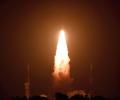
The polar satellite launch vehicle-C42 launch vehicle carrying the two satellites blasted off from the first launchpad at the Satish Dhawan Space Centre at 10.08 pm.

The launch of the crewed space mission, Gaganyaan, is being planned before the next Independence Day and this will be proceeded by two uncrewed missions, Lok Sabha was informed on Wednesday.

The ISRO team worked tirelessly to make the Mars mission a success

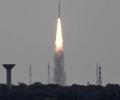
PSLV C-35, carrying India's SCATSAT-1 meant for ocean and weather studies and seven other satellites including from the United States and Canada, on Monday lifted off from the spaceport in Sriharikota.

In Budget 2020-21, the Department of Space has been allocated Rs 13,949.09 crore, of which Rs 8,228.63 crore has been earmarked for capital expenditure.

Bharti Group-backed OneWeb on Monday said it has entered an arrangement with the commercial arm of ISRO, NewSpace India Limited (NSIL), to launch its satellite in India from 2022.

Noting that the PSLV was a versatile launch vehicle which can do different jobs and put satellites in different orbits, he said streamlining of this operation with improved capabilities is on.
A S Kiran Kumar, chief of ISRO, said the mission was unsuccessful because the satellite housed within the heat sink could not be injected.
He also said it may be adopted for use in every stage of a rocket. He was speaking at the 16th convocation of SRM Institute of Science and Technology, near Chennai.

In a textbook mission, ISRO's PSLV-C32 lifted off from Sriharikota and later injected the IRNSS-IF in sub-Geosynchronous Transfer Orbit.

Military use apart, the new satellite would be useful for urban and rural applications, coastal land use and regulation, utility management and various related applications.

Heralding a new era, India on Friday night launched its heaviest commercial space mission ever with its polar rocket successfully putting five British satellites into the intended orbit after a flawless takeoff.

The announcement comes two days ahead of the proposed historic launch of the ISRO's 100th satellite along with 30 others in a single mission from Sriharikota.
The space agency has set 2020 as the deadline for the first privately built rocket to be launched into space.

The Indian space agency has already begun work on the third generation of the earth observation satellite -- the first of which will be ready by 2018 and boost the capability to generate digital maps.

The ISRO spy case is dead. And yet, not dead.
ISRO launched 12 Indian, 22 foreign satellites and successfully flight-tested India's first winged-body aerospace vehicle.

"Indeed, a satisfying feeling," K Radhakrishnan who as the then Chairman of Indian Space Research Oranisation (ISRO) led the Mars Orbiter Mission (Mangalyaan) team said on achieving the milestone.

"It is going to be the most complex mission ever undertaken by ISRO. It is going to take place between July 9 and 16, this year," Sivan said, addressing scientists from the Mission Control Centre.

In a boost for the country's surveillance capabilities to monitor activities of both military warships and merchant shipping in the Indian Ocean Region (IOR), the 'Sindhu Netra' satellite developed by a team of young scientists from Defence Research and Development Organisation (DRDO) was successfully deployed in space on Sunday.

The ISRO is strengthening 'eye in the sky', which helped the Indian army carry out surgical strikes last year, with the launch.
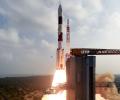
The 2,268-kg GISAT-1 was originally slated to be launched from Sriharikota in Andhra Pradesh's Nellore district, about 100 kms north of Chennai, on March 5 last year but was postponed a day before the blast-off due to technical reasons.

The heaviest rocket of the Indian Space Research Organisation -- LVM3-M2/OneWeb India-1 -- blasted off from the Sriharikota spaceport on Sunday to place 36 broadband communication satellites into the Low Earth Orbit (LEO) for a UK-based customer.

Veteran space scientist G Madhavan Nair said on Tuesday that Indian Space Research Organisation's unsuccessful bid to soft land on the moon is nothing to be alarmed about, and it would only enable the space agency master complex missions going forward.

Eminent rocket scientist S Somanath has been appointed as the chairman of the Indian Space Research Organisation as well as the space secretary, a personnel ministry order issued on Wednesday said.

A US court has asked Antrix Corporation, the commercial arm of Indian Space Research Organisation, to pay a compensation of USD 1.2 billion to a Bengaluru-based startup, Devas Multimedia, for cancelling a satellite deal in 2005.

Indo-French satellite 'SARAL', aimed at oceanographic studies, would be launched along with a mix of six foreign mini and micro satellites on board PSLV-C20 from the spaceport of Sriharikota on February 25.

With the launch of GSLV-MK III, slated for April, it will be able to cater to bigger satellites as well.

The Mars Colour Camera onboard Indian Space Research Organisation's Mars Orbiter Mission has captured the image of Phobos, the closest and biggest moon of Mars.
ISRO sources said that with Sunday's mission, the agency has launched 62 satellites, one space recovery module and 37 rockets, making it a grand 100

The stage is set for the launch of India's satellite IRNSS-1D on Saturday from Sriharikota onboard workhorse PSLV-C27 that would pave the way for the country's own navigation system on par with the GPS of United States.
Stage is set for the launch of PSLV-C9 from the Satish Dhawan Space Centre, Sriharikota. As many as ten satellites will be launched on Monday by the Indian Space Research Organisation, including country's latest remote sensing satellite and eight nano satellites.

This is ISRO's new record of launching 20 satellites, including those from the US, Germany, Canada and Indonesia.

K Sivan has to hasten the effort to bring in private players into satellite and rocket building and replicate India's software success in aerospace.

India is all set to script history by launching a record number of 22 satellites, including a number of micro and nano ones from foreign countries, in a single mission in May this year.
'India has got a unique opportunity to get more and more business from outside as India is cost-effective and reliable.'

The Indian Space Research Organisation successfully launched India's fifth navigation satellite IRNSS-1E from Sriharikota.

Countdown began on Thursday for the launch of the latest navigation satellite that will make India on par with the GPS of the US.

Indian Space Research Organisation's second mission of the year to place an earth observation satellite by a GSLV rocket faced a setback as the mission could not be accomplished fully due to performance anomaly in the cryogenic stage of the rocket, the space agency said on Thursday.
