
The images show VELC (Visible Emission Line Coronagraph) and SUIT (Solar Ultraviolet Imager) instruments as seen by the camera on-board Aditya-L1 on September 4, 2023.

Scientists are working on conducting various tests for the ambitious Gaganyaan mission and the agency is coordinating with the Navy and others in this connection, he said.

The polar satellite launch vehicle's 52nd mission is scheduled for lift-off at 15.41 hours on Thursday from the second launch pad at the spaceport of Sriharikota 'subject to weather conditions'.

Shifting the focus to its next space odyssey after successfully placing a lander on the moon's uncharted South Pole region, the Indian Space Research Organisation (ISRO) chief S Somanath on Saturday said that the country's maiden solar mission Aditya-L1 is ready and will be launched in the first week of September.

As India's first solar exploration satellite reached space, four Kerala public sector undertakings, including Keltron, have reason to be delighted as they too have contributed to this achievement by the country. Various products indigenously developed and manufactured by the four PSUs - Keltron, Steel and Industrial Forgings Limited (SIFL), Travancore Cochin Chemicals (TCC) and Kerala Automobiles Ltd (KAL) - have been used in the Aditya L1 mission. This milestone achieved by the PSUs was highlighted by state Industries Minister P Rajeev in a Facebook post.

The Lagrange point 1 (L1) of the Sun-Earth system is about 1.5 million km from the Earth. It is about one per cent of the total distance between the Earth and the Sun.

EOS-01 is an earth observation satellite intended for applications in agriculture, forestry and disaster management support, ISRO has said.

Aditya-L1 is the first Indian space-based observatory that will study the Sun from a halo orbit around the first Sun-Earth Lagrangian point (L1), which is located roughly 1.5 million km from the Earth.

Aditya L1, the first space based Indian mission to study the Sun underwent the second earth-bound manoeuvre successfully, during the early hours on Tuesday, Indian Space Research Organisation (ISRO) said.

The new year will witness two unmanned missions under the "Gaganyaan" project, deep ocean exploration project, "Samudrayaan" and many more.

The Department of Space (DoS) plans to realise entirely-built rockets -- GSLV-Mk III and SSLV -- from Indian industry partners, in addition to PSLV, according to a top official of its commercial arm NSIL.

Thursday's launch is the last one of 2020 for ISRO.

AzaadiSAT had around 75 small payloads developed by schoolgirls of 75 rural schools.

On Sunday morning, in its mission to place an earth observation satellite and students satellite into the low earth orbit, the SSLV-D1/EOS-02 blasted off precisely at 9.18 am amid cloudy skies from the first launch pad at Satish Dhawan Space Centre in this spaceport.
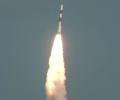
The launch marks a significant milestone for the space agency as it is the 50th flight of PSLV and the 75th vehicle mission from Sriharikota. The 628 kg satellite is meant for applications in various fields like agriculture, forestry and disaster management support. It would also serve military purposes.

Scientists expect to get new information about the past, present and future of the Sun after analysing the data that will be collected by India's first solar mission Aditya-L1, scheduled to be launched by Indian Space Research Organisation (ISRO) on September 2.
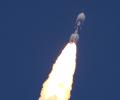
India's first solar mission, if successful, will showcase ISRO's ability to explore the cosmos, explains Kumar Abishek.

In this process, millions and millions of tons of solar materials are thrown into the interplanetary space, he said, adding these CMEs can travel at a speed of approximately 3,000 km per second.

The launch is tentatively scheduled at 09.28 hrs IST on November 25, 2019 subject to weather conditions, ISRO said.
A dome-shaped mysterious object has washed up on a remote Australian beach, amid speculation that it could be from a 20-year-old Indian rocket that was used for launching a satellite.

The year ended with the launch of the PSLV's 50th mission.

This is the first mission by the Indian Speace Research Organisation this year.

The space agency had earlier announced that the launch is tentatively scheduled at 09:28 hrs IST on November 25, subject to weather conditions.
The RISAT-2B would replace the RISAT-2, which has been actively used by India to monitor activities in camps across the border in Pakistan to thwart infiltration bids by terrorists.

Microsat-R, an imaging satellite, is meant for military purposes, but the ISRO did not give any details about it.

Cartosat-3 satellite is a third-generation agile advanced satellite having high-resolution imaging capability.
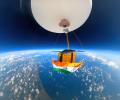
Lauding India's ambitious space programme, The New York Times has said the country, currently witnessing an 'explosive' growth in space-tech start-ups, is set to 'transform the planet's connection to the final frontier' and can emerge as a 'counterweight' to China.

India scripted history by successfully launching EMISAT, a military satellite, and 28 foreign nano satellites on-board its polar rocket from Sriharikota on Monday, in a complex mission which marked many a first for Indian Space Research Organisation.

In the first dedicated mission of its commercial arm New Space India Limited (NSIL), the Indian Space Research Organisation on Sunday successfully launched Brazil's earth observation satellite Amazonia-1 and 18 other co-passengers, including five built by students, onboard a Polar rocket from the spaceport in Sriharikota.
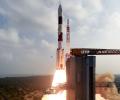
The Indian Space Research Organisation (ISRO) is all set to make its maiden commercial launch of 36 broadband communication satellites on board the space agency's heaviest rocket LVM3-M2, the countdown for which began early on Saturday at Sriharikota spaceport in Andhra Pradesh.

CARTOSAT-3 is a third generation agile advanced satellite having high resolution imaging capability.

The Indian Space Research Organisation on Sunday faced a blip in its plan to tap the small satellite launch vehicle market, as an anomaly in the placing of the satellites by the rocket led to deviation on its path thereby becoming 'no longer usable', Chairman S Somanath said on Sunday.

India on Monday successfully launched five foreign satellites from four countries on board PSLV-C23 rocket which placed them in orbit, an achievement described by Prime Minister Narendra Modi as an 'endorsement' of the country's space capabilities.

This would be the 44th flight of the PSLV and the third launch by ISRO this year.

'Today, when we talk of success of PSLV and GSLV Mk III, we owe it to important inputs that the Prof. Narasimha committee gave'

There was, however, no official word from the country's national space agency, headquartered in Bengaluru.

In its first multi-orbital launch, India's workhorse PSLV will on Monday inject eight different satellites, including the country's weather satellite SCATSAT-1 and five from other nations, into two different orbits.
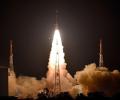
"I am really grateful to the entire ISRO family for having worked this hard and making IRNSS-1I a success," said the space centre's chief K Sivan.

The successful orbiting of the satellites by the Polar Satellite Launch Vehicle PSLV C-40 comes four months after the Indian space Research Organisation's mission to launch backup navigation spacecraft IRNSS-1H onboard PSLV-39 ended in a rare failure.

ISRO's first mission in 2023 and SSLV's sequel saw a strange coincidence--it was launched at 9.18 am, the same time its predecessor lifted off from the Satish Dhawan Space Centre here on August 7, 2022 but could not deliver due to orbit anomaly and flight path deviation.
