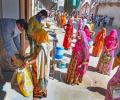
The government's food subsidy in the ongoing fiscal year is expected to be a little less than Rs 4 trillion.

Sonia hit out at the BJP, saying the ruling party's "divisive agenda" has become a regular feature of political discourse in all states and that history is being "mischievously distorted" to add fuel to its agenda.

Every week, we bring you fascinating videos, chosen by you, through your likes.
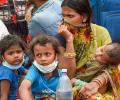
Only two in every five migrants said they received ration or cooked food from the administration either daily or at times.
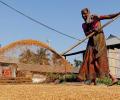
Stating that the food subsidy bill is becoming "unmanageably large", the Economic Survey 2021 on Friday suggested the government to increase the selling price of foodgrains provided through ration shops to over 80 crore beneficiaries. Foodgrains via ration shops are supplied at highly subsidised rates of Rs 3 per kg for rice, Rs 2 per kg for wheat and Rs 1 per kg for coarse grains through Public Distribution System (PDS) as per the National Food Security Act (NFSA). "While it is difficult to reduce the economic cost of food management in view of rising commitment towards food security, there is a need to consider the revision of central issue price (CIP) to reduce the bulging food subsidy bill," the survey said.

The Food and Security Bill will be implemented after few months.

"Fact that persons with disabilities get marginalised from every scheme does not require a debate," the court said.

Finance Minister Nirmala Sitharaman has brought down the budgetary allocation for the fertiliser subsidy for FY21 to Rs 71,309 crore, from the RE of Rs 79,998 crore for FY20, while increasing food subsidy to FCI through "ways and means advance" to Rs 50,000 crore for FY21, from Rs 36,000 crore in RE for FY20, and under the National Food Security Act (NFSA) to Rs 77,982 crore, from Rs 75,000 crore.
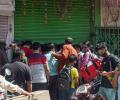
The Delhi government on Saturday claimed the Centre has 'stalled' its ambitious doorstep delivery of ration scheme that would have benefitted 72 lakh ration card holders in the national capital and termed the move 'politically motivated'.
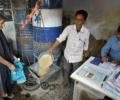
A study by eminent economists, by Jean Drze, Reetika Khera and Meghana Mungikar released few days back shows that more than 100 million people are excluded from the PDS because the central government insists on using 2011 population figures to calculate state-wise coverage under the National Food Security Act.

According to the Cabinet note, 75 per cent of the rural and 50 per cent of the urban population are to be brought under the food security umbrella.

The Supreme Court on Monday came down heavily on certain states for not implementing welfare legislation National Food Security Act, saying that why a state like Gujarat was not implementing the law passed by Parliament.

The government's subsidies on food, fertilisers, LPG and kerosene are pegged at Rs 5.96 lakh crore in the current fiscal, over 2.5-fold jump from the initial budget estimates as the Centre distributed additional foodgrains free of cost to help poor mitigate the impact of COVID-19 pandemic. In February 2020 Budget, presented in the pre-COVID scare, the government had estimated the subsidy bill at Rs 227,794 crore. However, all the budget estimates, have undergone major revisions as the country imposed strict lockdown to check the spread of COVID-19.

The government allowed sugar companies and distilleries to make hand sanitizers using ethanol. Sugar companies supply ethanol to oil marketing companies for blending with petrol.
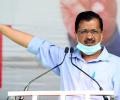
The central government on Friday stopped the doorstep delivery of ration scheme MMGGRY (Mukhya Mantri Ghar Ghar Ration Yojana) of the Delhi government, scheduled to be launched on March 25.
Prime Minister Dr Manmohan Singh announced that the National Food Security Mission would be formally launched from Andhra Pradesh.

While the likelihood of these states going the Lanka or Greece way may be an alarming assessment, the financial situation of some states such as Punjab and West Bengal is indeed quite weak.

'I am sceptical of the Indian economy returning to a sustained high-growth trajectory any time soon'
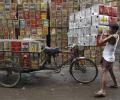
The Cabinet on Wednesday approved the National Mission on Edible Oils - Oil Palm (NMEO-OP) with a financial outlay of Rs 11,040 crore to promote domestic cultivation of oil palm in the next five years, and reduce the country's dependence on edible oil imports. The decision comes after Prime Minister Narendra Modi announced the new central scheme on August 15 during his Independence Day speech at Red Fort. Briefing the media, Union Information and Broadcasting Minister Anurag Thakur said the Cabinet approved the NMEO-OP with a focus on the northeast region and the Andaman and Nicobar Islands with a financial outlay of Rs 11,040 crore.
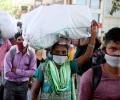
The government on Monday ruled out the possibility of free food-grains distribution to migrants saying there is no panic situation and no complete national lockdown unlike last year.
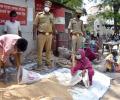
A recent study shows that more than 100 million people are excluded from the public distribution system because the central government insists on using 2011 population figures to calculate state-wise PDS coverage, which effectively leaves out 100 million people, reports Sanjeeb Mukherjee.

Of the total cash outgo Rs 40,000 crore is towards enhanced expenditure under Mahatma Gandhi National Rural Employment Guarantee Program and Rs 33,771.48 crore have been sought for direct benefit transfer under Pradhan Mantri Jan Dhan Yojana and National Social Assistance Programme.
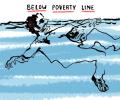
'I realised that if we don't get relief from the government, I'll be faced with the prospect of either starving in Delhi, or starving in my village.'
A meaningful long-run strategy to eradicate poverty would do more than a top-down distributive model.

8 crore migrant workers will get 5 kilogram of grains per person and 1 kilogram of 'chana' for two months.
The recently promulgated National Food Security Ordinance might breach the global trading rules on agriculture under the World Trade Organization if there is diversion of the subsidised foodgrain for export.

A day before the Cabinet considers issuing an ordinance to implement government's ambitious National Food Security Bill, Food Minister K V Thomas said all UPA allies, including Nationalist Congress Party, are on board and there was a consensus on issuing an ordinance.
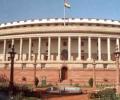
The government which introduced amendments to the landmark Food Security Bill in the Lok Sabha Thursday could not get it passed as opposition stalled proceedings in the House over killing of Sarabjit Singh in Pakistan and other issues.

The proposed ordinance on food security is likely to be taken up again at a meeting of the Union Cabinet on Wednesday, when it will consider whether to go ahead with promulgating it or convene a special session of Parliament for its passage.

The Bharatiya Kisan Union and the Mahila Aghadi have also opposed.

Food bill, which is dubbed as the world's largest social welfare programme, aims to give legal right over an uniform quantity of 5 kg foodgrains at a fixed price of Rs 1-3 per kg via ration shops to 67 per cent of the population.
The Budget session of Parliament was abruptly adjourned sine die on Wednesday , with the second phase turning out to be a total washout amid opposition demands for the resignation of Prime Minister Manmohan Singh and ministers Ashwani Kumar and P K Bansal.
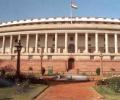
Setting a tough condition before the government, the Bharatiya Janata Party on Tuesday said it will not allow the passage of any bill in Parliament till Railway Minister Pawan Kumar Bansal and Law Minister Ashwani Kumar resign or are sacked. The opposition party also made it clear that it will not allow the passage of either the National Food Security Bill or the Land Acquisition Bill.
'Any meaningful food security programme should aim at gradually reducing the number of hungry dependent on government support,' says Devinder Sharma. 'This is only possible if the government had looked at the entire issue in a sincere manner. I don't think at any stage the government was honest in its approach. It had simply worked and reworked the Food Security Bill keeping the 2014 election in mind.'

It does not bar any state or the Centre from continuing or launching other food-based schemes.
In a big boost to farm sector, Finance Minister P Chidambaram proposed a whopping Rs 1.25 lakh crore increase in agri-credit target for next fiscal at Rs 7 lakh crore and raised allocation to the ministry by a handsome 22 per cent.
Providing cheap rice and wheat to 67.5% population would raise subsidy bills 45% to up to Rs 1.3 trn, and the country.

According to the food ministry, about 142 lakh migrants will benefit in Uttar Pradesh and in Bihar (86.45 lakh), Maharasthra (70 lakh), West Bengal (60.1 lakh), Madhya Pradesh (54.64 lakh), Rajasthan (44.66 lakh), Karnataka (40.19 lakh), Gujarat (38.25 lakh), Tamil Nadu (35.73 lakh), Jharkhand (26.37 lakh), Andhra Pradesh (26.82 lakh) and Assam (25.15 lakh).
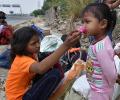
There was no announcement from the government on guaranteeing a minimum basic income, which is the need of the hour. The announcements on portability of ration cards and affordable rental housing to workers are for the long and medium terms. Migrant workers need immediate relief.

A day before the start of the Budget session of Parliament, as many as 18 opposition parties, led by the Congress, the Nationalist Congress Party, the Shiv Sena and the Trinamool Congress, decided on Thursday to boycott the President's address to the joint sitting of both Houses in solidarity with the farmers protesting against the new farm laws.
 © 2026 Rediff.com - Advertise with us - Disclaimer - Privacy Policy - Sitemap - Feedback - About us - Terms of use - Grievances