
A severe cold wave has intensified across North India, with Delhi recording its lowest temperature of the season. Rajasthan experienced sub-zero temperatures, and several states have issued alerts and closed schools due to the extreme conditions.

Delhi recorded its coldest January morning in three years with the minimum temperature dropping to 3 degrees Celsius. Cold wave conditions are expected to persist, and air quality has deteriorated to the 'very poor' category.

The national capital was in the grip of a cold wave, with the sun largely obscured by clouds and pollutants lingering in the atmosphere, leading to reduced visibility. At least 129 flights were cancelled at the Delhi airport on Saturday due to dense fog, according to an official.

The India Meteorological Department (IMD) reports that ash clouds from volcanic activity in Ethiopia, which impacted flight operations in India, are drifting towards China and will move away from India by 7.30 pm on Tuesday.

A 5.7 magnitude earthquake struck Dhaka and surrounding areas in Bangladesh, resulting in at least 10 deaths and over a hundred injuries. The quake caused building damage and fires, raising concerns about future seismic activity in the region.

Cyclone Montha crossed the Andhra Pradesh coast, resulting in two deaths, extensive crop damage, and disruptions to power and transportation. Neighboring Telangana also experienced heavy rains. Government relief efforts are underway.

Incessant rains and flooding have caused widespread disruption in northern India, with states like Himachal Pradesh, Delhi, Punjab, and Jammu and Kashmir facing landslides, road closures, and displacement. Rescue efforts are underway as authorities grapple with the aftermath of the deluge.

Heavy rains and landslides in Himachal Pradesh have resulted in multiple fatalities and widespread disruption, including road closures and train cancellations.

Heavy rains in Rajasthan lead to flooding, resulting in casualties and widespread disruption. Rescue operations are underway, and schools are closed in several districts.

Flash floods triggered by a cloudburst in Mandi, Himachal Pradesh, resulted in casualties and widespread damage, prompting rescue operations and relief efforts.

Monsoon hit the state on June 20 and has since then cost it Rs 5,000 crore in damages.

The meteorological centre in Shimla issued a 'red' alert on Sunday for very heavy downpour in 10 districts of Himachal Pradesh, while services on the Shimla-Kalka rail line were suspended for hours till the debris and trees fallen on the tracks following overnight rains were removed.

The temperatures in Leeds are expected to hover between 15 to 21C which is not ideal for batting, especially under cloudy skies and breezy conditions.

The labourers, who are said to be of Nepali origin, were engaged in the construction of a hotel.

'Nobody asked us to work on this. It was on our own that we decided to embark on this journey.'

A strong dust storm and gusty winds followed by rain hit Delhi-NCR on Friday evening, causing trees to be uprooted in several parts and leading to traffic congestion. Thunderstorms caused power disruptions in several parts of the city, primarily due to trees and branches falling on electricity cables. The India Meteorological Department (IMD) has issued an orange alert, recommending people stay indoors and avoid unnecessary travel.

Dense fog enveloped Delhi for a second consecutive morning, leading to disruptions in air and rail traffic. Visibility dropped to zero in several areas, causing delays for 81 trains and diversions for 15 flights. The Met office attributed the fog to calm surface winds, and predicted continued dense to very dense fog throughout the day. Meanwhile, the national capital's air quality remained in the 'very poor' category, with an AQI reading of 380 at 9 am.

A cold wave has intensified in most parts of north India, with temperatures in the Kashmir Valley dipping below freezing point. The national capital saw a brief respite from the bitter cold during the day, but cold conditions persisted in parts of Rajasthan and Himachal Pradesh. The weather department has issued a yellow warning for cold wave, ground frost and dense fog for some places in Himachal Pradesh. There is a possibility of rain and snowfall in parts of northwest India later in the week.

Residents of North India battle freezing conditions.
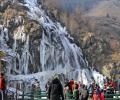
A cold wave has gripped many parts of north and east India, with Srinagar recording a minimum temperature of minus 5.3 degrees Celsius. Other areas experiencing below-freezing temperatures include Gulmarg, Pahalgam, Konibal, Qazigund, Kupwara, and Kokernag in Kashmir. Himachal Pradesh has issued an orange warning for severe cold wave conditions in several districts. Delhi recorded a minimum temperature of 5.9 degrees Celsius, while Faridkot in Punjab was the coldest in the region at 0 degrees Celsius. Extreme cold conditions also continued in parts of Rajasthan and Jharkhand. The Met office has forecast mainly dry weather until December 26, with the possibility of light snowfall in the higher reaches of Kashmir on the intervening night of December 21-22.

According to weather officials, wind speeds along and off the Odisha-West Bengal coasts are anticipated to reach 60 km/h from October 23, increasing to 120 km/h from October 24 night to October 25 morning.

Intermittent, widespread rains lashed Chennai and other regions of Tamil Nadu on Tuesday and the India meteorological department said the low pressure area over the Bay of Bengal has turned into a well-marked low pressure area and it is likely to become a depression.
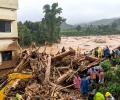
A red alert indicates heavy to extremely heavy rain of over 20 cm in 24 hours. An orange alert means very heavy rain of 11 cm to 20 cm, and a yellow alert means heavy rainfall between 6 cm and 11 cm.

Many low-lying areas in West Bengal's sub-Himalayan region were reeling from a flood-like situation while major rivers in Bihar were flowing above the danger level at several places as unabated heavy rain lashed the country's eastern parts on Sunday.

June rainfall accounts for 15 percent of the total precipitation of 87 cm recorded during the four-month monsoon season in the country.

In addition to that, 68 people still remain missing, with 100 more sustaining injuries in the disaster.

Heatwave conditions are expected over northwest India during the next five days, with Punjab, Haryana, Rajasthan and Delhi predicted to bear the maximum impact, the India Meteorological Department (IMD) said on Thursday.

Lakhs of voters will have to bear the searing heat when they step out to exercise their franchise in the second phase of the Lok Sabha elections on Friday.

He said scientists have noticed a trend of very deep cloud systems developing over the southeast Arabian Sea, and added that sometimes, these systems intrude into the land, like in 2019.

The Met office has issued a "red" warning for Delhi, Haryana, Punjab and west Rajasthan, stressing the need for "extreme care for vulnerable people".
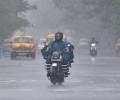
The cyclone ravaged adjacent coasts of the state and Bangladesh between Sagar Island and Khepupara, near the southwest of Mongla in the neighbouring country, after its landfall process began at 8.30 pm on Sunday.

The heat wave is likely to impact parts of Jammu and Kashmir, Himachal Pradesh, Uttarakhand, Punjab, Haryana, Delhi, Rajasthan, Madhya Pradesh, Jharkhand, Odisha and Gangetic West Bengal, the Met office said.

Light to moderate rain in many areas with heavy rain at isolated places is likely to occur in West Bengal's coastal districts of North 24 Parganas, South 24 Parganas and Purba Medinipur.

India has received 20 per cent less rainfall since the start of the monsoon period on June 1, with the rain-bearing system making no significant progress between June 12 and 18, according to the India Meteorological Department (IMD).

Temperatures in 17 locations breached 45 degrees Celsius on Monday, with the punishing heat affecting health and livelihoods.

The monsoon spelt mayhem in several parts of the country on Monday, particularly Mumbai where local train services and flight operations were hit and everyday life disrupted as well as Assam that was grappling with floods yet again.

Ten to 20 days of heatwave are expected against the normal of four to eight days in the entire April-June period.

Heatwave conditions have been prevailing in Odisha since April 15 and the Gangetic West Bengal since April 17, according to the MeT department.

Intense heat swept through east India and parts of the southern peninsular region on Thursday, testing power grids and prompting the Kerala government to order closure of educational institutions till May 6.

Voting for the second phase of Lok Sabha polls will be held on Friday for 88 seats in 13 states with Congress leader Rahul Gandhi seeking a second-straight term from Wayanad in Kerala.
 © 2026 Rediff.com - Investor Information - Advertise with us - Disclaimer - Privacy Policy - Sitemap - Feedback - About us - Terms of use - Grievances