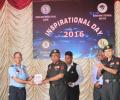
On World Disability Day, in the presence of 150 differently abled soldiers, Lieutenant General P M Hariz, the Southern Army Commander, honoured the late Rediff.com columnist Flying Officer M P Anil Kumar.

A quintessential military commander, Gen Bipin Rawat possessed an uncanny understanding of geopolitical upheavals, calibrated a tri-services military doctrine to make India face myriad security challenges, and is largely credited with bringing down militancy in the Northeast and Jammu and Kashmir.

He praised the Indian media for handling the issue in a "responsible" manner.

He added there would not have been need of any due process or Cabinet Committee for Appointment if seniority alone was the criterion.

Speculation are rife that he may seek premature retirement or will be given a new role by the government.

His absence will be felt because of his decision taking ability and rapport with armed forces.
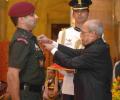
Major Rohit Suri and Naib Subedar Vijay Kumar were honoured at a military investiture ceremony.

Lt General Rawat belongs to the famous 5th Battalion of 11th Gorkha Rifles. He is the current vice chief of army staff of Indian Army.
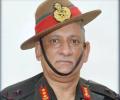
The Congress and the Left on Sunday questioned the appointment of the new army chief by superseding two officers, saying every appointment by the government has become controversial.

The Centre held that seniority is not the sole criterion for selection.
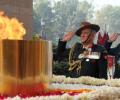
"The force is to maintain peace and tranquillity at the border but it will not shy away from flexing its muscles, if the need be," Gen Rawat said.

Chiefs of Army Staff in India have not been tactful about politicians. But they have stayed clear of politics, reports Aditi Phadnis.
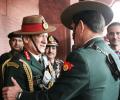
General Bakshi is understood to have been assured by Defence Minister Manohar Parrikar that the process was under way to appoint him as India's first tri-service commander, a post that would, at least nominally, place him senior to General Rawat.

Defence ministry says the focus was on suitability and merit for the selection of the new Army chief.

Over the past two decades, six of the eight army chiefs have been from the infantry and the other two from the artillery division. The appointment of either General Bakshi or General Hariz would interrupt the infantry's prolonged domination of the army command, says Ajai Shukla, a retired army officer himself.
By jettisoning the seniority principle, the government has sent a strong signal that only merit and suitability will count in occupying posts in the higher echelons of the military, writes national security expert Nitin Gokhale.

Lt Gen Bakshi announced 'full support' to the new chief and made it clear that he won't resign.

With ambitious generals knowing that political patronage might be rewarded, a worrying era of politicisation of the military looms ahead, observes retired Colonel Ajai Shukla who has known Generals Rawat, Bakshi and Hariz for a long time.
'In the present era of strategic uncertainty and rapidly changing threats, no military professional now disputes the unavoidable necessity of a joint planning staff for the planning and conduct of joint operations so that integrated operations can be planned 'top down',' says Brigadier Gurmeet Kanwal (retd).
 © 2026 Rediff.com - Investor Information - Advertise with us - Disclaimer - Privacy Policy - Sitemap - Feedback - About us - Terms of use - Grievances