
Chennai-based Agnikul Cosmos plans to launch a prototype AI data centre in orbit by the end of this year, aiming for commercial viability by 2027, according to co-founder Srinath Ravichandran.
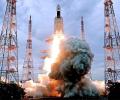
ISRO is developing a third launch pad at Shriharikota to accommodate heavier satellites and next-generation launch vehicles. The new facility will support both crewed and uncrewed missions.

Weighing 6,100 kg, the communication satellite would be the heaviest payload to be placed into the Low Earth Orbit (LEO) in LVM3 launch history from Indian soil.

The Bharatiya Antariksh Station represents the next phase of India's human spaceflight ambitions, enabling long-duration presence in space, advanced microgravity research and technology development, and supporting future human exploration missions.

NASA astronaut Sunita Williams retires after 27 years, completing three missions aboard the International Space Station and setting numerous spaceflight records. She is currently visiting India.

India is set to take its first steps towards its own human space flight when the uncrewed Gaganyaan mission soars to the skies later this year. Private players in the space sector are also gearing up for launching satellites on home-built rockets.

ISRO has announced plans for seven launch missions by March, including the first uncrewed mission for the Gaganyaan project and demonstrations of new satellite technologies.

From a surge in startups to crewed mission preparations, 2025 marks a transformative year as India eyes $44 billion space economy by 2033.
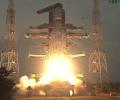
The heaviest communication satellite to be launched from the Indian soil onboard a new generation, homegrown 'Bahubali' rocket was successfully placed into the intended orbit on Sunday, the Indian Space Research Organisation said.

The satellite, weighing about 4,410 kg will be the heaviest to be launched from the Indian soil and into a Geosynchronous Transfer Orbit (GTO), the space agency said. The satellite will travel onboard a LVM3-M5 rocket, dubbed as 'Bahubali' for its heavylift capability.
ISRO Chairman V Narayanan announced the development of a massive rocket capable of placing 75,000 kg payloads in low earth orbit, highlighting India's growing space capabilities and future satellite launches.

ISRO is set to launch its communication satellite CMS-03 from Sriharikota. The satellite, weighing 4,410 kg, will be the heaviest launched from Indian soil into a Geosynchronous Transfer Orbit (GTO).

India's space regulator INSPACe has granted a license to Starlink to offer space-based internet services in the country. The authorization is valid for five years and subject to regulatory provisions and clearances.

As part of a plan to refinance debt and expand its upcoming constellation of satellites, French satellite major Eutelsat Communications will raise euro 1.35 billion, or $1.55 billion, through a reserved capital increase and a rights issue, the company announced on Friday. Bharti Enterprises' space venture, Bharti Space Ltd, will invest euro 31.4 million, or $36 million, in the capital raise.
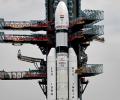
'The LVM3 rocket will orbit one Block 2 BlueBird satellite in Low Earth Orbit.'
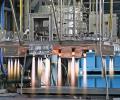
With these successful tests, ISRO has moved a step closer to India's first human spaceflight mission, Gaganyaan.

Indian astronaut Shubhanshu Shukla, currently on the ISS as part of the Axiom-4 mission, has acknowledged ISRO's efforts in ensuring his safe travel. He spoke with ISRO chairman V Narayanan about his well-being and the experiments being conducted on the ISS.

The government has issued Letter of Intent to Starlink for satcom services, sources said on Wednesday. Starlink is a satellite internet service developed by SpaceX -- the American aerospace manufacturer and space transportation company founded in 2002 by world's richest man Elon Musk.
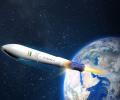
The Vikram-I rocket will fly with its maximum carrying capacity and put the satellites in a Low Earth Orbit.
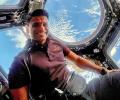
Astronaut Shubhanshu Shukla and the Axiom-4 mission crew are scheduled to return to Earth from the International Space Station on July 14, according to NASA.

India's Group Captain Shubhanshu Shukla and three other astronauts on Thursday reached the International Space Station as the Dragon spacecraft docked with the orbital laboratory.
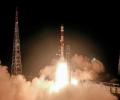
State-run Hindustan Aeronautics Limited has won a bid under which it will receive technology from the Indian Space Research Organisation for the end-to-end commercial production of the Small Satellite Launch Vehicle (SSLV), a first for the industry as India seeks to become a global hub for small satellite manufacturing and launches.

The Human-rated LVM3 vehicle, the Crew Escape System and the Crew Module and Service Module are all in final stages of testing and integration.
The company had announced similar pricing for Sri Lanka, where its application was in advanced stages of regulatory clearance.

The mission was originally scheduled for lift-off on May 29 but was put off multiple times when engineers detected a liquid oxygen leak in the boosters of the Falcon-9 rocket and NASA also detected leaks in the ageing Russian module of the ISS.

If Rakesh Sharma represented the dreams of a nascent India looking outward, Shubhanshu Shukla embodies a confident India reaching for the controls.
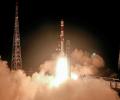
The Indian government has approved the construction of a third launch pad at Sriharikota, capable of sending heavier spacecraft into orbit. This new facility will support India's ambitious space program, including the Gaganyaan human spaceflight mission and a lunar landing. The launch pad will be built at the Satish Dhawan Space Centre and is expected to be operational within four years.
Elon Musk's Starlink has got licence for satcom services in India, according to sources.

The Reliance Industries' digital services company Jio Platforms Limited has signed an agreement with SpaceX to offer Starlink's broadband internet services to its customers in India, the company said on Wednesday. The agreement is subject to SpaceX receiving authorisation to sell Starlink in India. The development came a day after Jio's rival Bharti Airtel signed a similar pact with SpaceX.
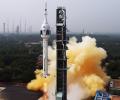
Chandrayaan-4 will involve at least two separate launches of the heavylift LVM-3 rocket that will carry five different components of the mission which will be assembled in orbit.
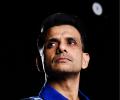
Indian astronaut Shubhanshu Shukla will be the first Indian to travel to the International Space Station (ISS), flying aboard a SpaceX Dragon spacecraft as part of a joint effort between NASA and ISRO. Shukla, a group captain in the Indian Air Force, will serve as the pilot for the Axiom Mission 4, scheduled for launch no earlier than spring 2025. The mission will also carry the first astronauts from Poland and Hungary to stay aboard the ISS.

Starlink's application for offering satcom services in India had been held up for the company's inability to comply with mandatory ownership disclosure norms.

The Indian Space Research Organisation (ISRO) successfully launched its third and final developmental flight of Small Satellite Launch Vehicle here on Friday whose payloads can be used in applications like satellite-based surveillance, disaster and environmental monitoring, fire detection, volcanic activity among others.

In terms of success rate, the PSLV rocket has an enviable record of 57 successful missions out of 58 commercial ones.
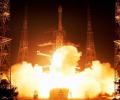
ISRO is part of an exclusive league which has forayed into the Moon and Sun.
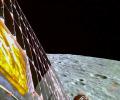
According to the Indian Situational Space Awareness Report for 2023, the nominal lift-off of the Launch Vehicle Mark-3, carrying the Chandrayaan-3 spacecraft, had to be delayed by four seconds based on the Collision on Launch Avoidance analysis.

Group Captain Shubhanshu Shukla Shukla says Wing Commander Rakesh Sharma -- the first Indian to travel to space --has been advising him about the space flight.

ISRO said the upper stage of the Polar Satellite Launch Vehicle - C37 (PSLV-C37) re-entered the earth's atmosphere on October 6, 2024 and the impact point was the North Atlantic Ocean.
India is marching towards becoming the fourth country in the world to have space docking technology.
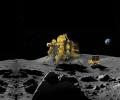
In a boost to the space programme, the government on Wednesday approved the Chandrayaan-4 mission to bring back moon rocks to earth, to send a spacecraft to orbit planet Venus and to expand the Gaganyaan project to build an Indian space station.
 © 2026 Rediff.com - Investor Information - Advertise with us - Disclaimer - Privacy Policy - Sitemap - Feedback - About us - Terms of use - Grievances