
Bharatiya Janata Party, which has been trying to shrug off the 'communal' tag, has fielded nearly 40 per cent Muslim candidates in Jammu and Kashmir assembly polls under its ambitious 'Mission 44 plus' to wrest power in the state.

The move is aimed at reflecting the diversity of India and highlighting the contribution of prominent personalities.

'There are many able, good, police officers in Bengal who are capable of handling this situation, but without Mamata Banerjee nothing moves.'
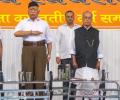
'For the last 10 years the Congress made the RSS an idea of intolerance, anti-minority, especially anti-Muslim, and an idea of fascism.' 'That has been demolished now by Pranab Mukherjee.'

Virtually launching the party's campaign for 2014 elections, Gujarat Chief Minister Narendra Modi on Sunday talked about the need to "heal the wounds" of Kashmiris and connect its aspiring youths with the national mainstream for the development of the state.

Punjab politics has produced a dog's breakfast on the river waters issue. Except, you'd see even dogs eat better, says Shekhar Gupta.

'We are certainly disappointed by our inability to win a single seat in the valley... We will analyse what led to this kind of dismal -- in terms of seats -- non-performance by the BJP.' 'I certainly don't want to attribute any religious or so-called communal reasons for it; for the simple reason, that even in Ladakh, a Buddhist majority area, we failed to win seats.' BJP General Secretary Ram Madhav, the man in charge of the party's election campaign in J&K, discusses the verdict with Sheela Bhatt/Rediff.com

'The new generation voter is hyper-nationalistic, but it isn't essentially illiberal.' 'They will find the rants of Adityanath as laughable as Irfan Habib's. They will also find the BJP's polarising approach to vote-gathering unacceptable if it fails to deliver jobs and growth,' says Shekhar Gupta.

'Unity in diversity is a dated notion as India, today, is more unified and cohesive and yet more pronouncedly diverse than ever in its history,' argues Shekhar Gupta.

While the Indian Government was aware of it, it tried to play it down and instead referred to it as genocide against the Bengali community in Bangladesh so as to avoid an outcry from the leaders of the then Jan Sangh, the predecessor of the today's main opposition Bharatiya Janata Party, says Gary J Bass, author of the book The Blood Telegram: Nixon Kissinger and a Forgotten Genocide, which recently hit the book stores.
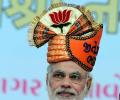
The Narendra Modi wave seems to have reached the Bengal shores, indicated by the more than two-fold increase in the membership of the Bharatiya Janata Party's state unit.
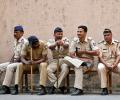
'When you read that for the first time, areas in Gujarat dominated by Patidars/Patels have been declared 'sensitive' for the civic polls that were held this week, you sit up and take note,' says Jyoti Punwani.

'He is a man whose utterances have been so virulent and communalistic.' 'That's why many people did not look at him as the party's choice for chief minister.' 'UP is the state that reports the largest number of communal incidents every year.' 'Modi may not be using the Hindutva card, but he never condemns the incidents too.'

Theatre director Saif Hyder Hassan talks about his new play Ek Mulaqat.

Swadeshi economist, columnist and chartered accountant S Gurumurthy speaks to Shobha Warrier about one year of Modi Sarkar.

Why Dalit leaders cross over to the BJP

'RSS chief Mohan Bhagwat was on the Hindu extremists' hit-list. In June 2008, this information was made public. Prior to that, you should hear Bhagwat's speeches and listen to his 'liberal' statements.' 'After he was informed that he was on their hit-list, he became a hardliner. He was not like that before.'

BJP-supported students' union, aided by a friendly government, is aggressively settling historical scores with Leftist students' organisations.

'The BJP is not the party it was 10 years ago. It has changed. It is emerging like the Congress.' 'Sometimes, I feel the BJP has taken the Congress' space.' 'Its politics is also resembling the Congress.'

'Nowhere in the country, except perhaps Jammu and Kashmir, do extremist groups enjoy political patronage as they do in Kerala. Terrorists are exported from Kerala to Afghanistan, Syria.'

Muslims constitute 20% of UP's electorate. Currently, Muslim voters are divided between Akhilesh's SP and Mayawati's BSP. What will tilt the balance? Can Muslims back the winning party? Mohammad Sajjad explains the mysteries of UP's Muslim politics.

'They must bow their head before the people's might and start their work immediately. Now nothing can help them, but a show of sincerity and a life without cosmetic frills.' 'They don't have any option, but to succeed and prove themselves worthy of this massive victory,' says BJP MP Tarun Vijay.

L K Advani has less to lose because he has actually lost what is vital in politics. His support base within the party is lost because the party thinks Advani can't help the BJP regain power. Since Modi is vulnerable, Advani, now and then, hits the headlines. Rediff.com's Sheela Bhatt explains the Advani Affair.

'America's withdrawal from Vietnam was an inspiring moment for all of us. We believed that it was a glorious victory of ideology and spirit and as historic as the defeat of the Nazis exactly 30 years ago,' remembers Kumar Ketkar 40 years after the end of the Vietnam War.

'There is nothing like the Sangh agenda or the BJP agenda... we believe only in the Nation's Agenda,' says newly appointed BJP Vice-President Vinay Sahasrabuddhe.
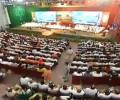
The 10-year UPA rule came under sharp attack in the BJP's National Council meeting in on Saturday, which unveiled the new government's future plans and policy prescription in domestic and foreign affairs arena in a political resolution, which hailed the "strong and able" leadership of Narendra Modi.

Atal Bihari Vajpayee would seek to placate the hawks in the RSS by stating that the writing of history should not be one-sided. At the same time, he would project a moderate 'Nehruvian' image of himself as the archetypal liberal politician who would strive to attain a balance between conflicting viewpoints. A fascinating profile of the former prime minister and Bharat Ratna by Paranjoy Guha Thakurta and Shankar Raghuraman.
 © 2026 Rediff.com - Investor Information - Advertise with us - Disclaimer - Privacy Policy - Sitemap - Feedback - About us - Terms of use - Grievances