
Jamiat Ulama-i-Hind has criticized the central government's directive mandating the singing of all six stanzas of Vande Mataram at official functions, alleging it violates religious freedom.

The petition demanded stern legal action against those who allegedly threatened to massacre Muslims and said it was not just a matter of religion but of the Constitution, law, unity and integrity of the country.
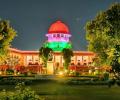
The Supreme Court has agreed to list for final hearing the pleas challenging the validity of certain provisions of the Places of Worship (Special Provisions) Act, 1991.

The Supreme Court dismissed a plea by Jamiat Ulama-i-Hind seeking compensation from the Uttar Pradesh government for victims of mob lynching, deferring to the Allahabad High Court's order to approach the state government directly.

Jamiat Ulama-i-Hind chief Maulana Arshad Madani's remarks alleging discrimination against Muslims, citing the Al Falah University case, have sparked a row with the BJP, who accused him of supporting terrorists.
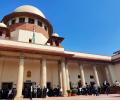
The Supreme Court on Monday agreed to consider listing for urgent hearing the petitions challenging the constitutional validity of the Waqf (Amendment) Act, 2025.

A fresh plea has been filed in the Supreme Court challenging the constitutional validity of the Waqf (Amendment) Act, 2025, claiming it was a "blatant intrusion" into the rights of a religious denomination to manage its own affairs in the matter of religion. The plea, filed by Samastha Kerala Jamiathul Ulema, argues that the amendments would distort the religious character of Waqfs and irreversibly damage the democratic process in their administration. Several other petitions have been filed in the apex court challenging the validity of the bill, including those by Congress MP Mohammad Jawed, AIMIM president Asaduddin Owaisi, and AAP MLA Amanatullah Khan.
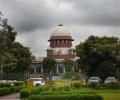
The Supreme Court of India will likely hear a batch of petitions challenging the constitutional validity of the Waqf (Amendment) Act, 2025 on April 15. The Act, which came into force on April 8, has been met with widespread criticism from various stakeholders, including politicians, the All India Muslim Personal Law Board (AIMPLB), and Jamiat Ulama-i-Hind. They argue that the law is discriminatory and violates the fundamental rights guaranteed under Articles 25 and 26 of the Constitution. The petitions allege that the amendments give the government more control over the administration of Waqf, effectively sidelining the Muslim minority from managing their own religious endowments.

A three-judge Supreme Court bench will hear petitions challenging the constitutional validity of the Waqf (Amendment) Act, 2025, on April 16. The petitions, including those by politicians and the All India Muslim Personal Law Board (AIMPLB) and Jamiat Ulama-i-Hind, were filed in the top court challenging the validity of the newly-enacted law. The Centre has filed a caveat in the apex court, seeking a hearing before any order is passed.

The Supreme Court on Friday refused to entertain a fresh plea challenging constitutional validity of the Waqf (Amendment) Act, 2025.

'Grief united all of us as Ahmedabadis.'

The Delhi High Court has stayed the release of the movie 'Udaipur Files' amid concerns that it could promote communal disharmony. The court has directed petitioners to approach the central government with their grievances, and the stay will remain in effect until the government decides on the matter.

Jamiat Ulama-i-Hind, a Muslim body, has raised objections to a recent fashion show held in a local college where participants walked down the ramp wearing burqas.

The case has been registered against entities such as the Halal India Private Limited Chennai, Jamiat Ulama-i-Hind Halal Trust Delhi, Halal Council of India Mumbai, Jamiat Ulama Maharashtra and others for allegedly exploiting religious sentiments to boost sales by providing halal certificates to customers of a specific religion, the UP government said in a statement on Saturday.

The Supreme Court on Wednesday said that it would hear after two weeks the petitions filed by Muslim body Jamiat Ulama-i-Hind and others seeking directions to various state governments to ensure that no further demolition of properties of alleged accused in rioting cases of violence is carried out.
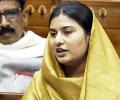
Samajwadi Party leader and Kairana MP Iqra Choudhary has moved the Supreme Court seeking effective implementation of the Places of Worship (Special Provisions) Act, 1991. This move comes amidst several petitions challenging the law's validity, including those filed by the Akhil Bhartiya Sant Samiti and lawyer Ashwini Upadhyay. The Supreme Court, in December 2022, had restrained all courts from examining fresh suits and passing interim orders in pending cases seeking to reclaim religious places. The Act aims to maintain the religious character of places of worship as they existed on August 15, 1947, but the dispute relating to Ram Janmabhoomi-Babri Masjid at Ayodhya was kept out of its purview. The court has listed Choudhary's plea with other pending pleas for February 17.

The apex court said it cannot pass an omnibus order preventing authorities from taking action.

The Supreme Court on Tuesday said it will lay down guidelines for all citizens and not for any particular community on the issue of demolition of properties.

With several state administrations flattening the houses of those involved in criminal cases with bulldozers, the Supreme Court on Monday questioned how can anybody's house be demolished just because he is an accused.
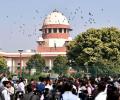
A bench comprising Chief Justice Sanjiv Khanna and Justice Sanjay Kumar also indicated that it may not take up the pending scheduled petitions, heard earlier by a three-judge bench, during the day as it was sitting in a combination of two judges.
The Centre on Thursday assured the Supreme Court that it will neither denotify Waqf properties, including "Waqf by user", nor make any appointments to the central Waqf council and boards till May 5.
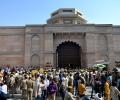
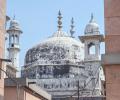
The Supreme Court of India is scheduled to hear a batch of petitions challenging the validity of certain provisions of the Places of Worship (Special Provisions) Act, 1991, which prohibits lawsuits to reclaim a place of worship or change its character from what prevailed on August 15, 1947. The pleas, including one filed by Ashwini Upadhyay, argue that these provisions violate the right to judicial remedy and create an arbitrary cut-off date. The matter will be heard in the backdrop of several ongoing cases related to places of worship, including the Gyanvapi Mosque in Varanasi and the Shahi Idgah Mosque in Mathura. The Muslim side has cited the 1991 law to argue that such suits are not maintainable. The Supreme Court had previously sought the Centre's response to Upadhyay's petition, which alleged that the law creates an "arbitrary and irrational retrospective cut-off date" for maintaining the character of places of worship.

In a statement, the state government alleged 'malicious attempts' to discourage the use of products lacking a halal certificate not only seek 'unfair financial benefits' but also form part of a 'pre-planned strategy to sow class hatred, create divisions in society, and weaken the country' by "anti-national elements".

The Jamiat Ulama-i-Hind has moved the Supreme Court seeking a direction to the Centre and some states, including Madhya Pradesh and Uttar Pradesh, that "precipitative actions" like razing buildings in criminal proceedings be not taken.

The Supreme Court on Friday said it will hear after Dussehra vacation the pleas filed by Muslim body Jamiat Ulama-i-Hind and others seeking directions to various state governments to ensure no further demolition of properties of the accused in rioting cases is carried out.
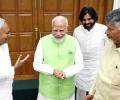
It also cautioned that if the legislation is passed, the "two crutches" on which the Bharatiya Janata Party-led government is running at the Centre would not be able to escape responsibility.
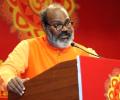
Narsinghanand has several cases against him, including for allegedly making a hate speech at a conclave in Haridwar in December 2021, and was out on bail.

We expect the authorities to strictly follow the due procedure under the law, the SC said.

We will follow the SC order and there will be no further action in Jahangirpuri, the mayor said.
The AIMPLB contended that the object of the Act is to prevent disturbances of public order, maintain peace and tranquility, and strengthen the basic feature of secularism.

Stating that the United Progressive Alliance government was committed to the welfare of minorities, Prime Minister Manmohan Singh, in a letter to Jamiat Ulama-I-Hind, said there was a need to create "broad-based national consensus on the issue of reservations to the Muslim community."
'At the far end we have the likes of Maulana Mahmood Madani with their separatist agenda, but that does not mean every Muslim is persuaded by the Jamiat Ulama-i-Hind's bunkum.'

In an affidavit filed in the court in response to petitions challenging the law, the Union of India said that despite the top court setting aside the practice in 2017, it has "not worked as a sufficient deterrent in bringing down the number of divorces by this practice" among the members of the Muslim community.
A bench of Justices B R Gavai and K V Viswanathan clarified that its order will not be applicable to unauthorised structures on public roads, footpaths etc.

A plea has been filed in the Supreme Court seeking a court-monitored investigation and prosecution in hate crimes related to the "continuous attack" on the personality of Prophet Mohammad and disparaging remarks by various people in different parts of the country attacking the very belief system of Muslims at large.
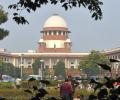
The pleas, filed by advocate Vishal Thakre and others and an NGO 'Citizens for Justice and Peace', have challenged the Constitutional validity of the Uttar Pradesh Prohibition of Unlawful Religious Conversion Ordinance, 2020 and the Uttarakhand Freedom of Religion Act, 2018 which regulate religious conversions of interfaith marriages.

Several Muslim organisations on Wednesday demanded dismissal of Samajwadi Party government in Uttar Pradesh and imposition of President's rule in the state, saying Chief Minister Akhilesh Yadav has failed to contain communal violence in Muzaffarnagar and surrounding areas.

'Islam is the oldest religion among all religions. India is the best country for Hindi Muslims'
Denying charges that Madarasas were terror hubs, Jamiat Ulama-i-Hind General Secretary Maulana Hakimuddin Qasmi has said that Darul Uloom or any Madarasa in the country never harboured terror activities.
"I want to put this in absolutely clear terms that Islam does not preach violence. In fact, the so called jihad that terror groups talk about, is not what they think it is. Real jihad in fact means fighting the perpetrators of terror," the cleric said. Madni added that the Jamiat is planning to organise a conference to discuss the various aspects of terrorism and ways to stop it, in Mumbai next month.
 © 2026 Rediff.com - Advertise with us - Disclaimer - Privacy Policy - Sitemap - Feedback - About us - Terms of use - Grievances