
From Dr A P J Abdul Kalam to Sourav Ganguly, these coming biopics are bringing some of India's most fascinating lives to the big screen.

Astronaut Shubhanshu Shukla discusses the Gaganyaan mission and its potential to inspire other nations in space exploration, drawing on his experiences as an IAF test pilot and his time on the International Space Station.
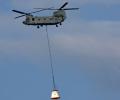
ISRO successfully conducted the first Integrated Air Drop Test (IADT-01) to validate the parachute-based deceleration system for the Gaganyaan mission, demonstrating a crucial step towards India's human spaceflight program.
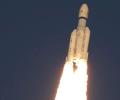
Indian Space Research Organisation scientists have carried out a new experiment on the indigenously developed C25 cryogenic stage of the LVM3-M5 rocket which successfully placed the Communication Satellite CMS-03 into the intended orbit on Sunday, said its Chairman V Narayanan.

A parliamentary committee has voiced concerns over ongoing examination irregularities despite government measures, recommending the Ministry of Education publish a time-bound roadmap for reforms. The panel also urged a nationwide blacklist of firms involved in exam processes and suggested utilising the National Testing Agency's financial surplus to enhance its capabilities.

Concerns are rising about the status of GalaxEye Space's Mission Drishti, India's first Made in India OptoSAR satellite, launched on May 3. Reports suggest the satellite is tumbling in space, and experts highlight potential issues with solar panel deployment and stabilisation. The company has remained silent on the matter, fueling further speculation.

The CBI Director has updated a parliamentary panel on the NEET-UG paper leak investigation, while education ministry officials outlined measures for a fair retest.

The role of the space sector in armed conflicts came into sharp focus during Operation Sindoor, which saw extensive use of drones and loitering munitions and tested the capabilities of air defence systems such as indigenously developed Akash Teer.

The NASA-ISRO NISAR mission has entered its 90-day commissioning phase, involving rigorous checks and calibrations to prepare the satellite for Earth observation. Scientists highlight the collaborative benefits and technological advancements of the mission.
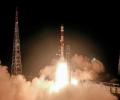
State-run Hindustan Aeronautics Limited has won a bid under which it will receive technology from the Indian Space Research Organisation for the end-to-end commercial production of the Small Satellite Launch Vehicle (SSLV), a first for the industry as India seeks to become a global hub for small satellite manufacturing and launches.
The successful Artemis II mission has boosted confidence in India's upcoming Gaganyaan mission, as both aim to demonstrate similar spaceflight capabilities. Experts highlight the collaboration between ISRO and NASA and the shared training programmes for astronauts.

The move follows a quiet visit by National Security Advisor Ajit Kumar Doval to the Vikram Sarabhai Space Centre in Thiruvananthapuram.

ISRO to launch a 6,500 kg communication satellite built by the US, marking a significant milestone in the Indian space program after the successful launch of the NASA-ISRO NISAR mission.

We who were dreaming of being the third largest economy in dollar terms, have slid back to sixth, thanks to the falling rupee. We are moving about with begging bowls for investments and trade opportunities, which will be a while in materialising, if ever, notes Shreekant Sambrani.
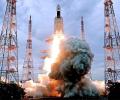
'You can observe a lot of things from space.' 'Another thing is communication, in real time, especially in war-like situations.' 'During Operation Sindoor, we could play our part well.'

Indian astronaut Shubhanshu Shukla, currently on the ISS as part of the Axiom-4 mission, has acknowledged ISRO's efforts in ensuring his safe travel. He spoke with ISRO chairman V Narayanan about his well-being and the experiments being conducted on the ISS.
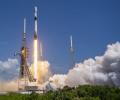
'ISRO recommended to carry out in-situ repairs or replacement and conduct a low-temperature leak test to validate system performance and integrity, before proceeding with launch.'

It remains a mystery that when its scientists were accused of selling technologies which did not exist in ISRO, ISRO's leadership did not say to the public that they were searching in a dark room for a black cat which was not there, points out Ambassador T P Sreenivasan.
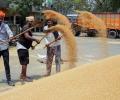
ISRO has projected wheat production of 122.24 million tonnes.

Param Foundation inaugurates 'ParSEC Whitefield', a 30,000 sq ft experiential science and innovation centre in Bengaluru, designed to engage visitors through interactive exhibits, innovation workshops and public programmes.
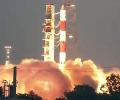
ISRO chairman announces plans for nine major launches by the end of the fiscal year, including the Blue Bird Block2 communication satellite for the US in collaboration with NASA.
ISRO Chairman V Narayanan announced the development of a massive rocket capable of placing 75,000 kg payloads in low earth orbit, highlighting India's growing space capabilities and future satellite launches.

While India's interplanetary ambitions remain significant, the current pace of financial and technical progress raises questions about whether the 2027-2028 timelines can be met.

Weighing 190 kg, Mission Drishti is India's heaviest privately developed Earth observation satellite.
'There's too much coincidence in back-to-back failures of missions critical to national security.'

Twice every 12 days, the NISAR satellite will scan nearly all of earth's land and ice surfaces to measure changes in the planet's ecosystems, growth and retreat of its land and sea ice, and deformation of its crust.
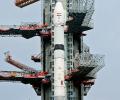
The main focus of the all weather RISAT-1B satellite will be to observe the Indian land with its C-band synthetic aperture radar.
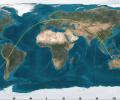
The Indian Space Research Organisation (ISRO) announced that the fourth edition of the PSLV Orbital platform Experiment Module (POEM-4), used for the space docking experiment mission, has successfully re-entered the Earth's atmosphere. The module, a repurposed spent upper stage of the Polar Satellite Launch Vehicle, impacted at 02:33 UTC (08:03 IST) on April 04, 2025, in the Indian Ocean. This successful re-entry signifies ISRO's commitment to mitigating space debris and contributing to the long-term sustainability of the outer space environment. POEM-4 had hosted 24 payloads during its mission life, yielding valuable science data. ISRO and the United States Space Command (USSPACECOM) closely monitored the module's orbit decay and predicted the re-entry date. This event showcases ISRO's proactive approach to responsible space operations.

'A solid motor, once ignited, burns until the propellant is exhausted. It cannot simply stop mid-burn,' said a retired senior ISRO official. 'That is what makes this failure puzzling.' Venkatachari Jagannathan reports on the latest PSLV failure.

K Kasturirangan, former chairman of the Indian Space Research Organisation (ISRO), passed away at the age of 84 in Bengaluru on Friday. He was suffering from age-related ailments for the past few months. Kasturirangan, who also served as the chairperson of the drafting committee on the New National Education Policy (NEP), was a renowned space scientist and had a distinguished career spanning several decades. He was known for his contributions to ISRO's successful space programs and his role in shaping India's education policy.
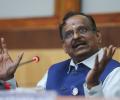
Ahead of Prime Minister Narendra D Modi's meeting United States President Donald J Trump, Russia's ambassador to India and the US charge d'affaires met Indian Space Research Organisation Chairman Dr V Narayanan.
'The work is already on with various data being studied.'

Researchers at IIT Mandi have developed a real-time landslide monitoring and early warning system that has been deployed in landslide-prone areas of Mandi district, Himachal Pradesh. The system uses machine learning and sensors to detect ground movements and provide early warnings to authorities and the public.

"If we have to ensure the safety of our country, we have to serve through our satellites. We have to monitor our 7,000 km seashore. We have to monitor the entire northern part continuously. Without satellite and drone technology, we can't achieve that."

Indian Space Research Organisation's 101st mission from Sriharikota, an earth observation satellite onboard the agency's trusted Polar Satellite Launch Vehicle (PSLV) rocket, could not be accomplished on Sunday following a pressure issue in the third stage of the launch vehicle, the space agency said.
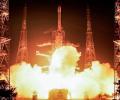
ISRO's vendor policy and quality control processes are under scanner.
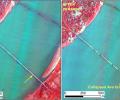
ISRO's Cartosat-3 satellite captured images of the damage caused by the 7.7 magnitude earthquake in Myanmar on March 28. The images show significant damage in Mandalay and Sagaing cities, including the complete collapse of the historic Ava (InnWa) Bridge near Inn Wa City. The earthquake also caused cracks and ground ruptures in the flood plains of the Irrawaddy River.
'The satellite's condition is healthy.'

Narayanan has a long and distinguished career at ISRO, having played a key role in several important missions, including Chandrayaan-2 and 3, and the Gaganyaan programme.
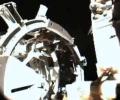
The Indian Space Research Organisation (ISRO) has successfully de-docked the SpaDeX satellites, a significant achievement that clears the path for future missions such as exploring the moon, human spaceflight, and building India's own space station. The de-docking, announced by Union Minister Jitendra Singh, follows a successful docking experiment conducted in January. The SpaDeX mission involved launching two satellites, SDX01 and SDX02, to demonstrate the docking technology in space.
