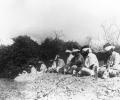
Can Imperial Japan be forgiven for what it did to Indian soldiers it was supposed to protect as PoWs?

The proscribed ULFA(I) claimed drone and missile attacks on its camps along the Myanmar border by the Indian Army, resulting in casualties. The Indian Army has not confirmed the incident. Assam Chief Minister Himanta Biswa Sarma denied state police involvement.
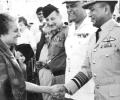
There are times in each nation's life when the gods shower their blessings on it. The right leaders are in place and they make the right decisions. Everything seems to click and good luck favours its people. Such times came to this country 50 years ago, recalls Admiral J G Nadkarni (retd).
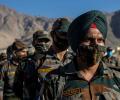
'China is mindful of the fact that it is not confronting the Indian Army of 1962. But the sabre rattling will continue.'
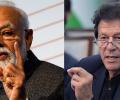
Modi's hardline policy towards Pakistan and J&K has created numerous leverages and bargaining positions that New Delhi can bring to the bargaining table and translate into concessions, argues Ajai Shukla.

General T N Raina was an iconic Indian military leader whose contributions to the nation should be more widely known, notes Lieutenant General Syed Ata Hasnain (retd).
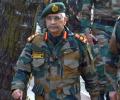
The commanders will also deliberate on the overall situation in Jammu and Kashmir besides delving into issues having national security implications, they said. However, the main focus will be on the situation in eastern Ladakh where Indian and Chinese troops are locked in an eyeball-to-eyeball face-off in Pangong Tso, Galwan Valley, Demchok and Daulat Beg Oldie, the sources said.

The Indian Army has been matching up to the Chinese build up in both Pangong Tso lake and Galwan Valley, the two locations in Ladakh which have witnessed major reinforcement of troops in the last two weeks, sources said. There was very little chance of easing of tension anytime soon as both sides are aggressively holding onto their respective positions, they said.
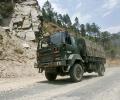
It is learnt that Defence Minister Rajnath Singh has conveyed to top military brass that there was no need for reviewing the implementation of any of the key projects along the Line of Actual Control (LAC) in Ladakh, Sikkim, Uttarakhand or in Arunachal Pradesh in view of the aggressive behaviour by Chinese troops in several sensitive areas.
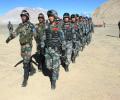
Indian and Chinese troops remained engaged in an eyeball-to-eyeball situation in several disputed areas.
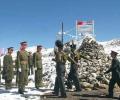
People familiar with the situation in the region said the two sides were engaged in trying to resolve the dispute, but there was no indication of a positive outcome yet as both the armies continued to bolster their positions in disputed areas of Pangong Tso and Galwan Valley and Demchok.
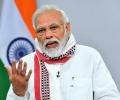
The military brass is learnt to have apprised Modi about the evolving situation in eastern Ladakh, though officials maintained that the agenda of the pre-scheduled meeting was to discuss the ambitious military reforms and ways to boost India's combat prowess.
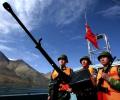
The Chinese side has particularly bolstered its presence in the Galwan Valley, erecting around 100 tents in the last two weeks and bringing in heavy equipment for construction of bunkers, notwithstanding the stiff protest by Indian troops. There have been reports of multiple incidents of transgressions by Chinese troops in several areas in Eastern Ladakh.

'They know that India is no pushover.' 'We have to be extremely vigilant, remain ready and keep strengthening our positions.' 'We have to be militarily strong, whatever be the cost.'
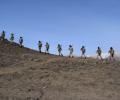
The MEA said it was the Chinese side that recently undertakook activities hindering India's normal patrols in the areas.

'When I looked at the map I was astonished to see the extent of the enemy minefields and the heavy concentration of armour and artillery. This deployment was specially designed to confront the numerically larger Indian Army. Of course, it didn't work! Later we learned how poor 'our intelligence' was. There was not even one-third deployment of the enemy on the ground!!' remembers Colonel John Taylor (retd), a young captain in the 1971 war.
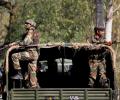
Defence sources had said possible 'action plan' was also discussed about how the Army can respond to the attack.

'When war is thrust on you as in 1962 and 1965 or is tempting as in 1971, ensure that all other fronts are kept quiet, leaving your army free to deal with one,' says Shekhar Gupta.

'He was believed to finish his own work in an hour and spend the remainder of the time walking from one office to another, sitting down with the harried junior staff and helping them sort out the problems they were working on.'
 © 2026 Rediff.com - Advertise with us - Disclaimer - Privacy Policy - Sitemap - Feedback - About us - Terms of use - Grievances