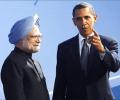
Prime Minister Manmohan Singh will meet with United States President Barack Obama at the White House next month, where the two leaders will chart a course seeking enhanced bilateral ties and defence cooperation between the two countries, US officials have said. Dr Singh will visit the White House on September 27.

Australia's Prime Minister Tony Abbott on Friday said he will sign an agreement with India to sell uranium for non-weapon use. "Prime Minister Modi and I will today sign a nuclear cooperation agreement that will finally allow Australian uranium to India," he said while addressing a meeting, organised by industry chambers including CII and Ficci.

Aziz Haniffa reports from Washignton, DC, on Foreign Secretary Sujatha Singh's three-day visit to the US capital.

All the three issues raised by China at the Modi-Xi meeting are either intractable or peripheral to the bilateral relations and suggest conventional methods to placate the other side without yielding much, says Srikanth Kondapalli.

Indian diplomat Devyani Khobragade, whose arrest soured India-US relations, was on Friday re-indicted on visa fraud charges, a couple of days after a US court dismissed an earlier indictment.

'It would not be incorrect to say that the Chinese-Pakistani strategy of containing India began in the aftermath of the 1965 war.'

'There is much symbolism in President Pranab Mukherjee's participation in the Victory Day celebrations in Moscow.'

It is time to throw an outer ring around India's national security by proactively engaging in areas immediately outside our neighbourhood. Such a ring will not only insulate India from emerging threats, but also create new leverage in securing our own neighbourhood, says Nitin Pai.
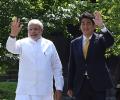
Although the India-Japan relationship has its own driving forces in terms of robust economic ties and shared values, China is the elephant in the room in the strategic parleys between the two countries, says Rup Narayan Das.

'The origins of the model of planned economic development adopted by independent India was a direct consequence of the war.' 'The war provided an opportunity for groups at the margins of Indian society to find new avenues for mobility.' 'The war also led to the emergence of India as a major Asian power and set the stage for it to play a wider role in international politics.'

President Obama's coming visit to India has created quite a buzz, here is a look at all past visits of American Presidents to the country
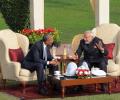
'When George Bush Senior decided in 1992 that India and the United States must start talking in this-now-changed world, who would have thought that 10, 15 years down the road, we will start looking at each other as strategic partners?'

'We want to provide data, we want to provide consultation, but we don't want to lecture.' 'The consciousness about this issue in India is starting to get quite high and if we can help contribute to solving this air quality issue in a spirit of partnership with the Indians, it would be a big achievement.'

India comes under attack over religious intolerance, human trafficking and slavery at a Senate Foreign Relations Committee hearing.

Indian Ambassador to the United States Dr S Jaishankar told Rediff.com's Aziz Haniffa that it was "a very nice meeting and President Barack Obama was extremely cordial."

'The question remains: Was the Obama visit truly a success? Only the future will tell us if the "breakthrough" in the nuclear liability issue will concretise into electricity.' 'As importantly, it will be interesting to watch how India's relations with China will evolve in the months to come.'

'Pakistan may feel emboldened to give an upswing to the proxy war in J&K, having secured a better international consensus on its strategic importance.' 'The raising of Pakistani flags by separatists in J&K is an attempt to win psychological space and more of this can be expected as we go into the summer.' 'Pakistan should remain warned that pushing India on this issue will be dangerous.'

On her last day as India's envoy to the United States, Ambassador Nirupama Rao was felicitated by the Barck Obama administration at the State Department on Monday, with US Secretary of State John F Kerry thanking her for her service toward furthering the strategic partnership between the two nations.
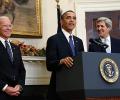
'The threat that India faces and the threat the United States faces is not just to the homeland, but to our people and to our institutions wherever they may be.' In an exclusive conversation with Aziz Haniffa/Rediff.com, US Assistant Secretary of State Nisha Desai Biswal outlines the importance of Prime Minister Modi's visit for America.

'The US wants Modi to succeed because we want India to succeed. For our part, when India thinks of its partners in the world, we want it to think of the US first. That means positioning our country as the preferred provider of the key inputs that can help to propel India's rise.' 'The meeting between Modi and Obama is, and must be, an opportunity for true strategic dialogue -- not a scripted exchange of talking points, but an open discussion of the big questions. What kind of world do we want to live in? What are our true priorities? And most importantly, why does this partnership still matter?'

In the second and concluding part of his interview, Gurumurthy outlines the two areas he believes the government should focus on.

The debate over Prime Minister Modi's nixed Congressional address continues. Aziz Haniffa has the scoop
The two countries that will be most affected by the internal developments in Pakistan are India and the United States, says Bob Blackwill. Aziz Haniffa reports

'We don't have to be the world's policeman. We don't have to impose our values. But we need to lead and when we pull back as we've done, you begin to see exactly what happens -- the voids are filled by threats of terror that countries have to suffer with, including India.'
The finance minister hiked the total defence expenditure from Rs 203,672 crore in FY 2013-2014 to Rs 229,000 crore for FY 2014-2015. Though the increase appears substantial, it is insufficient to undertake the military modernisation necessary to meet the emerging threats, feels Brigadier Gurmeet Kanwal (retd).

India and Japan have a shared interest in countervailing China's hegemonic ambitions in Asia. Although neither has an interest in forming an overt anti-China alliance, Tokyo and New Delhi feel increasingly obligated to work together to find ways to guard against a muscular Beijing's power sliding into arrogance, says Brahma Chellaney.

'Modi's investment in the relationship with Washington is the biggest deliverable of this visit. He means business and that's fantastic!'

Terrorism and Afghanistan were the focus points of Prime Minister Narendra Modi's talks with Uzbek President Islam Karimov on his first visit to Central Asia.

'Devyani -- she is a public servant and her personal life has already received far too much attention -- and her ambitious father now need to retreat to the background so that wiser diplomatic heads restore sanity to India-US relations as India prepares for parliamentary elections,' says Ambassador K C Singh.
Natwar Singh's book is un-illuminating, largely self-justificatory, often contradictory, and at times tendentious. He is too preoccupied with depicting himself as a victim of the Congress party's machinations, says Praful Bidwai.

'The Panchsheel Agreement is unique in the annals of international relations as it stands out as a bizarre illustration of a prime minister trading his country's crucial national interests solely to buffer his personal international image,' feels R N Ravi.

'When you see Modi standing there at the G20, or in New York or at the United Nations, amongst all the leaders, he stands out in the crowd.' 'He looks different, he sounds different, and he has something about his quality of presentation, his oratorical skills, which clearly set him apart from the crowd.' 'The relationship between Modi and the rest of the world and India and the rest of the world has been reset as a result of the election in 2014.'

'Evacuating' Devyani's maid's family from India on T visas -- associated with severe sex or labour trafficking... The maximum number of persons thus evacuated by the US from foreign countries last year was from India... A thorough investigation of this is required at India's end,' says former foreign secretary Kanwal Sibal, 'with the US warned that such interference in India's judicial system will not be tolerated.'

In perhaps the first major conference on the United States-India strategic partnership in the aftermath of the Khobragade controversy that plunged the bilateral relationship in a downward spiral and is now in the process of being resurrected, the undeniable consensus among the panelists and participants was that much ballyhooed strategic convergence between Washington and New Delhi has dissipated.

'We have a common way of looking at the world, a common way of thinking, and a common set of values that predispose us to be partners. And our interests overlap greatly,' Dr Ashton B Carter, America's next defence secretary, told Aziz Haniffa/Rediff.com in an exclusive interview.
 © 2026 Rediff.com - Investor Information - Advertise with us - Disclaimer - Privacy Policy - Sitemap - Feedback - About us - Terms of use - Grievances