
'Theatrics replace analysis. Public spectacle takes the place of public service.'

Her black bag had "National Herald Ki Loot" emblazoned over it in red colour.

A special court in Mumbai denied bail to businessman Sujit Patkar, an aide of Shiv Sena (UBT) MP Sanjay Raut, in the alleged COVID treatment centres scam. The court found that Patkar played with the "life of people" by under-deployment of doctors and staff to generate proceeds of crime. The Enforcement Directorate (ED) alleged that Patkar's firm, Lifeline Hospital Management, fraudulently obtained a contract for supplying medical staff at Dahisar and Worli Jumbo Covid facilities during the pandemic, resulting in the generation of proceeds of crime (PoC) amounting to Rs 32.44 crore. The court noted that there are ample statements of the witnesses to show that a list of more staff members was prepared than being deployed on the instructions of Patkar.

The Supreme Court will hear on Friday a plea challenging a Bombay high court verdict upholding a Mumbai college's decision to ban hijabs, burqas and naqabs inside the campus.
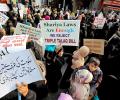
The Supreme Court on Friday said that it will set up a five-judge Constitution bench to hear pleas challenging the constitutional validity of polygamy and 'nikaah halala' practice among Muslims.
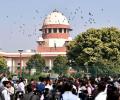
The Supreme Court said on Thursday that it will set up a fresh five-judge Constitution bench at an "appropriate stage" to hear pleas challenging the constitutional validity of polygamy and 'nikah halala' among Muslims.

The Supreme Court said on Thursday it will set up a fresh five-judge Constitution bench to hear the pleas challenging the constitutional validity of polygamy and 'nikah halala' among Muslims.

A bench of Justices Hemant Gupta and Justice Vikram Nath noted that as of now 246 witnesses have been examined.
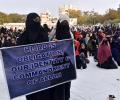
A bench comprising Chief Justice D Y Chandarchud, and Justices V Ramasubramanian and J B Pardiwala, took note of the submissions of senior advocate Meenakshi Arora that an interim order was needed keeping in mind the practical examinations, scheduled for some classes from February 6 in the state.
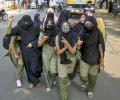
Asserting that hijab is the "identity" of Muslims, senior advocate Dushyant Dave told the Supreme Court on Monday that various acts of omission and commission like Karnataka's headscarf controversy showed a "pattern to marginalise the minority community".

The Supreme Court is scheduled to pronounce its verdict on Thursday on a batch of petitions challenging the Karnataka high court judgment refusing to lift the ban on hijab in educational institutions of the state.
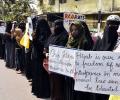
A student cannot wear hijab to a secular school as a matter of right, Supreme Court judge Justice Hemant Gupta said on Thursday, insisting that they are required to follow the discipline of the school in the matter of uniform.
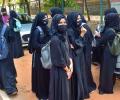
Citing popular protests in Iran, an Islamic country, against the mandatory use of hijabs, he claimed that religion freedom in India cannot mean promotion of "separatist" designs.
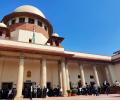
The apex court noted that the Representation of People Act, 1950, read with the Conduct of Elections Rules, 1961, has contemplated the name of a candidate has to be proposed while filling the nomination form.
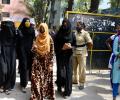
As you know that the Karnataka Education Act and Rule does not permit any religious items inside the class. So we are very clear that no student can wear hijab inside the class, Nagesh explained.

The apex court also issued notice on the interim relief sought in the plea for restraining the state from appointing or dismissing 'archakas' (priests) at temples and Hindu religious institutions in the state till the disposal of the petition.

The Supreme Court on Tuesday sought the response of the National Human Rights Commission (NHRC), National Commission for Women (NCW) and the National Commission for Minorities (NCM) to pleas challenging the constitutional validity of polygamy and 'nikah halala' among Muslims.
The courts are not forums to solve "theological questions", Supreme Court judge Justice Sudhanshu Dhulia said on Thursday in his verdict on the Karnataka hijab ban controversy.

The counsel appearing for the Centre told the top court on Friday that they have written to the secretaries of the ministries of external affairs as well as health on the issue.
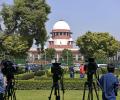
Supreme Court judge Justice Hemant Gupta, who is set to retire on October 16, said on Friday that a judge cannot make people happy as "that's not the role assigned to him".

It is necessary to have discipline in schools but not at the cost of freedom and dignity, Supreme Court judge Justice Sudhanshu Dhulia said on Thursday in his judgment on the Karnataka hijab ban row.
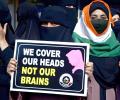
While Justice Hemant Gupta dismissed the appeals against the high court verdict, Justice Sudhanshu Dhulia allowed them.
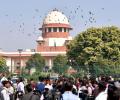
The top court was hearing a plea which referred to his statement on restoring Article 370, which gave special status to Jammu and Kashmir, and contended it clearly amounts to a seditious act and therefore he is liable to be punished under section 124-A of the IPC.
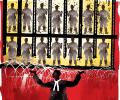
'Judges have families; they have their future to worry about.' 'In an atmosphere of fear, the judges are constantly under some kind of psychological pressure.' 'I have seen this is happening across the board in the country today.'

In March last year, a petition was filed in the Supreme Court by Rajat Sharma and Dr Neh Srivastava who demanded that a former Jammu and Kashmir chief minister be booked under the sedition law, claiming he had sought China's help to restore the erstwhile state's special status.
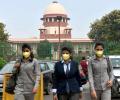
'The right to shelter does not mean right to government accommodation. The government accommodation is meant for serving officers and officials and not to the retirees as a benevolence and distribution of largesse,' a bench of justices Hemant Gupta and A S Bopanna said in its judgement passed last week.
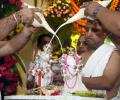
"The Pujari is only a grantee to manage the property of the deity and such grant can be reassumed if the Pujari fails to do the task assigned to him, i.e, to offer prayers and manage the land. He cannot be thus treated as a Bhumiswami," the bench said.
Asking a pre-university schoolgirl to take off her hijab at her school gate is an "invasion" of her privacy and dignity, Supreme Court judge Justice Sudhanshu Dhulia said on Thursday.

The Supreme Court on Friday suggested that the Centre assist the medical students who had returned to the country from Ukraine in view of the war with Russia by creating a web portal giving details of the foreign universities, where they could complete their courses as per the government's academic mobility programme.
A person has a right to practise religion but the question is whether it can be taken to a school which has a prescribed uniform, the Supreme Court observed on Monday while hearing the Karnataka hijab ban row.

Ganesh Chaturthi celebrations will not be held at Bengaluru's Idgah Maidan, the Supreme Court said on Tuesday while refusing to grant permission for the function and ordered status quo on the plot by both parties. Noting that no such function as Ganesh Chaturthi was organised at Idgah Maidan for the past 200 years, the top court asked the parties to approach the Karnataka high court for the resolution of the dispute.
The bench pulled up some of the petitioners, who sought adjournment in the matter, and said it would not permit "this kind of forum shopping".
The Karnataka government told the Supreme Court on Wednesday that the state has not touched any "religious aspect" in the hijab ban row and that the restriction on wearing the Islamic headscarf is limited to the classroom.
The Supreme Court said on Thursday it is not the 'interpreter' of the Holy Quran and it has been argued before it in the Karnataka hijab ban matter that courts are not equipped to interpret religious scriptures.
The Supreme Court on Wednesday asked whether there is any authentic figure regarding the dropping out of students from educational institutions in Karnataka because of the hijab ban and the subsequent judgment by the high court on the issue.
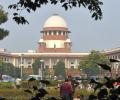
The Centre has moved the Supreme Court seeking review of the May 5 majority verdict which held that 102nd Constitution amendment took away the power of state governments to declare Socially and Educationally Backward Classes (SEBC) for grant of quota in jobs and admissions.
The apex court observed the five Ks in Sikhism -- Kesh, Kara, Kanga, Kaccha and Kirpan -- are well established.
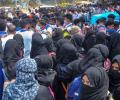
The Supreme Court on Wednesday said that the question in the Karnataka hijab ban matter is only about the restriction in schools as nobody is prohibited from wearing it anywhere else they want.
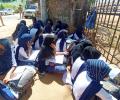
The Supreme Court on Thursday reserved its verdict on a batch of petitions challenging the Karnataka high court judgment refusing to lift the ban on hijab in educational institutions of the state.
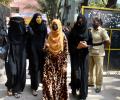
The counsel for the petitioners in the hijab ban row on Monday told the Supreme Court the Karnataka high court did an "objectionable" thing when it tried to "interpret" the Holy Quran and held the headscarf worn by Muslim women was not an essential religious practice.
 © 2026 Rediff.com - Investor Information - Advertise with us - Disclaimer - Privacy Policy - Sitemap - Feedback - About us - Terms of use - Grievances