
Rising mercury levels in Madhya Pradesh are causing discomfort for residents as night temperatures fail to provide relief, disrupting sleep patterns and daily routines.

This is the time for India to plan forward fully, with the goal of Atmanirbharata, and energy security. The Persian Gulf is no longer a reliable source, points out Rajeev Srinivasan.
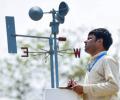
'This system will be of immense help in agricultural planning, disaster management and water resources management.'

About 57 per cent of Indian districts, home to 76 per cent of the country's population, are currently at high to very high risk from extreme heat.

ITC reported a 6.1 per cent year-on-year growth in its consolidated adjusted net profit from continuing operations, reaching ~5,469.74 crore in the January-March quarter (Q4FY26), primarily fuelled by strong performances in its cigarettes and non-cigarette fast-moving consumer goods (FMCG) businesses.

Four Census officials were assaulted in Odisha's Dhenkanal district, prompting the state government to formulate a standard operating procedure (SOP) to safeguard census officials from physical harm and heat-related risks.

'During the hot season (April to June), above-normal minimum temperatures are likely over most parts of the country, except in some regions of Maharashtra and Telangana, where minimum temperatures are expected to be normal to below normal,' IMD said.
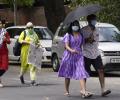
The India meteorological department said heatwave conditions will persist for at least two more days.
India is expected to experience hotter-than-usual temperatures from April to June, with more heatwave days in central and eastern India and the northwestern plains, the IMD said. Most parts of the country will see higher-than-normal maximum temperatures, except for some areas in western and eastern India where the temperatures are expected to be normal. Minimum temperatures will also be above normal in most regions. The IMD has warned that landslides could occur in parts of Kerala and Karnataka in the Western Ghats and that northeastern states might face flooding in April.
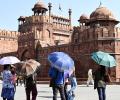
In Rajasthan, Pilani recorded 44.9 degrees Celsius, Phalodi and Churu touched 43.8 degrees Celsius and 43.5 degrees Celsius respectively, while Bikaner and Jaipur registered 43.4 degrees Celsius and 43 degrees Celsius.

As Mumbai, Thane and other neighbouring districts in Maharashtra's Konkan region swelter under an unexpected, scorching heatwave, Dr Vidhe Sharma suggests how you can keep cool.

India's peak power demand is projected to hit 270 GW this summer, surpassing last year's record of 250 GW.

The heatwave alert has been issued for Mumbai, Thane, Raigad and Ratnagiri on February 25 and 26, the IMD said.

Climate scientists warn that climate change is intensifying heatwaves in India, with the cooling effects of La Nia potentially becoming less effective in a warmer future. The India Meteorological Department (IMD) predicts an early summer with above-normal temperatures and intense heatwave spells, following an unusually dry winter and the warmest February since 1901. Experts emphasize the role of human-caused climate change, along with natural climate drivers like El Nio and La Nia, in shaping weather patterns. While La Nia typically brings cooler temperatures, scientists suggest that under climate change, its ability to mitigate heatwaves may be diminished.
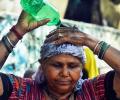
With the summer approaching sooner than scheduled, Maharashtra, Telangana, Odisha, and West Bengal have already started experiencing heat waves with temperatures soaring above 40°C.

As Singapore, New York and Melbourne have shown, cities can mitigate the impact of heatwaves if they have the will to create green infrastructure, explain Amit Kapoor & Bibek Debroy.
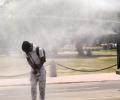
Delhi is experiencing its first heatwave of the season, with temperatures reaching 40.2 degrees Celsius. Doctors have warned that exposure to extreme heat can lead to a range of health issues, from mild rashes and muscle cramps to serious conditions like heat exhaustion and heatstroke. They advise staying hydrated, avoiding outdoor activities during peak hours, and wearing light, breathable clothes. Vulnerable groups like children, the elderly, and those with pre-existing conditions are at greater risk.

Bencic and Paul coasted through the first set but won a total of just 12 points in the second set as the match went into a tiebreak.

The asset quality of microfinance portfolios worsened in the quarter ending June 2024 due to the impact of heatwaves on borrowers' incomes and collections, coupled with rumours of loan waivers, according to Sa-Dhan. Jiji Mammen, executive director and chief executive officer of Sa-Dhan, said loans with 90+ days past due (dpd) rose to 1.2 per cent in June 2024, compared to 0.9 per cent in June 2023. The 90+ dpd also increased from 1.16 per cent in March 2024.

Heatwave conditions are expected over northwest India during the next five days, with Punjab, Haryana, Rajasthan and Delhi predicted to bear the maximum impact, the India Meteorological Department (IMD) said on Thursday.

Ten to 20 days of heatwave are expected against the normal of four to eight days in the entire April-June period.

Temperatures in 17 locations breached 45 degrees Celsius on Monday, with the punishing heat affecting health and livelihoods.
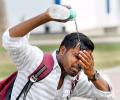
Heatwave conditions have been prevailing in Odisha since April 15 and the Gangetic West Bengal since April 17, according to the MeT department.

To ensure immediate cooling of the body, the hospital has set up a first-of-its-kind heatstroke unit.

The India meteorological department predicted mainly clear skies with heatwave conditions in many parts of Delhi and severe heat wave conditions in other areas.

Chelsea's James warns England of extreme heat at 2026 World Cup

IMD officials said the maximum temperature in the three districts could go up to 38 degrees Celsius.

The unrelenting heatwave sweeping large parts of the country has claimed at least 110 lives and left over 40,000 people grappling with suspected heatstroke between March 1 and June 18 this year, health ministry sources said on Thursday.

Among the fatalities recorded on Friday, the maximum 17 were from Uttar Pradesh, 14 from Bihar, five from Odisha and four from Jharkhand, where officials said more than 1,300 people are hospitalised with heatstroke conditions.

Temperatures remained above 45 degrees Celsius in large parts of Rajasthan, Haryana, Delhi, Chandigarh and Uttar Pradesh, affecting daily life as many chose to remain indoors in the afternoon.
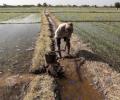
Gross Value Added (GVA) growth in agriculture and allied activities in the first quarter of the 2024-25 financial year (Q1FY25) dipped to 2.7 per cent at constant prices from 4.2 per cent in Q1FY24 due to a drop in output of some crops following heatwave in the main growing months. Low post-monsoon rains, which dried most of the reservoirs in several states across the country, also impacted the production of many crops. At current prices, the growth was estimated at 8.5 per cent as against 4.1 per cent in Q1FY24 due to a spike in food inflation during the April to June months of FY25.
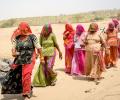
The Election Commission (EC) on Wednesday increased the polling time for the Lok Sabha elections in Telangana by an hour in view of heatwave conditions prevailing in the state.

Delhi sweltered under intense heat as the Safdarjung observatory, considered the official marker of the national capital, noted a high of 43.8 degrees Celsius, four notches above the normal average.
Temperatures are likely to remain in a similar range until Thursday, with a gradual fall expected from June 13.

The threshold for a heat wave is met when the maximum temperature of a weather station reaches at least 40 degrees Celsius in the plains, 37 degrees in coastal areas, and 30 degrees in hilly regions, and the departure from normal is at least 4.5 notches.

Srinagar recorded the maximum temperature of 35.6 degrees Celsius on Wednesday, the highest temperature in the month of July in 25 years since 1999 when the mercury had settled at 37 degrees Celsius, the officials said.
Heatwaves claimed more than 17,000 lives in 50 years in India, according to a paper authored by M Rajeevan, former secretary of Ministry of Earth Sciences, along with scientists Kamaljit Ray, S S Ray, R K Giri and A P Dimri.

After a long and harsh spell of heatwave, Delhi witnessed a pleasant morning on Thursday, with the weather department saying parts of the national capital received light rains.

Heatwave may abate over most parts of North India in next two days; temperatures likely to drop by 2-3C.

'If you look at the entire 60-day period of March and April, you see that temperatures were soaring more than 3.5 degrees Celsius above the maximum temperature.' 'Normally, events like this happen only for a short period.'
