
'It is not economical to operate GSLV-Mk II due to its cost and complexity. Future launches to be managed with LVM3.'
ISRO has successfully launched EOS-05, India's first geo-imaging satellite, into a precise sub-geosynchronous transfer orbit using a GSLV rocket. This 2,367 kg satellite, the heaviest ever carried by a GSLV, will provide real-time imagery for applications in agriculture and disaster management from an altitude of 36,000 km.

'An instruction came from somebody in Delhi saying, "don't go with the launch".'

Buying a mature rocket technology gives companies the designs and hardware know-how, but not necessarily the decades of engineering wisdom needed to make it work.

Global analysts say a successful launch of operational GSLV MkII rocket will reduce dependency for ISRO on foreign launchers.

There is no answer to the question of how IN-SPACe invited EOIs for ISRO's mature rockets and whether it was based on any government policy decision.

A rocket designed and developed by ISRO is being transferred to industry for production.
Nine ISRO associations want to know whether this is simply an effort to expand India's industrial capacity or part of a larger policy under which ISRO itself will eventually withdraw from rocket manufacturing.

It is about proving that the agency can still deliver when the stakes are high.

'I don't think the government will sacrifice such a fine institution for monetary gains.'

A high-level committee investigating the failures of ISRO's PSLV rockets, which have impacted strategic satellite missions, has yet to release its report and recommendations, raising concerns about the future of the ageing launch vehicle.

The EoI comes at a time when ISRO is working to enhance LVM3's payload capacity to five tonnes in GTO and is also evaluating the procurement of a Russian semi-cryogenic engine for the vehicle's second stage.

'He didn't touch upon the core questions raised by the nine employee associations.'

The larger question raised by the associations is simple: If ISRO is no longer to manufacture launch vehicles, what will happen to the institution's accumulated capabilities and the people who built them?
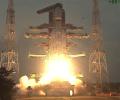
The heaviest communication satellite to be launched from the Indian soil onboard a new generation, homegrown 'Bahubali' rocket was successfully placed into the intended orbit on Sunday, the Indian Space Research Organisation said.

Indian Space Research Organisation's second mission of the year to place an earth observation satellite by a GSLV rocket faced a setback as the mission could not be accomplished fully due to performance anomaly in the cryogenic stage of the rocket, the space agency said on Thursday.

Weighing 6,100 kg, the communication satellite would be the heaviest payload to be placed into the Low Earth Orbit (LEO) in LVM3 launch history from Indian soil.

ISRO chairman S Somanath said the success gave the space agency "greater confidence," as the GSLV will be next deployed in the NISAR mission, a collaborative effort with the US' NASA.

ISRO stated that the disengagement of at least one contact -- in both the main and redundant paths -- of a connector led to the failure of NVS-02.

Based on the broadcast visuals, a rocket expert said the failure appeared similar to the anomaly seen during the PSLV-C61 mission.
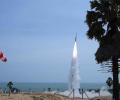
The fuel cost will come down if rockets are launched from Kulasekarapattinam as they will have a straight trajectory and need not have to avoid Sri Lanka, which is being done by rockets flown from Sriharikota.

India and the US on Wednesday marked their maiden space collaboration with the successful flight of a GSLV rocket that placed an earth observation satellite, jointly developed by the two space agencies, in a precise orbit.
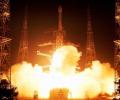
ISRO is part of an exclusive league which has forayed into the Moon and Sun.
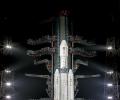
The Indian Space Research Organisation on Thursday launched its first experimental suborbital flight. Here are five things you need to know about the GSLV Mark III mission.

In terms of success rate, the PSLV rocket has an enviable record of 57 successful missions out of 58 commercial ones.

Scientists are working on conducting various tests for the ambitious Gaganyaan mission and the agency is coordinating with the Navy and others in this connection, he said.
The Indian Space Research Organisation successfully launched its 100th mission on Wednesday, with a GSLV rocket carrying navigation satellite NVS-02.

These upcoming launches carry added significance in light of setbacks suffered in recent years.

The satellite, weighing about 4,410 kg will be the heaviest to be launched from the Indian soil and into a Geosynchronous Transfer Orbit (GTO), the space agency said. The satellite will travel onboard a LVM3-M5 rocket, dubbed as 'Bahubali' for its heavylift capability.
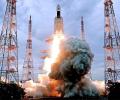
ISRO is developing a third launch pad at Shriharikota to accommodate heavier satellites and next-generation launch vehicles. The new facility will support both crewed and uncrewed missions.

ISRO has announced plans for seven launch missions by March, including the first uncrewed mission for the Gaganyaan project and demonstrations of new satellite technologies.

ISRO is set to launch its communication satellite CMS-03 from Sriharikota. The satellite, weighing 4,410 kg, will be the heaviest launched from Indian soil into a Geosynchronous Transfer Orbit (GTO).
ISRO chairman announces plans for nine major launches by the end of the fiscal year, including the Blue Bird Block2 communication satellite for the US in collaboration with NASA.
ISRO to launch a 6,500 kg communication satellite built by the US, marking a significant milestone in the Indian space program after the successful launch of the NASA-ISRO NISAR mission.
'A solid motor, once ignited, burns until the propellant is exhausted. It cannot simply stop mid-burn,' said a retired senior ISRO official. 'That is what makes this failure puzzling.' Venkatachari Jagannathan reports on the latest PSLV failure.
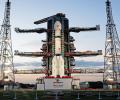
The imaging technology in Nisar can provide very high-resolution data on changes as small as one centimetre in size on the earth's surface.
The Indian Space Research Organisation (ISRO) on Monday successfully launched a second generation navigation satellite, using a GSLV rocket with a cryogenic upper stage to do the job.

It is important for India to develop multiple launch sites and become capable of undertaking more launches in a year's time, says Ajey Lele.
Taking its baby steps towards realising India's ambition to send humans into space, Indian Space Research Organisation on Thursday successfully tested the atmospheric re-entry of a crew module after its heaviest launch vehicle GSLV MK III blasted off from Sriharkota.
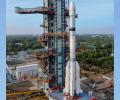
At 6.23 am on 29.1.2025, the 50.9 metre tall and weighing 420.7 ton Geosynchronous Satellite Launch Vehicle-F15 (GSLV-F15) is slated to blast off from the second launch pad carrying the 2,250 kg NVS-02 navigation satellite.
Indian Space Research Organisation is gearing up for one of its busiest times with seven more launches planned this financial year, even as India's first human spaceflight remains scheduled for 2027, its chairman V Narayanan said.
