
'Waiting for a market correction and optimising entry time in the markets will be akin to missing the woods for the trees.'

The report said South Asia is expected to be the fastest-growing region.

With no rate cuts on the table, the other monetary policy alternative could be to reduce the width of the asymmetric policy corridor or increase in reverse repo rate when the pandemic subsides, they opined.

In a festival gift to borrowers, the finance ministry on Wednesday approved guidelines for a scheme for grant of ex-gratia payment of the difference between compound interest and simple interest for six months of loans up to Rs 2 crore.

Moody's on Thursday raised India's GDP forecast for the calendar year 2020 upwards to -8.9 per cent contraction from -9.6 per cent contraction forecast earlier. Similarly, India's GDP forecast for the calendar year 2021 has been revised upwards to 8.6 per cent from 8.1 per cent projected earlier. The report released by Moody's Investors Service attributed the reason behind better growth to the falling of coronavirus cases in the country.

If you plan to invest in an FD, go for the 12-15-month tenure. This will allow you to redeploy maturity proceeds at higher rates (if rates rise), advises Sarbajeet K Sen.

With the world's worst outbreak of COVID pandemic stalling a nascent economic recovery, the government has begun assessing the impact of the second wave of infections on different sectors and may look at providing support at an appropriate time to segments requiring fiscal help. Some of the economic indicators, including the Goods and Services Tax (GST) collections, still provide confidence and incoming data will throw some more light on the state of the economy, sources said. Services sectors like hospitality, tourism and aviation which had just started recovering were hit hard by the second wave of COVID, the sources said, adding these segments might need some support on an urgent basis from the government.

The government's capex spend is expected to rise and much of this is likely to be focussed on rural India, particularly for housing, roads and irrigation.

Fitch Ratings on Wednesday said India's high fiscal deficit would pose a challenge in lowering the debt to GDP ratio, which is expected to rise above 90 per cent in the next five years. It said India entered the pandemic with little fiscal headroom from a rating perspective. Its general government debt/GDP ratio stood at 72 per cent in 2019, against a median of 42 per cent for 'BBB' rated peers.

China is considering a gradual rollback of its last year's $586 billion stimulus package, as the economy sets its sights at over eight per cent growth this year.

Chief Economic Adviser K V Subramanian on Monday said the overall impact of the second wave of COVID-19 on the country's economy is not likely to be large but cautioned about an uncertainty surrounding the pandemic going ahead. He further said that given the circumstances due to the pandemic, it is difficult to forecast if the country would achieve a double digit growth in the current fiscal. The Economic Survey 2020-21 released in January this year had projected GDP growth of 11 per cent during the current financial year ending March 2022.

IThe fiscal deficit target for 2020-2021 was originally set at 3.5 per cent of GDP. But the government's revenues have collapsed and its expenditure burden will only increase over the Budget estimates.' With the government having already planned for an additional borrowing of over Rs 4 trillion, the fiscal deficit for the current year would be much higher than the Budget estimate, notes A K Bhattacharya.

The sovereign ratings outlook for India may turn negative, from stable currently, if the country's fiscal policy fails to check external shocks like crude prices or aggravates the inflation concerns, global rating agency Moody's warned on Monday.

India's sovereign credit ratings do not reflect the economy's fundamentals, the Economic Survey said on Friday and nudged the global agencies to become more transparent and less subjective in their ratings. The Economic Survey 2020-21, tabled in Parliament, said that sovereign credit ratings methodology must be amended to reflect economies' ability and willingness to pay their debt obligations, and suggested that developing economies must come together to address this bias and subjectivity inherent in sovereign credit ratings methodology. "Never in the history of sovereign credit ratings has the fifth largest economy in the world been rated as the lowest rung of the investment-grade (BBB-/Baa3). While sovereign credit ratings do not reflect the Indian economy's fundamentals, noisy, opaque and biased credit ratings damage FPI flows," the survey said.

'Rather than cutting and pasting from advanced economies, we should use basic economic principles to think about what is right for India at the stage of development at which we are,' says Chief Economic Advisor Krishnamurthy Subramanian.

The additional outgo to combat the impact of COVID-19 will significantly erode the fiscal consolidation achieved by the state governments in the past three years, an RBI report said on Tuesday. In its study of the state budgets of 2020-21, the RBI report which has dwelled on the theme 'COVID-19 and its Spatial Dimensions in India', said that Gross Fiscal Deficit (GFD) of the states would spiral during the current fiscal.

'We are looking at the Budget with the hope that it will address all issues even at the cost of exceeding the fiscal deficit target.'

The benefit coming in from the Rs 1.45 lakh crore tax giveaways will also help companies to cut prices by up to 5 per cent to boost consumer demand, which has been sagging and is one of the prime reasons for the deepening slowdown.
The government should focus on growth, inflation management, fiscal policy and relationship with the Reserve Bank of India, according to RBS.

In Q1, India's GDP shrank by a staggering 24 per cent year-on-year amid the imposition of one of the most stringent global nationwide lockdowns.

Analysts at foreign brokerage Bank of America Merrill Lynch said the RBI will cut rates by 0.25 per cent in December, and follow it up with a 0.15 per cent in February.

That's why he is now finally focusing on the two things that alone can help: Fiscal expansion -- from December onwards -- and supply management via amended laws and rules that affect business, notes T C A Srinivasa-Raghavan

On an overall basis, Nomura believes the economic conditions are suited for equity markets. The brokerage is predicting the market performance will be better in the first half of 2020 and "somewhat weaker" in the second half.
It was not immediately clear when Garg submitted his voluntary retirement scheme application to the government. It was also not known if the government would accept the application. If he hadn't applied for VRS, he would have retired from government service at the end of October 2020 on attaining of 60 years of age. Garg did not answer phone calls seeking his comments.

There are several welcome standalone reforms, but these do not add up to a coherent strategy to achieve a $5 trillion economy or secure Aatmanirbharta, observes Rathin Roy.
Rajan also expressed hope that a stable government after the Lok Sabha elections will continue the broad fiscal policies of the current regime and India may finally get the Goods and Services Tax, an ambitious indirect tax reform measure.

The Indian economy is likely to benefit from tailwinds from both monetary and fiscal policy in the coming month
When he speaks of them, it is either in denial or to highlight successes that are only part of a larger story that is worrisome in its totality, observes T N Ninan.
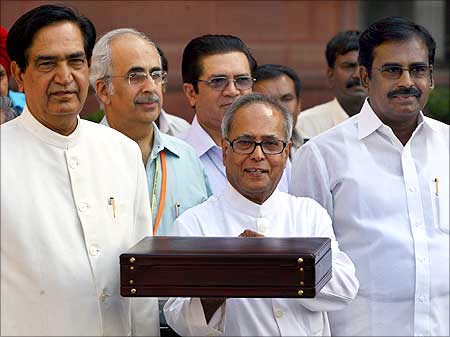
The sad truth is that the debt-to-GDP ratio will shoot up close to 90 per cent in the coming year, and the fiscal deficit glide path does not promise to reduce it substantially any time soon, predicts Mihir S Sharma.
RBI said aggregate demand during the year so far suggests that the shock to consumption is severe, and it will take quite some time to mend and regain the pre-COVID-19 momentum.

The government may have to resort, eventually and however unwillingly, to printing money, abandoned as policy and practice in the 1990, predicts T N Ninan.

'Aggressively stepping up vaccinations will constitute the most enduring stimulus of all in the coming quarters,' observes Sajjid Z Chinoy, Chief India Economist at J P Morgan.
India's rampant inflation remains a hotly debated puzzle.
It took three years of collective fiscal profligacy and policy mismanagement to cause this crisis.

The G-20 leaders under the chairmanship of Saudi Arabia's King Salman held an extraordinary video conference in which they resolved to use all available policy tools to minimise the economic and social damage from the pandemic that has killed over 21,000 people and infected more than 470,000 globally.

While most economies contracted in the second quarter of 2020, the Chinese economy grew by 3.2 per cent.

Alibaba's pervasive economic and social influence in China is seen as a threat to the authority of the Chinese Communist party, notes Shyam Saran.
In less than five months of resuming charge of the finance ministry, Palaniappan Chidambaram has put in place virtually a new team to take charge of the government's fiscal policy management in the remaining months of its tenure. Will the celebrated economists and IAS officers share the required equation remains to be seen.

Developing countries need to focus on raising the growth potential of their economies, while strengthening buffers to deal with risks from the euro area and fiscal policy in the US, the Bank said in its latest report Global Economic Prospects, which was released on Tuesday.
 © 2026 Rediff.com - Investor Information - Advertise with us - Disclaimer - Privacy Policy - Sitemap - Feedback - About us - Terms of use - Grievances