
Mexico is facing widespread violence and travel advisories after the death of drug lord 'El Mencho,' the notorious leader of the Jalisco New Generation Cartel, during a military operation.
The US President had hosted Modi for an official working visit in Washington, DC, on February 13 last year.
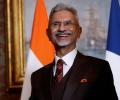
The US Department of State highlighted a mission-defining challenge during External Affairs Minister S Jaishankar's visit in November amid the US government shutdown, detailing the security measures taken to ensure his protection.

"The calf, the only tusker which had survived the accident, died this morning while undergoing treatment at the Centre for Wildlife Rehabilitation and Conservation (CWRC) in Kaziranga," Nagaon Division's Forest Ranger Shamim Akhtar told PTI.

The US has expanded its review of social media and online presence to cover all H-1B speciality occupation workers and their H-4 dependents, the US embassy in India said on December 10.
The United States Embassy in India on Monday said starting December 15, the United States has 'expanded' online presence reviews to all H-1B and H-4 applicants as part of standard visa screening, and this vetting is being conducted globally for 'all applicants of all nationalities' for these two visa categories.
The Trump administration has sanctioned entities and individuals from India involved in sales of Iran's petroleum and petroleum products, saying the funds from this trade support Tehran's regional terrorist proxies and procure weapons systems that are a direct threat to the US.
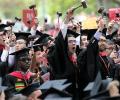
A new report indicates a decrease in international student enrolments in US colleges, but India remains the top source of international students.

The US Department of State's Consular Affairs, in a "security alert", said that "while the cause of the explosion is unknown at this time, the Government of India has placed several Indian states on high alert."

The US Citizenship and Immigration Services (USCIS) in a 'H-1B FAQ' document, released on Sunday, said that the September 19 proclamation took an "important, initial, and incremental step" to reform the H-1B visa programme to curb abuses and protect American workers.
Social media feeds and immigration forums lit up with questions from workers and families who feared they might be stranded abroad, unable to return to their jobs or reunite with loved ones.
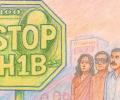
A deep dive into Trump's new policy and what it means for Indian professionals and companies.

India has said it will take all steps to protect its national interests and ensure comprehensive national security in all domains after Pakistan and Saudi Arabia signed a strategic defence pact.
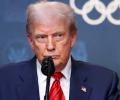
US President Donald Trump signed a proclamation restricting entry of certain non-immigrant workers and imposing a USD 100,000 fee on H-1B visas, citing abuse of the program and national security concerns.
'Another demonstration of strong India-USA counter-terrorism cooperation. Appreciate the Department of State for listing The Resistance Front (TRF) as a designated Foreign Terrorist Organization and Specially Designated Global Terrorist.'

The Supreme Court has ordered authorities not to take coercive action against owners of diesel vehicles over 10 years old and petrol vehicles older than 15 years in Delhi-NCR.
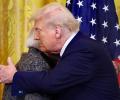
'For the region and for the world, the US working with both those nations is good news.'
The United States has imposed sanctions on at least half a dozen Indian companies accused of trading in Iranian petroleum and petrochemicals as part of broader action targeting 20 entities worldwide.
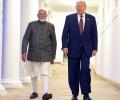
US President Donald Trump expresses frustration with the lack of progress in trade talks with India, imposing a 25% tariff. The move comes amid concerns over trade deficits and India's reliance on Russian military equipment and energy.
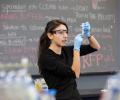
'Violating the terms of your student visa can result in revocation, deportation and even long-term ineligibility for future US visas,' says the US embassy in India.
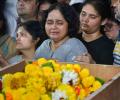
The US has issued a 'Do Not Travel' advisory for Jammu and Kashmir citing potential for terrorist attacks and violent civil unrest. The advisory, issued on Wednesday, comes a day after a deadly terror attack in Pahalgam that killed 26 people, mostly tourists. The advisory also warns against traveling within 10 kilometers of the India-Pakistan border.
'If you follow the law, America offers opportunities. But those who violate the law will face the consequences.'

Pananjay Tiwari, founder and director of Impel Overseas Education, explains how the new changes can impact Indian students who are applying to US universities and those who are already studying in the US.
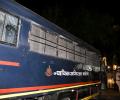
The United States has extradited Pakistani-Canadian Tahawwur Hussain Rana to India to face charges for his alleged involvement in the 2008 Mumbai terrorist attacks. Rana, 64, was convicted in the US in 2011 for providing material support to Lashkar-e-Taiba, the Pakistani militant group responsible for the Mumbai attacks. The US Department of State said it has long supported India's efforts to bring those responsible for the attacks to justice and that the extradition is a critical step towards seeking justice for the victims. Rana's extradition comes after the US Supreme Court denied his last-ditch attempt to evade extradition. He will now face justice in India for his role in the attacks which killed 166 people, including six Americans.
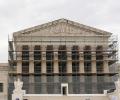
The US Supreme Court has denied the application of Tahawwur Rana, a Canadian national of Pakistani origin accused in the 2008 Mumbai terror attacks, seeking a stay on his extradition to India. Rana, currently detained in Los Angeles, had submitted the application after Associate Justice Elena Kagan initially denied it. Despite a renewed appeal, the Supreme Court ultimately rejected the request.
The Ministry of External Affairs (MEA) has asked Indian students in the US to comply with American laws following the detention of a postdoctoral fellow at Georgetown University and the self-deportation of another student to Canada. The MEA spokesperson said that the two Indians did not reach out to Indian missions in the US for assistance. Badar Khan Suri, the postdoctoral fellow, was detained on charges of "actively spreading Hamas propaganda." Ranjani Srinivasan, a student at Columbia University, self-deported to Canada after her visa was revoked for allegedly "advocating for violence and terrorism" and involvement in activities supporting Hamas. The MEA spokesperson also said that India is keen to bolster educational ties with the US.
Tahawwur Rana, accused in the 2008 Mumbai terror attacks, has been extradited to India after the US Supreme Court denied his last-ditch effort to avoid being sent back. Rana, a close associate of David Coleman Headley, another key conspirator in the attacks, was expected to be extradited "shortly" after his legal appeals failed. This decision comes after a multi-agency team from India traveled to the US to complete all necessary paperwork and legalities with the US authorities. Rana's extradition marks a significant development in the pursuit of justice for the victims of the Mumbai attacks.

Ranjani Srinivasan, a citizen and national of India, entered the United States on a F-1 student visa as a doctoral student in Urban Planning at Columbia University, the Department of Homeland Security said in a statement on Friday. It added that Srinivasan was "involved in activities supporting" Hamas, a terrorist organisation.

Badar Khan Suri, an Indian postdoctoral fellow at Georgetown University, is facing deportation after US authorities accused him of "spreading Hamas propaganda" and having "close connections to a suspected terrorist." The Department of Homeland Security claims Suri has been actively promoting antisemitism on social media and is connected to a senior Hamas advisor. Suri's lawyer, Hassan Ahmad, argues that his client is being targeted due to his wife's Palestinian heritage and their opposition to US foreign policy towards Israel. The incident follows the self-deportation of another Indian student from Columbia University who was also accused of supporting Hamas.

A 20-year-old Indian student, Sudiksha Konanki, has gone missing while on vacation in the Dominican Republic. US federal law enforcement agencies are working with Dominican authorities to investigate her disappearance. Konanki, a student at the University of Pittsburgh, was reported missing on March 6 while vacationing with friends in Punta Cana. The Loudoun County Sheriff's Office (LCSO) is assisting in the investigation, which includes a review of surveillance video, telephone records, and interviews with anyone who may have seen Konanki. The LCSO has filed for a Yellow Notice (worldwide police alert for a missing person) to be issued by INTERPOL. While Dominican officials believe Konanki may have drowned in the ocean, the LCSO cautions against drawing any unsubstantiated conclusions. The investigation is ongoing.
Ranjani Srinivasan, an Indian student at Columbia University, has left the United States after her student visa was revoked over allegations of supporting Hamas. Srinivasan, a PhD student in Urban Planning, claims her visa was revoked for engaging in protected political speech. The Trump administration has been accused of targeting pro-Palestinian demonstrators through the use of federal immigration powers, and this case has drawn attention to the potential for free speech suppression in the United States.
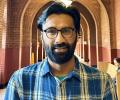
In his petition, Suri's lawyer said that he is being punished as his wife, who is a US citizen, is of Palestinian heritage and because the government suspects that he and his wife are against the US foreign policy towards Israel.
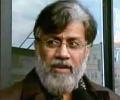
Tahawwur Rana, accused in the 2008 Mumbai terror attacks, has renewed his application to the US Supreme Court seeking a stay of his extradition to India. The Supreme Court will hear the application next month. Rana, currently detained in Los Angeles, claims his extradition would violate US law and expose him to torture in India due to his health and Muslim background. The US government has denied these claims and authorized his surrender to India, citing the Extradition Treaty between the two countries. The Supreme Court's decision will determine if Rana will face justice in India or remain in the United States.
Tahawwur Rana, accused in the 2008 Mumbai terror attacks, has renewed his plea for a stay on his extradition to India, citing health concerns and alleging potential torture. He argues that his extradition would violate US law and the UN Convention Against Torture. Rana's lawyers claim he is at risk of being subjected to torture in Indian detention facilities due to his Pakistani origin, Muslim religion, and medical conditions. The US Supreme Court had previously denied his emergency bid for a stay, but he has now appealed to Chief Justice John Roberts. The US government has declined to provide information on any commitment from India regarding Rana's treatment, further fueling his concerns.
Mumbai terror attack accused Tahawwur Rana has moved an 'emergency application' with the United States Supreme Court against his extradition to India, claiming that he will be tortured there since he is a Muslim of Pakistani origin.

The United States has temporarily suspended foreign assistance to Pakistan for re-evaluation following an executive order issued by President Donald Trump, according to a media report on Tuesday.
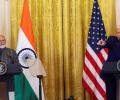
United States President Donald Trump on Thursday announced the extradition of the 26/11 Mumbai terror attack accused Tahawwur Rana to India and said he will face justice.
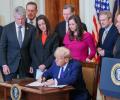
The Guantanamo Bay facility, which has so far been used to hold terrorists, will now also house illegal immigrants with criminal records.
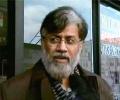
In a long battle, this is Rana's last legal chance not to be extradited to India.

A US federal government commission has flagged the alleged worsening of religious freedom in India and called for it to be designated as a "Country of Particular Concern".
 © 2026 Rediff.com - Investor Information - Advertise with us - Disclaimer - Privacy Policy - Sitemap - Feedback - About us - Terms of use - Grievances