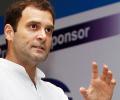
Gandhi, 47, begins his nearly two-week trip to the US with an address at the University of California, Berkeley, tomorrow on contemporary India and the path forward for the world's largest democracy.

The India@60 event seeks to attract the world's attention, particularly that of the global Inc, to India by portraying its strengths -- democracy, diversity and demographics -- which have powered the sub-continent nation's development.

On his 100th birth anniversary M F Husain, one of the best known painters in modern and contemporary India, has been honoured with a Google Doodle.

Is there a likeness between the characters from Ved Vyas's timeless epic and those prancing about on the political proscenium? Saisuresh Sivaswamy finds out.

Is it time to take a relook at our economic theories? asks Ajit Balakrishnan.

Here's the full text of President's address with a word cloud.

He said the Aadhaar programme violated informational privacy, self-determination and data protection.

'It is a travesty that I have to prove my commitment to Gandhi and to this country.'

'Our religion had some important philosophies regarding trans people that cannot be ignored.' 'Contemporary India is refusing and ignoring transgender people.'

No conversation about Indian art is complete without mention of Madhvi Parekh

'...that it cannot accommodate dissent and objection.' 'Are its foundations so delicate that it feels endangered even in instances outside of armed rebellions?' 'The question that needs to be asked of the political supporters of such laws is not why they are confident of the importance of the law on sedition.' 'It is instead why they are lacking in such confidence about India.'
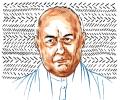
Martand Singh, the master of weaves, took India to the world.
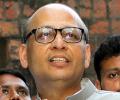
Hitting out at the Bharatiya Janata Party, the Congress on Tuesday accused it of playing "cheap politics" ahead of Lok Sabha polls on the issue of 1962 India-China war in the wake of a classified report on it being made public, saying it only showed the principal opposition party's mindset.

'Hindus are proud of what the Dharmashastras symbolise, but they don't want to do any work to preserve it!,' Sanskrit scholar Donald Davis tells Kanika Dutta.

'I bow to the 125 crore citizens of this great nation and promise to stay true to the trust they have bestowed on me.'
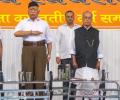
'For the last 10 years the Congress made the RSS an idea of intolerance, anti-minority, especially anti-Muslim, and an idea of fascism.' 'That has been demolished now by Pranab Mukherjee.'

energy is India's binding supply-side constraint for inclusive growth.

What does one deduce from this silence? That the minorities in the BJP era have been muted, perhaps even coercively, asks Sajad Ahmad Dar.

The demand for OROP has been projected as an unambiguous issue but a good policy argument must have a sound economic element.
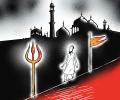
'Indian nationhood is indeed at the cusp of alarming redefinition -- hate-filled, and exclusionary.' 'Nations are not built this way, instead these are the ways of liquidating nations.' 'We must pre-empt it.' 'Can we?' asks Mohammad Sajjad.

'Narendra Modi could be too old to change his personality. On the other hand, his attachment to the RSS could be mostly sentimental. So one must hope that if he becomes prime minister, he is able to detach himself from the RSS view of the world as completely as Narasimha Rao detached himself from the Congress's First Family.' 'India cannot be governed by the autocratic methods by which he has governed Gujarat. If he becomes prime minister he will have to learn to speak in a more civil language about his political opponents,' historian Ramachandra Guha tells Arthur J Pais/Rediff.com

Sanket Avlani started Taxi Fabric to provide a platform for young and upcoming designers who deserve a stage.
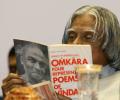
'His simple lifestyle, his optimism, his hard work and his genuine humility made him an authentic role model to millions of children, many of them growing up in challenging circumstances.'

Rahul attacked Modi and BJP, alleging that 'politics of divide and polarisation is radicalising people in India'.

In conversation with Karan Thapar, former Vice President Hamid Ansari takes on one of the most sensitive issues of our times.

'How can middlemen disappear as long as our political parties are sucking in massive amounts of black money?' 'There is an old political art well practised in New Delhi -- people create artificial problems and then solve it for you to earn your gratitude for a lifetime.'

India's secular democracy remains mortgaged to rabid communal politics. Quite clearly, the bloodshed by the religious communities is absolutely political. Even non-BJP political formations have their own Narendra Modis, says Mohammad Sajjad.

How will the return of a majority government at the Centre, the new India-US friendship and the Mangalyaan triumph change India?

The AIB Roast of Karan Johar, Arjun Kapoor and Ranveer Singh may not have gone down well with certain sections of people, but Bottoms Up's incisive social commentary, peppered with delightfully subtle double entendre, still enjoys unprecedented success.

'Naik is an outcome of an image-centric Islam, which is linked to the technological changes introduced by new media.' 'English educated upper middle class Muslims embraced Naik's image-centric Islam in the 1990s.' 'Television converted him into a religious object.'

'The dirt in the Indian Ocean must be less than the abuses Narendra Modi got from secular forces.' 'If you are going to put the blame on the central government and the RSS for every wrongdoing, then it is not going to serve any purpose, rather it will complicate the issue instead of resolving it.' 'There are fringe elements in every society, but for an ideal State it is important to finish off the fringe elements.'

How do you translate a first love into a profession? How do you become a writer once you set your heart on it? Susmita Bhattacharya, who once worked as a graphic designer in Mumbai, now teaches the basics of English to newcomers to Britain and is also a creative writing tutor. Her first novel The Normal State of Mind was published earlier this year after a grim battle with cancer.
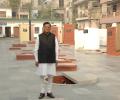
'I had been to a village in Haryana. One woman who had four daughters-in-law and three daughters, told me that she had to be awake the whole night to take each of them, one by one to the fields.' 'I am not saying all rapes are because of lack of toilets. 20 to 30 percent of rape cases happen because of the lack of toilets.' Dr Bindeshwar Pathak, founder, Sulabh International, on how India should go about building toilets for all its people in this exclusive interview with Shobha Warrier/Rediff.com
 © 2026 Rediff.com - Investor Information - Advertise with us - Disclaimer - Privacy Policy - Sitemap - Feedback - About us - Terms of use - Grievances