
Sports Minister Mansukh Mandaviya will inaugurate the BRICS Traditional and Indigenous Demonstration Games 2026 in Ahmedabad on Monday. Organised by the Ministry of Youth Affairs and Sports in collaboration with the Gujarat government, the event on 12 October 2026, under India's BRICS Chairmanship, will feature traditional sports like Mallakhamb, Yogasana, and Kalaripayattu from India. The non-competitive Games aim to foster cultural exchange and knowledge-sharing among BRICS and partner countries including Belarus, Bolivia, Brazil, China, Ethiopia, Iran, Kazakhstan, Russia, South Africa, and the UAE.

BRICS Sports Ministers adopted a Joint Declaration in Visakhapatnam, reaffirming their commitment to strengthen sports cooperation through dialogue and mutual respect. The meeting, held under India's 2026 Chairship, saw Union Minister Dr. Mansukh Mandaviya call for a BRICS Sporting Partnership and introduce three key initiatives: a Working Group on Sports Technology, a Sports Manufacturing Conclave in Udaipur, and Traditional and Indigenous Sports Demonstration Games in Ahmedabad in 2026.
Union Minister Mansukh Mandaviya inaugurated the BRICS Traditional and Indigenous Sports Demonstration Games 2026 in Ahmedabad, emphasising the role of traditional sports in reflecting cultural identity and fostering international cooperation. The one-day event, hosted by the Ministry of Youth Affairs and Sports, brought together delegations from BRICS and partner countries to showcase indigenous sporting practices like Mallakhamb, Yogasana, and Kalaripayattu from India, alongside Wushu from China and Sambo from Russia. Gujarat Deputy Chief Minister Harsh Sanghavi also highlighted India's rich sporting heritage and proposed initiatives for global promotion and preservation of traditional sports.

India is sending a 125-member contingent to the 2026 Commonwealth Games in Glasgow, with established stars like Neeraj Chopra, Mirabai Chanu, and Lovlina Borgohain, alongside rising talents such as Aryan Nehra and Gurindervir Singh, expected to lead the nation's medal charge across 13 disciplines.

The Delhi and District Cricket Association (DDCA) has confirmed that the first T20I between India and Afghanistan will proceed as scheduled on September 13 at the Arun Jaitley Stadium, despite earlier requests from Delhi Traffic Police to reschedule due to the high-profile BRICS Summit.

'The Chinese military cannot advance much in Ladakh, even if they want to.' 'Similarly, in Arunachal Pradesh, they can rename a village or two, intrude here or there, but cannot do much more realistically.'

Navigating this geopolitical minefield requires a cold-blooded blend of immediate tactical pleading, structural domestic diversification, and aggressive collective resistance, suggests Ambassador Rajasekhar.

External Affairs Minister S Jaishankar stated that the world is entering an age of flux marked by conflicts and tariff volatility, requiring India to respond effectively to these challenges. He reiterated India's consistent stance on the Russia-Ukraine conflict, advocating for dialogue and diplomacy, and highlighted India's efforts to engage with both sides. Jaishankar also emphasised India's role in championing the voice of the Global South and navigating complex strategic partnerships in a multi-aligned world.

'India is trying to project that it can engage with the world in a different way too.'

Who is running the show in Dhaka? This kind of flip-flop, culminating in a last-minute decision to skip a maiden visit, can happen only when the remote is in the hands of one of the competing lobbies within the BNP -- one that appears determined to play a game of chess with India.

India is navigating a complex diplomatic landscape, attempting to balance its 'forever honeymoon' with the Israel-UAE-Bahrain axis against its historical ties with Iran, as evidenced by recent high-level visits and evolving geopolitical realignments in the Middle East, observes Ambassador M K Bhadrakumar.
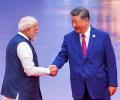
India's dual pursuit of a robust strategic partnership with Washington and a pragmatic, tension-management policy with Beijing represents the essence of modern multi-alignment. By embracing economic pragmatism, learning to compartmentalize political differences, and engaging in continuous dialogue, India can secure its borders, grow its economy, and contribute to a stable, multipolar Asian century, points out Ambassador Rajasekhar.

Taking Kharg would give the US control over virtually all of Iran's oil exports and thus provide significant leverage, notes Prem Panicker in his must read daily blog on the Gulf War. It would also put American troops within range of Iran's remaining missiles, drones, and artillery on a piece of real estate that is just eight square miles in size, and just 15 miles from the Iranian mainland.

'I suspect that Bangladesh being given permission stuck in India's official craw, and this story was an attempt to balance the scales by giving the impression that a similar waiver had been given to India as well.'

China has made serious inroads into Latin America, which the US may now be hinting is simply not ok: Stay in your lane, Xi! In simple terms, China will no longer have access to Venezuelan oil, points out Rajeev Srinivasan.
