
India and China have agreed to advance discussions on an "Early and Substantial Harvest" of boundary delimitation and border management during the 25th round of Special Representatives talks between National Security Advisor Ajit Doval and Chinese Foreign Minister Wang Yi in Beijing. Both sides reached an eight-point consensus, committing to the 2005 Agreement on Political Parameters and Guiding Principles for Settlement. Key outcomes include enhancing border management, improving understanding of the Line of Actual Control, establishing new meeting points and hotlines, and continuing cooperation on trans-border rivers and pilgrimage.
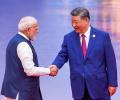
India and China held diplomatic talks to review the situation along the Line of Actual Control (LAC), discussing boundary delimitation, border management, and trans-border cooperation. Both nations stressed the importance of maintaining peace and tranquillity for bilateral relations and agreed to continue using existing channels to resolve outstanding issues.

China emphasises proper handling of differences and a long-term perspective for bilateral ties ahead of President Xi Jinping's visit to India for the BRICS summit and talks with Prime Minister Narendra Modi. The visit aims to stabilise relations following the 2020 Ladakh standoff and strengthen BRICS cooperation.

Chinese President Xi Jinping's upcoming visit to India for the BRICS summit is a pivotal diplomatic event poised to significantly impact bilateral ties and global cooperation amidst ongoing international instability.

While the total number of assembly seats remains unchanged at 126, the redrawing of boundaries has reshaped voter composition across constituencies -- a shift that is likely to influence electoral outcomes in the years ahead.

Chinese President Xi Jinping is in New Delhi for the 18th BRICS Summit, where he is scheduled to hold bilateral talks with Prime Minister Narendra Modi. This visit, his first to India in nearly seven years, comes amidst efforts to normalise India-China relations following the 2020 Eastern Ladakh standoff and is expected to have significant implications for bilateral ties and BRICS cooperation.

The delimitation of constituencies, which aimed to reduce the influence of minority candidates, is a significant factor in the NDA's strong performance in the Assam elections, where they secured a record 102 seats. The 2023 delimitation exercise redrew constituencies, reserving some Muslim-majority seats for indigenous communities, which increased the BJP and its allies' seat count.

India on Tuesday conveyed to China the importance of maintaining peace and tranquility along the Line of Actual Control (LAC) for overall bilateral ties as national security advisor Ajit Doval held talks with Chinese Foreign Minister Wang Yi focusing on delimitation of the frontier and sustaining work on trans-boundary cooperation.

The delimitation in Assam has quietly changed the political scene, raising questions about whether new constituency boundaries helped the BJP by spreading out Muslim-majority voters.

Indian and Chinese armies held their first high-level commanders' flag talks in the Arunachal Pradesh sector, following Special Representatives dialogue. These talks, aimed at maintaining peace along the Line of Actual Control, occurred amidst reports of aggressive military posturing and just days before Chinese President Xi Jinping's visit to India for the BRICS summit.

'The Supreme Court stated that once the delimitation plan is approved by Parliament and receives assent of the President, it cannot be undone. Nor can it be modified.'

Indian and Chinese military officials have held corps commander-level talks in Arunachal Pradesh to review the Line of Actual Control (LAC) situation, following recent Special Representative discussions aimed at de-escalating border tensions and fostering bilateral ties.

Former CDS Anil Chauhan stated that China poses a long-term and comprehensive challenge to India, with the boundary issue remaining unresolved due to differing perceptions of the Line of Actual Control. However, he emphasised that India's ties with Beijing cannot be solely defined by border disputes, advocating for engagement through platforms like SCO and BRICS. He also highlighted the broader global geopolitical flux and instability in India's neighbourhood as significant security concerns, stressing the need for self-reliance.

Chinese President Xi Jinping's first visit to India in seven years for the BRICS Summit and bilateral talks with Prime Minister Narendra Modi is set to address crucial aspects of India-China relations, including trade, investment, and persistent border tensions.

China and Bhutan held the 15th Expert Group Meeting to discuss boundary alignment, focusing on areas where there are no disputes, and agreed to maintain the momentum of negotiations.

The Congress party has accused the government of using women's reservation as a pretext to push through delimitation, arguing that the women's quota law should be implemented immediately based on the current Lok Sabha strength.

'The Chinese military cannot advance much in Ladakh, even if they want to.' 'Similarly, in Arunachal Pradesh, they can rename a village or two, intrude here or there, but cannot do much more realistically.'

Rahul Gandhi accuses the government of using the women's reservation bill as a smokescreen to manipulate India's electoral map and diminish representation for certain states.

India and China are in what experts call 'a cooperation-versus-competition situation'.

The Union Territory administration in Ladakh has announced the establishment of an Autonomous Hill Development Council (AHDC) for each of its seven districts, significantly expanding democratic decentralisation. This move extends elected local self-governance beyond Leh and Kargil, with a proposed Union Territory-level body under a customised Article 371 framework to oversee these councils.
West Bengal Chief Minister Mamata Banerjee announced that the TMC will support the women's quota bill but opposes the delimitation bill introduced by the Modi government in the Lok Sabha. She also criticised the central government over central agency raids on TMC candidates.

West Bengal Chief Minister Mamata Banerjee has accused Prime Minister Narendra Modi of misleading the nation regarding the women's quota bill and plotting to push through the delimitation exercise by using women as a shield.

The government has released a set of FAQs to address concerns and clarify the details surrounding the Women's Reservation Bill, which aims to provide 33 per cent quota for women in legislatures.

Prime Minister Narendra Modi appealed to Lok Sabha members to vote for the women's reservation bill, emphasising the need to empower women and rectify decades of political inaction.

The Indian Parliament is expected to extend its budget session to introduce a bill increasing Lok Sabha seats to 816, reserving 273 for women, and amending the women's reservation law.

A bill to implement 33 per cent reservation for women in Lok Sabha and state assemblies by increasing the lower house's strength to 850 is slated for introduction in Parliament. The bill seeks to amend Article 81 of the Constitution and utilise 2011 Census data for redrawing constituencies.

India and China held constructive talks on the situation along the Line of Actual Control (LAC) in eastern Ladakh, emphasising that maintaining border peace and tranquillity enabled progress in normalising overall relations.

'All this talk about women's reservation and Nari Shakti is a mirage.' 'It is a classic Trojan horse to bring about an alteration in the structure of political competition -- to the enduring advantage of the BJP.'

The 2026 election appears to have reinforced a new political formula in Assam: Strong organisation, continuous grassroots engagement, effective alliance management and welfare-based voter outreach.
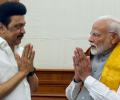
Tamil Nadu Chief Minister M K Stalin has reiterated his request to meet Prime Minister Narendra Modi to discuss concerns over the proposed delimitation. In a social media post, Stalin reminded Modi of his earlier request for a meeting along with MPs from various parties to present a memorandum on the issue. He also shared a letter addressed to Modi on March 27, 2025, requesting an "audience" to formally submit the memorandum on behalf of the Joint Action Committee.

'Peninsular Indians could ask 'Why should we contribute half of India's tax revenues if we account for only a quarter of the seats in the Lok Sabha?'.' 'The rest of the country seems likely to counter that 'democracy means one vote per person irrespective of where that person resides in India'.' 'With no easy answers to this thorny debate, the south's economic ascendancy could end up creating a Hobson's choice.' A revealing excerpt from Nandita Rajhansa and Saurabh Mukherjea's book, Behold the Leviathan: The Unusual Rise of Modern India.

'If China shows greater concerns for Indian interests, ties could improve. Otherwise, the thaw could be short-lived.'

The Galwan clashes indicate to the limitations in relations if they do not address border stability, points out Srikanth Kondapalli.
The Galwan clashes indicate to the limitations in relations if they do not address border stability, points out Srikanth Kondapalli.

The Commission said a ban has been put in place effective January 1, 2023 on the creation of new administrative units in the state till the exercise is completed.

Chief Minister Himanta Biswa Sarma said it was only "temporary" and did not disclose the reason behind the decision.
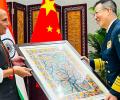
Defence Minister Rajnath Singh, in his meeting with Chinese counterpart Dong Jun in Qingdao on June 26, proposed that India and China should solve the "complex issues" under a structured roadmap comprising steps to de-escalate tensions along the frontiers and rejuvenate the existing mechanism to demarcate the borders.
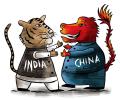
India and China have announced a series of measures aimed at improving their relationship, including maintaining peace along the border, reopening border trade, and resuming direct flights.

India-US relations, like Rome, were not built in a day, nor can they be demolished in a day.
All said and done, when the new global order emerges, India can only remain with the democracies, asserts Ambassador T P Sreenivasan.
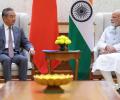
'New Delhi is not naive about its foreign policy choices.'
