
In a major relief for Imran Khan, Pakistan's Supreme Court on Thursday declared the former prime minister's arrest "illegal" and ordered his immediate release after he was produced before a bench on its orders.

Pakistan's Chief Justice Umar Ata Bandial on Thursday noted that National Assembly deputy speaker Qasim Suri's move to dismiss a no-confidence motion against embattled Prime Minister Imran Khan through a controversial ruling is, prima facie, a violation of article 95 of the constitution as the apex court heard the high-profile case for the fourth day.

The court ordered all parties to avoid taking any unconstitutional measures and adjourned the hearing until Monday.
The apex court within hours took suo motu notice of it and a five-member bench started hearing the case on Monday.

A larger bench of the apex court -- comprising Chief Justice Umar Ata Bandial, Justice Ijazul Ahsan, Justice Mazhar Alam Khan Miankhel, Justice Munib Akhtar and Justice Jamal Khan Mandokhail -- took up the matter after Deputy Speaker Qasim Suri rejected the move to dislodge the prime minister by declaring the no-trust motion unmaintainable due to its link with a so-called foreign conspiracy.

Pakistan's Supreme Court on Saturday allowed Hamza Shehbaz to remain as the 'trustee' Punjab province chief minister till hearing resumes on Monday, but barred him from using his powers for 'political gains' during this period.

These are obviously not 'organic' desertions but brought about under intense military pressure, post the 9/5 arrests. It seemed as if the party was being dismantled the same way it was brought into power!, notes Rana Banerji, who headed the Pakistan desk at RA&W, India's external intelligence agency.
The apex court on Wednesday sought the minutes of the National Security Council meeting to know more about the alleged 'foreign conspiracy' as it delayed its verdict on whether Prime Minister Khan had violated the Constitution by dissolving Parliament rather than face a no-confidence vote.

His disqualification to participate in future elections may follow, notes Rana Banerji, who headed the Pakistan desk at RA&W, India's external intelligence agency.

Pakistan's Supreme Court on Thursday struck down National Assembly Deputy Speaker Qasim Suri's controversial move to dismiss a no-confidence motion against Prime Minister Imran Khan, in a major blow to the cricketer-turned politician who is now likely to face a no-trust vote in parliament after the ruling.

If the Pakistani foreign minister attends the meeting in person, it will be the first such visit from Islamabad to India since 2011.
The Pakistan National Assembly's crucial session on a no-trust motion against embattled Prime Minister Imran Khan was adjourned on Friday without tabling of the resolution, amid vociferous protests from opposition lawmakers.
The judges reserved the verdict on Monday after the rival lawyers concluded their arguments on the suspension of the three-year sentence handed down to the 70-year-old PTI chairman by Additional District and Session Judge, Islamabad, Humayun Dilawar on August 5.

Khan took strong exception to the Inter-Services Public Relations (ISPR) allegations against him and said the spokesperson of the army's military wing was not even born when he represented Pakistan in the world.

The PTI government lost the majority in the lower house of the parliament following the late-night development ahead of the no-confidence motion against Imran Khan on April 3.

Chief Justice Athar Minallah of the Islamabad high court delivered a reserved verdict during which he also fined the petitioner Maulvi Iqbal Haider Rs100,000, the Express Tribune newspaper reported.

The review petition, filed through Dr Babar Awan and Azhar Siddique, named the Pakistan Peoples Party, Pakistan Muslim League-Nawaz, Supreme Court Bar Association, Sindh High Court Bar Association and the Sindh Bar Council as respondents.

Prime Minister Khan, who had effectively lost his majority in the 342-member National Assembly, made a brief address to the nation after a stormy parliament session was adjourned by Deputy Speaker Qasim Suri.

Pakistan's ARY news channel on Wednesday reported that the police in Karachi arrested its head and registered an FIR against the CEO and others in connection with some controversial remarks made by opposition party leader Shahbaz Gill during a news programme.

A Pakistan court on Monday asked President Asif Ali Zardari not to take part in political activities till the next hearing on March 29 of a petition challenging his holding of the post of head of the Pakistan Peoples Party.

Khan said he was hit by four bullets on his right leg during the assassination attempt.

Pakistan Muslim League-Nawaz president and Leader of Opposition in National Assembly Shehbaz Sharif, 70, who is the Opposition's candidate for the new prime minister, will announce his possible government priorities after taking the oath.

The SC has restored the National Assembly after it declared the government's decision to dissolve the assembly and NA Deputy Speaker Qasim Suri's ruling against the Constitution.

The rather amateurish, even ham-handed, attack would lend some credence to a 'false flag' theory, of the PTI leadership staging this incident, to provide new impetus to a flagging agitation, notes Rana Banerji, who headed the Pakistan desk at RAW, India's external intelligence agency.

As the people of Pakistan woke up to a new dawn on Sunday, the details of the gruelling and murky political activities in the preceding day and night have emerged, showing the country may have averted a damning showdown between ousted prime minister Imran Khan and the powerful Army.
The Opposition parties need 172 members in the 342-member house to orchestrate the downfall of Prime Minister Khan.

Pakistan's embattled Prime Minister Imran Khan on Wednesday shared some details from what he called a "foreign conspiracy letter" with senior journalists and cabinet members, asserting that the document was authentic.

Imran Khan will continue to be the prime ninister of Pakistan until the appointment of a caretaker premier, according to a notification issued by President Arif Alvi on Monday.

No prime minister in Pakistan's recent history has survived long in office after appointing an ISI chief who did not have the army chief's confidence. Imran may be no exception, observes Rana Banerji, who headed the Pakistan desk at the Research and Analysis Wing.
While in power, Khan repeatedly talked about making Pakistan an Islamic welfare state. However, he failed to fix the economy and the basic problem of keeping the prices of commodities in control.

The Opposition parties need 172 members in the 342-member house to orchestrate the downfall of Prime Minister Khan.

In his address, 69-year-old Khan also expressed disappointment over the Supreme Court's verdict on the National Assembly deputy speaker's controversial decision on the rejection of no-trust motion against him.
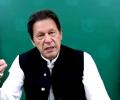
Talking to reporters in Islamabad, he said the Opposition has laid all of their cards, but the no-confidence motion against him would not be successful.
Amid controversy over Pakistan President Asif Ali Zardari's dual office, a Pakistani court has constituted a larger five-judge bench to hear a contempt petition against him on September 5 for not relinquishing his political post of co-chairman of the ruling Pakistan Peoples Party.
A Pakistani court on Friday directed Jamaat-ud-Dawah chief Hafiz Saeed to establish his case that the government should defend him in a US lawsuit filed by relatives of Jewish victims of the 2008 Mumbai attacks.

A Pakistan court on Friday gave a last chance to the government to respond to a petition seeking contempt proceedings against President Asif Ali Zardari for not acting on a suggestion that he should give up the political office of head of the ruling PPP.
A Pakistani court on Monday constituted a larger bench to hear a contempt of court petition against President Asif Ali Zardari while a lawyer filed a plea in the supreme court challenging the president's immunity and holding of dual offices.

A four-judge bench of the Lahore high court headed by Chief Justice Umar Ata Bandial issued the direction after hearing arguments by the government's lawyer, Waseem Sajjad, who argued that the court had not passed any formal order to bar Zardari from holding the two offices of President and co-chairman of the PPP.
Amid controversy over Pakistan President Asif Ali Zardari's dual office, the Lahore high Court on Wednesday issued a notice to him to explain by September 14 why he had not followed its direction to relinquish the political post of co-chairman of the ruling Pakistan People's Party.
A Pakistani court on Wednesday set September 5 as the deadline for President Asif Ali Zardari to disassociate himself from political activities and warned that he would have to face the consequences if he failed to do so.
 © 2026 Rediff.com - Advertise with us - Disclaimer - Privacy Policy - Sitemap - Feedback - About us - Terms of use - Grievances