
Much has been said about Friday's attack on the Indian consulate in Heart and the connection it has with the invitation sent out to Pakistan Prime Minister Nawaz Sharif. While a few believe that the two could be connected, officers who have worked in Afghanistan-Pakistan say the issues are completely different. Vicky Nanjappa reports
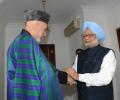
With the United States planning troops withdrawal by next year, Afghan President Hamid Karzai is believed to have pressed India on Friday for stepping up military aid including lethal and non-lethal weapons amid indications that the government was not averse to the Afghan leader's demand which could be met depending on the country's capacity.

It is not every day that one of the planet's richest men is arrested by his government.
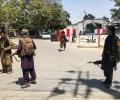
Despite dependence on the ISI for years of sustenance, Taliban leaders may harbour resentment over the ISI's excessive control, notes Rana Banerji, who headed the Pakistan desk at the Research and Analysis Wing.

'India could help in Afghanistan, but if it does too much, it will stoke Pakistan's paranoia and risk making the situation worse,' Michael O'Hanlon, one of America's leading experts on international security, tells Rediff.com's Vicky Nanjappa.

Imran Khan knows Pakistan is holding a strong hand and doesn't have to flaunt it while claiming victory. But Pakistan has learned from the experience of the 1990s -- high risk of going out on a limb, asserts Ambassador M K Bhadrakumar.

India on Tuesday supported Afghanistan's reconciliation process with the Taliban, but warned that it must not undermine the legitimacy of the Afghan government and should be within the internationally accepted "red lines".
Britain's Prime Minister David Cameron on Sunday promised to "stand together" with Pakistan in the war against terrorism and nudged his counterpart Nawaz Sharif to help clinch a peace deal with Afghanistan before NATO's withdrawal from the war-torn nation next year.
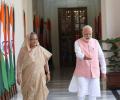
'The curtain is coming down on India's leadership role as a regional power even before the drama of the Asian Century truly began,' warns Ambassador M K Bhadrakumar.
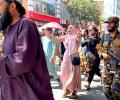
ISI chief Faiz Hameed coerced the Taliban to announce an interim government guaranteed to preserve Pakistan's control over the levers of power in Kabul, observes Ambassador M K Bhadrakumar.
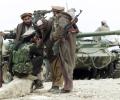
'Washington is well aware that the Haqqani group was responsible for terrorist attacks on the Indian diplomatic establishments in Afghanistan.' 'But today US self-interest dictates that Sirajuddin Haqqani's mainstreaming in Afghan political life and a potential elevation eventually to a leadership role at the national level is useful and necessary, since he can deliver peace,' notes Ambassador M K Bhadrakumar.

Afghanistan will never allow its territory to be used for any anti-India activity, Afghan ambassador Shaida Mohammad Abdali said here and dismissed apprehensions that withdrawal of NATO forces may allow the Taliban to make a comeback.

India has sought access to Lashkar-e-Tayiba operative David Headley, the Mumbai terror attack convict now lodged in a US prison, as it insisted on bringing to justice the perpetrators of the 26/11 assault.

Afghan President Hamid Karzai is in Pakistan on a day-long visit to mend frayed ties with Pakistan and to seek the release of high-profile Taliban prisoners, including Mullah Barader, to give a fresh impetus to the reconciliation process in his war-torn country.
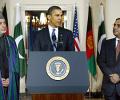
'The real purpose of President Obama writing to President Zardari,' Husain Haqqani tells Rediff.com's Aziz Haniffa, 'was to seek a turnaround on terrorism -- that Pakistan, whatever its grievances, cannot have jihadi groups operating openly on its soil.'

Aziz Haniffa reports from Washignton, DC, on Foreign Secretary Sujatha Singh's three-day visit to the US capital.

Condemning terrorism in all its forms and manifestations, US President Barack Obama and Pakistan Prime Minister Nawaz Sharif on Thursday said that no country's territory should be used to destabilise its neighbours.
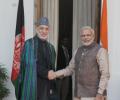
Security will be a consideration, as would protocol, but given Modi's penchant for the unconventional, it should not come as a surprise if he indeed decides to attend the ceremony in Kabul, says Ramesh Ramachandran.

Hein Kiessling has the kind of access in Pakistan that journalists (and spies) would die for, says Kanika Datta.
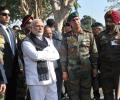
'The attack on the Pathankot base constituted an act of war. Yet Modi's only public comment up until now on that attack has been to blame it on "enemies of humanity".' 'Modi came to power talking tough about Pakistan. But in office, he has pursued a Pakistan policy that has lost both direction and purpose,' argues Brahma Chellaney.
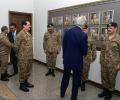
'Both India and Pakistan are now, for the first time in history, very closely allied and connected with the US -- economically and politically.'
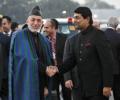
As the western forces prepare to leave Afghanistan in the coming year, India stands at a crossroads where it remains keen to preserve its interests in Afghanistan but has refused to step up its role as a regional security provider. New Delhi needs to recognise that there is no short-cut to major power status, says Harsh V Pant

'India alone cannot walk the path of peace. It also has to be Pakistan's journey to make,' says Prime Minister Narendra Modi at the government's geo-political flagship initiative "Raisina Dialogue-II".

A list of all the foreign visits taken up by PM Narendra Modi this year and their outcomes.
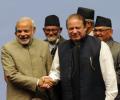
'Modi has said he has been made the PM of India not to do small things but big things. What bigger thing can there be than to have peace with Pakistan and in the neighbourhood?'

'India should think big: About how in a multi-polar world, India can indeed be one of the poles, rather than being a secondary power that has to worry about 'alignment' with one of the poles. A G3 in other words, India should look to getting others to align with itself rather than the US or China,' says Rajeev Srinivasan.
 © 2026 Rediff.com - Advertise with us - Disclaimer - Privacy Policy - Sitemap - Feedback - About us - Terms of use - Grievances