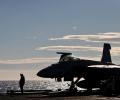
The USS Harry S Truman led a strike group, operating under NATO command and control, along with other NATO allies in coordinated maritime manoeuvres in the Adriatic Sea, February 2, 2022.

'Indian policy-makers need a realistic assessment of what China's growing assertiveness means for India.'

There are enough people at the top decision-making level in Tehran who are still willing to negotiate, provided Trump can create the right setting for the negotiation to acquire a dynamic of its own, points out Ambassador M K Bhadrakumar.

Admiral Samuel J Paparo, Commander of the US Indo-Pacific Command, lauded India's military restraint during Operation Sindoor and emphasized the growing India-US defence partnership aimed at maintaining peace and security in the Indo-Pacific region.

The visit is part of the "Op Deployment of #IndianNavy's @IN_EasternFleet to the #SouthChinaSea," it said, amidst China flexing its muscles in the South China Sea.
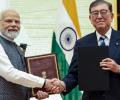
India and Japan have unveiled a comprehensive framework to boost their defence cooperation in response to security challenges, particularly concerning China's increasing military presence in the East and South China Seas.

The government has approved the construction of two indigenously designed nuclear attack submarines and is expected to ink contracts next month to procure 26 naval variant of Rafale jets and three Scorpene submarines, Navy Chief Admiral Dinesh Tripathi said on Monday.
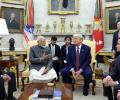
India and the United States have agreed to deepen their strategic partnership in several key areas, with President Donald Trump announcing plans to provide India with F-35 fighter jets and billions of dollars in military supplies. The two leaders also discussed energy cooperation, critical technologies, connectivity, and countering terrorism. They agreed to work together on the India-Middle East-Europe Economic Corridor, and Trump noted India's reforms to welcome US nuclear technologies. Prime Minister Modi said the two countries can shape a better world through their cooperation. Both leaders also addressed the Russia-Ukraine conflict, with Modi stressing India's commitment to peace.
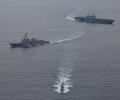
China said that military cooperation should be "conducive" to regional peace and stability.

As a 10 year old, it was what she dream of become. At 18, she achieved her dream.
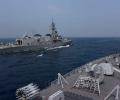
The navies of India, the US, Japan and Australia on Tuesday held a series of complex manoeuvres in the Bay of Bengal, kick-starting the four-day-long first phase of the Malabar naval exercise, seen as a prelude to future military cooperation among the member nations of the Quad or Quadrilateral Coalition.

India's decision to heed to Australia's request to be part of the mega naval drill comes in the midst of growing strain in ties with China over the border row in eastern Ladakh.

Three naval ships of China's Nanhai Fleet left a naval port in Sanya, Hainan Province on Wednesday, kicking off an annual combat drill in the South China Sea, East Indian Ocean and West Pacific, state-run Xinhua news agency reported.

The next edition of the high-voltage Malabar naval exercise begins from August 26 to 29 off the coast of Guam amid mounting global concerns over China's growing military muscle-flexing in the Indo-Pacific region.

China is engaged in hotly contested territorial disputes in the South and East China Seas. Beijing has also made substantial progress in militarising its man-made islands in the past few years, which it says it has the right to defend.
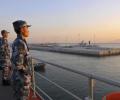
A naval formation consisting of aircraft carrier Liaoning has conducted take-off and landing drills in the South China Sea.
The second phase of the mega exercise is scheduled to be held from November 17 to 20 in the Arabian sea.

If you are serious about countering the Chinese threat, then the best weapon is investing in real freedom, plurality, elections and democracy. Unfortunately, it isn't an approach all Indians currently seem to agree on, asserts Shyam G Menon.
China hiked its annual defence budget by 7.1 per cent.

Although the pact would focus mainly on the Pacific and the South China Sea region, any action designed to deter China with or without New Delhi's active participation is a welcome move, notes Commodore Venugopal Menon (retd).

It is the first-ever visit by a head of the Indian Army to South Korea.

President Biden underscored that the United States will 'continue to stand up for its interests and values and, together with our allies and partners, ensure the rules of the road for the 21st century advance an international system that is free, open, and fair', the White House said in a readout of the meeting.

The India-Japan joint naval exercises are a strategic signal for China, observes Dr Rajaram Panda.

Not just Vietnam, but other countries in the region like Philippines, Malaysia and Thailand, have also expressed an interest in acquiring the BrahMos cruise missile. Debalina Ghoshal explains the significance of the move.

The exercise is taking place at a time India and China are locked in a nearly six-month-long bitter border standoff in eastern Ladakh that has significantly strained their ties.

Asserting that "maritime muscle flexing" by some countries and other factors have made the Indo-Pacific region "more contested and more volatile," naval chief Admiral Sunil Lanba on Tuesday said that the Indian Navy has its task cut out as it has been a major security provider in the region.

Among others, China is developing the strategically located Gwadar port in Balochistan, which is aimed towards having a military presence, says a Pentagon report

'By causing military humiliation of India it intends to send a signal to other Asian countries to toe the Chinese line,' argues Colonel Anil A Athale (retd).
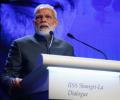
"No other relationship of India has as many layers as our relations with China. We are the world's two most populous countries and among the fastest growing major economies. Our cooperation is expanding," he said.

Flexing its muscles over Taiwan, China on Monday sailed its aircraft carrier close to the estranged island amid tensions with the US following President-elect Donald Trump's telephone call with the Taiwanese president.
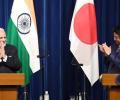
During the 13th annual summit, the two prime ministers reviewed developments in bilateral relations and explored new areas of cooperation, focusing on shared vision for peace and prosperity in the Indo-Pacific, where China is flexing its muscles.

The Indian armed forces, especially the Navy, are building partnerships in the Indo-Pacific region for peace and security, as well as humanitarian assistance and disaster relief, he said.
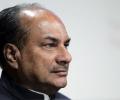
Against the backdrop of growing Chinese assertion in the Asia-Pacific region, India on Thursday said it supports the "freedom of navigation" in international waters noting that any disputes or differences in the region must be resolved diplomatically.

'Assuming the official defence allocations represent the true picture, the $142 billion figure still represents a phenomenal increase and surpasses that of Japan ($42 billion), India ($40 billion), South Korea ($33 billion) and several other Asian countries put together and shows that China is flexing its military muscle.'

India needs to have a re-look of whole gamut of its relations with major powers and also prepare for a more turbulent neighbourhood. But such is the tyranny of Indian status quo mindset that any talk of re-look at nuclear doctrine or foreign relations is treated as blasphemy, says Colonel (retd) Anil Athale.

'With the recent challenging of the notion of the Indian Ocean Region being India's strategic backyard, China is gradually upping the ante in the maritime realm around India.'

'It is imperative to restore the dignity and authority of the services chiefs. Erosion of this has resulted in lowering of service efficiency. It is also time to end the practice of taking seniority as the sole criterion for appointing chiefs.'

Narendra Sharma of MotorOctane took the Bajaj V15 for a ride and here are his impressions
 © 2026 Rediff.com - Advertise with us - Disclaimer - Privacy Policy - Sitemap - Feedback - About us - Terms of use - Grievances